Multiplayer games carry a unique engagement challenge that single-player experiences never have to deal with, they depend on more than one person showing up and staying interested at the same time. A brilliant mechanic means little if players are stuck waiting in empty lobbies, matched against opponents who quit immediately, or stuck feeling like their individual contribution doesn’t matter within a larger group. Keeping multiplayer engagement high requires solving problems that are specific to the format itself, not just making the core gameplay good.
Why Multiplayer Engagement Is a Different Problem
Engagement Depends on More Than One Person
A single-player game only needs to hold one person’s attention. A multiplayer game needs enough people engaged at the same time for the experience to actually function as intended, which means engagement problems compound in ways that don’t exist in single-player design.
Other Players Become Part of the Experience, for Better or Worse
In multiplayer games, other players directly shape whether a session feels enjoyable or frustrating. A well-designed mechanic can still result in a bad experience if the people a player is matched with behave in ways that undermine it, which adds a layer of unpredictability single-player games don’t have to account for.
Common Reasons Multiplayer Engagement Breaks Down
Long Wait Times Before Matches Start
Players who have to wait too long for enough others to join a match often lose interest before the game even begins. This is especially damaging in multiplayer games, since a slow start can turn away exactly the players a game needs to reach a healthy population in the first place.
Uneven Skill Matching
Being consistently matched against players significantly more or less skilled creates a frustrating experience in either direction. Stronger players may feel bored facing weaker opponents, while weaker players can feel discouraged facing consistently stronger ones, and both patterns tend to push players away over time.
Feeling Like an Individual Contribution Doesn’t Matter
In team-based multiplayer games, players who feel like their actions have little effect on the outcome, whether due to unclear roles or systems that reward only a few standout actions, often disengage faster than players who feel like their individual choices genuinely influence what happens.
What Keeps Multiplayer Engagement High
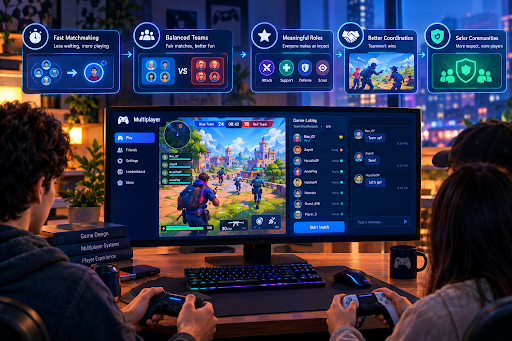
Fast, Reliable Matchmaking
Getting players into an active match quickly removes one of the biggest sources of early frustration in multiplayer games. Even imperfect matchmaking that gets players playing quickly often outperforms a slower system aiming for a perfect match.
Clear Roles and Visible Contribution
Players stay more engaged when they can clearly see how their actions affect the outcome of a match, whether that’s a visible score, a specific role they’re responsible for, or direct feedback tied to their individual performance within a team effort.
Moments That Reward Coordination
Building in specific moments where coordinating with teammates produces a clearly better outcome than acting independently gives players a concrete incentive to engage with others, rather than relying on players to seek out cooperation purely on their own initiative.
Designing Systems That Support Stronger Engagement
Reduce Friction Between Matches
Minimizing the time and steps between finishing one match and starting the next helps maintain momentum, since long gaps or complicated menus between sessions give players more opportunities to simply stop playing instead of queuing up again.
Balance Matchmaking for Fun, Not Just Fairness
While skill-based matching matters, overly rigid systems can sometimes create matches that are technically balanced but not actually enjoyable. Factoring in variety and pacing alongside pure skill metrics tends to produce more consistently engaging matches than optimizing for balance alone.
Give Every Player a Meaningful Role
Designing systems where different playstyles or roles all contribute meaningfully to a team’s success, rather than funneling all the recognition toward a single dominant strategy, helps more players feel genuinely engaged regardless of their individual skill level or preferred approach.
Testing and Improving Multiplayer Engagement
Multiplayer engagement issues are often difficult to diagnose from design documents alone, since they frequently emerge only once real groups of players are interacting with each other and with the game’s systems simultaneously.
Why Real Player Testing Matters So Much Here
A matchmaking system or team mechanic that looks balanced on paper can behave very differently once real players, with real skill variance and real behavior patterns, start using it. Observing actual multiplayer sessions reveals problems that are difficult to predict through design alone.
A Platform That Supports Fast Multiplayer Iteration
Astrocade makes it easier to create a game and test different multiplayer systems quickly, letting creators adjust matchmaking logic, team structures, or engagement mechanics without needing to rebuild core systems each time something needs refining based on real player behavior.
Seeing Engagement-Focused Design in a Real Game
Garbage Truck Madness is a good example of a game built around a specific, accessible premise that gives players an immediate sense of what to expect. Games with this kind of clear, approachable structure tend to have an easier time keeping multiplayer sessions engaging, since players understand the core activity quickly and can focus on the social experience around it rather than puzzling through confusing systems.
Common Mistakes That Hurt Multiplayer Engagement
Prioritizing Perfect Balance Over Fun Matches
Chasing statistically perfect matchmaking can sometimes produce matches that technically look fair but feel repetitive or uninteresting. A slightly less precise system that prioritizes variety and quick match times often keeps players more engaged than a slower, more rigid one.
Letting Toxic Behavior Go Unaddressed
A multiplayer game can have strong mechanics and still lose players if negative interactions between players go unmoderated. Engagement depends heavily on players feeling safe and respected during matches, not just on the quality of the core gameplay itself.
Ignoring Why Players Leave Mid-Match
Players quitting partway through a match often signals a specific, identifiable problem, whether that’s long wait times, unclear objectives, or a frustrating mechanic. Ignoring this pattern instead of investigating it means missing valuable information about what’s actually driving disengagement.
A Practical Approach to Improving Multiplayer Engagement
A reasonable process looks like this. Identify the specific points where players tend to lose interest or leave, whether that’s during matchmaking, early in a match, or after a particular frustrating pattern repeats. Test adjustments to matchmaking speed, role clarity, or coordination incentives individually, so the effect of each change is clear. Pay close attention to real player behavior during actual multiplayer sessions rather than relying solely on how systems look in design documents, and address negative player interactions proactively rather than waiting for them to drive people away.
Final Thoughts
Multiplayer engagement depends on more than strong core mechanics, it requires solving problems specific to getting and keeping multiple people genuinely invested at the same time. Reducing friction, giving every player a meaningful role, and paying close attention to real player behavior tend to matter more than chasing perfectly balanced systems, and together they make the difference between a multiplayer game that holds onto its audience and one that quietly loses players to frustration.