Most people know a pool heat pump Perth homeowners install will warm their water. Fewer know how it does it, or why it can pull heat out of air that feels cold to us. Understanding the process makes it easier to judge what a unit can and cannot do.
Heat Exists in Cold Air
Air at 12 degrees still holds a lot of thermal energy. A heat pump does not burn fuel to make heat. It collects the heat already in the air and moves it into your pool. That is why it behaves very differently to a gas heater or a resistance element.
The Four Stages
Every heat pump runs the same loop.
The fan pulls outside air across a coil called the evaporator. Liquid refrigerant inside the coil is so cold that it absorbs heat from the passing air and turns into a gas.
The compressor squeezes that gas. Compression raises its temperature sharply, well above the temperature of your pool water.
The hot gas passes through a heat exchanger, where pool water flows past it. The heat transfers into the water, and the refrigerant cools back into a liquid.
An expansion valve drops the pressure, the refrigerant chills, and the loop starts again.
Why Titanium Matters
The heat exchanger sits in constant contact with pool water and its chemicals. Titanium resists corrosion from salt and chlorine, which is why it is the standard material in quality units. Weaker materials can break down over time and let refrigerant escape.
What Affects Output
Several things change how much heat the unit delivers on a given night.
Air temperature and humidity set how much energy is available to collect. Airflow around the unit matters as well. If the fan recirculates its own cooled exhaust, the coil is working with colder air than the surrounding garden. Water flow through the exchanger also plays a part, which is why the pump and plumbing need to suit the unit.
Defrost Cycles Are Normal
On cold, humid mornings, frost can form on the evaporator coil. Most units detect this and run a short defrost cycle. You may see vapour or hear the fan stop briefly. This is routine behaviour and not a fault.
Inverter and Fixed-Speed Models
Fixed-speed compressors run flat out until the water reaches the set temperature, then switch off. Inverter compressors adjust their speed to match demand. They run longer at lower output, produce less noise and hold temperature more steadily. When comparing pool heat pumps, ask which type is being offered and how it behaves in cooler weather.
Sizing and Placement
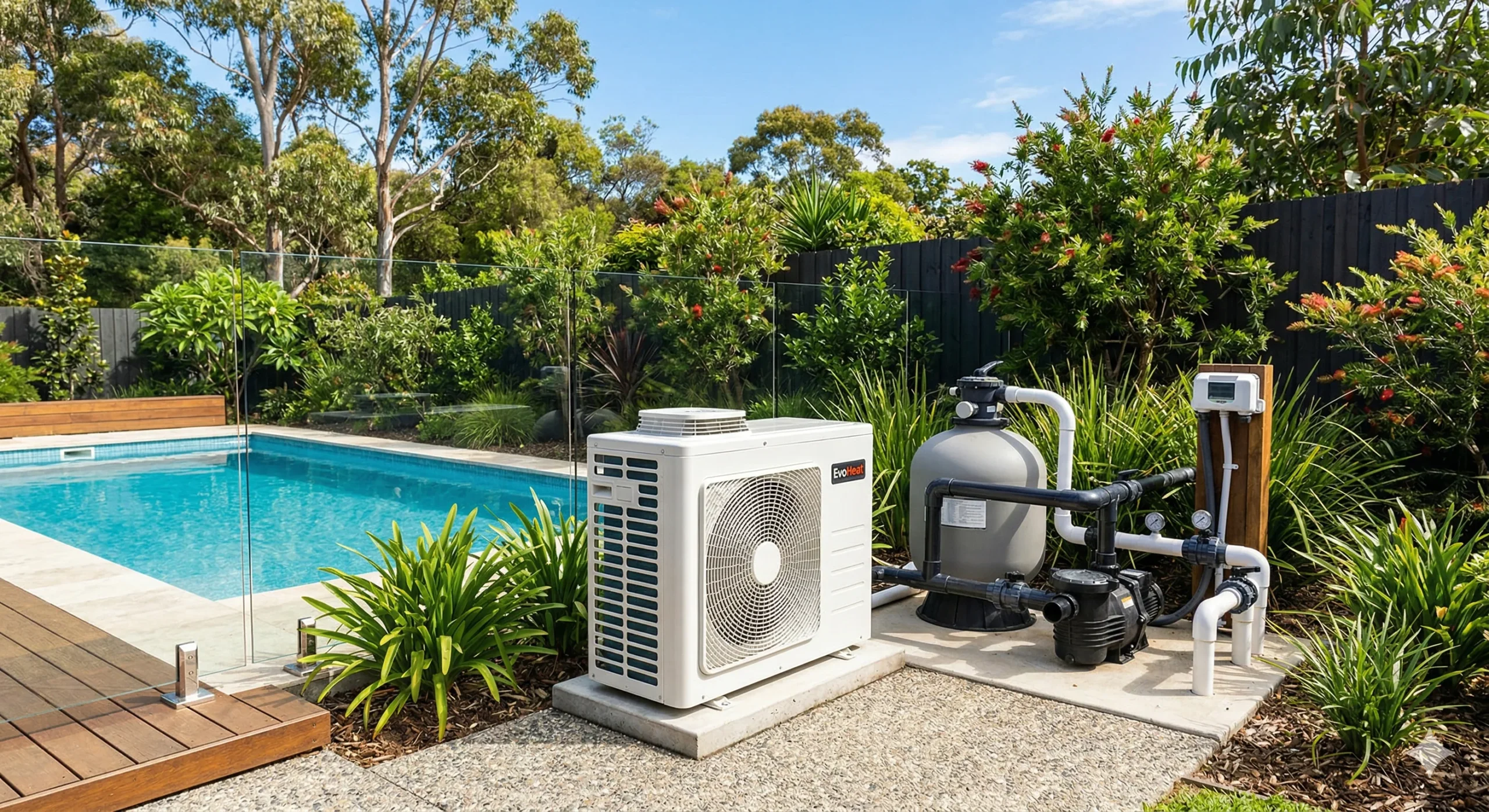
A unit that is too small runs constantly and still struggles to hit the target. A unit sized for the pool volume, exposure and cover use settles into a steady rhythm. Placement is just as important. Open space around the unit lets air move freely, while tight corners and enclosed spaces choke the fan.
Servicing
Dust, leaves and salt air collect on the evaporator coil over time. A dirty coil absorbs less heat, so the unit has to work harder for the same result. Regular inspection of the coil, fan and electrical connections keeps the system running as designed.
The Takeaway
A heat pump is a heat mover, not a heat maker. Once you understand the four stages and what influences them, it becomes easier to ask suppliers the right questions and to spot a system that suits your pool.