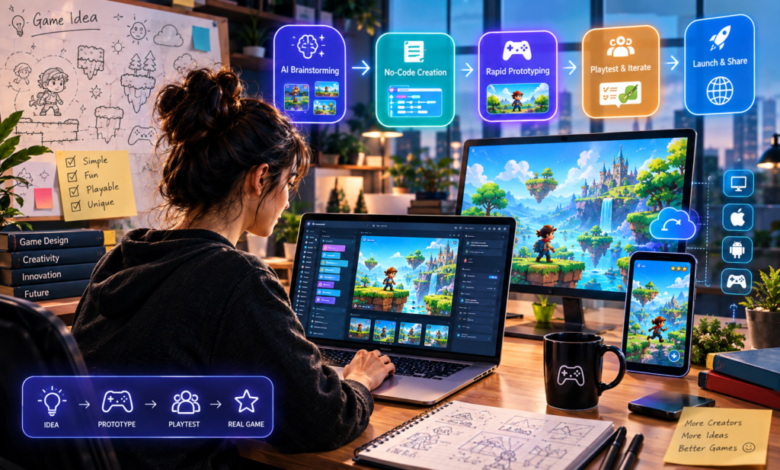
Game design has gone through a few real turning points in its history. The move from cartridges to CDs changed what games could contain. The rise of mobile opened development to a much wider audience. The arrival of accessible game engines like Unity brought professional-grade tools within reach of hobbyists. Right now, the industry is in the middle of another shift, and it’s arguably bigger than any of the ones that came before it.
AI and no-code tools are combining to remove the last major barrier standing between someone having a game idea and actually building it. This isn’t a distant, futuristic concept, it’s already happening, and it’s reshaping who gets to call themselves a game designer.
Why This Shift Feels Different From Past Ones
Previous Shifts Lowered the Ceiling, Not the Floor
Earlier advances in game development mostly made it easier for people who already had some technical skill to do more with less effort. A better engine still required understanding an engine. A better toolset still assumed a baseline of coding knowledge. Those shifts raised the ceiling of what was possible, but they didn’t necessarily lower the floor of what was required to get started.
AI and No-Code Are Lowering the Floor
What’s happening now is different. AI and no-code tools are lowering the floor itself, removing the requirement for coding knowledge entirely for a large category of games. Someone with a strong creative idea and no technical background can now build something playable, which simply wasn’t true even five years ago.
What No-Code Game Design Actually Looks Like Today
No-code doesn’t mean no effort or no skill, it means the skill required shifts away from programming syntax and toward design thinking, logic, and creative decision-making.
Visual Logic Instead of Written Code
Most no-code game tools let creators define behavior through visual systems, drag-and-drop logic, or plain language descriptions instead of lines of code. A creator can specify that touching an object triggers a score increase, or that reaching a location changes the environment, without writing a single function. The logic still exists, it’s just expressed in a form that doesn’t require a programming background to understand.
AI Filling in Technical Gaps Automatically
Where no-code tools alone sometimes hit limitations, AI steps in to fill the gap. Instead of a creator needing to manually configure every interaction, AI can interpret a described intention and generate the underlying implementation. This combination is what makes today’s tools meaningfully more powerful than earlier no-code platforms that existed years before AI was integrated into them.
Where Creators Are Already Building Real Games
It helps to look at what’s actually being built with these tools rather than treating this as a theoretical trend. Platforms designed specifically around AI-assisted, no-code creation are already home to a wide range of playable games made by people without traditional development backgrounds.
A Platform Designed Around This Exact Shift
Astrocade is one such no-code game maker built specifically around this new way of working. Instead of asking creators to learn an engine before they can start, it lets them describe what they want and iterate on a playable version almost immediately, which is exactly the kind of workflow this broader shift in game design is pointing toward.
An Example That Shows the Range of What’s Possible
Steal an Egg is a good example of the kind of focused, hook-driven game that comes out of this approach. It’s built around a simple, playful premise rather than a sprawling feature list, which reflects a broader pattern in AI and no-code creation: smaller, sharper concepts tend to work better than overly ambitious ones, especially when a creator is moving quickly from idea to playable build.
How This Changes Who Gets to Be a Game Designer
Creative People No Longer Need to Become Programmers First
For years, having a great game idea and having the ability to build it were treated as two separate skill sets that a single person rarely possessed together. AI and no-code tools are collapsing that separation. A person’s creative instincts, sense of humor, understanding of pacing, or eye for what makes something fun can now translate directly into a finished product without a multi-year detour into learning to code first.
Younger and Newer Creators Are Entering the Space
Because the technical barrier has dropped so significantly, people who would never have considered themselves capable of making a game are now doing exactly that. Students, hobbyists, and people simply curious about trying it out are shipping playable games, which is expanding the overall pool of ideas the industry gets exposed to.
What This Means for Established Developers
Faster Iteration on New Concepts
Experienced developers aren’t being replaced by these tools, they’re using them to move faster. Testing a new mechanic or a spinoff idea no longer requires the same investment it once did, which means more ideas get a real chance to prove themselves before a team commits significant resources.
More Time Spent on Design, Less on Execution
As AI handles more of the repetitive technical execution, experienced designers can spend more of their time on the parts of the job that actually require experience and taste, like pacing, balance, and the subtle feel of a mechanic, rather than the mechanics of implementing it.
Where This Is Likely Headed Next
Tools Will Keep Getting More Capable
The current generation of AI and no-code tools is already impressive, but it’s still early. As these tools mature, the range of games that can be built without traditional coding will keep expanding, likely including more complex genres that currently still require some technical background.
The Definition of a Game Designer Will Keep Widening
As the technical barrier continues to shrink, the term game designer will increasingly describe someone with strong creative judgment and an understanding of what makes an experience fun, rather than someone who necessarily also has deep programming expertise. That’s a meaningful shift in how the industry defines the role.
Community and Discovery Will Matter More Than Ever
As more people gain the ability to build and publish games, the games that stand out will increasingly be the ones with a clear hook, a defined audience, and a community around them, rather than simply the ones with the most technical polish. Creative clarity is becoming more valuable than technical complexity.
Getting Started With This New Approach
For anyone curious about trying this way of building games, the best starting point is a small, focused idea rather than an ambitious one. Pick a simple, clear concept, use an AI-assisted no-code tool to bring it to life quickly, and get it in front of real players as soon as possible. The goal isn’t to build something perfect on the first attempt, it’s to get comfortable with a workflow that lets ideas move from concept to playable reality faster than traditional development ever allowed.
Final Thoughts
The future of game design isn’t about AI replacing creativity, it’s about AI and no-code tools removing the technical obstacles that used to stand between an idea and a finished game. As that barrier keeps shrinking, the people building games are going to look increasingly different from the traditional image of a developer, and that’s a genuinely exciting shift for anyone who has ever had an idea worth trying.