Phillip Blond: The Thinker Behind Red Tory Politics
From academic theology to ResPublica, Blond built a public career around Red Tory ideas, local power, community ownership and a different view of British politics.

Introduction
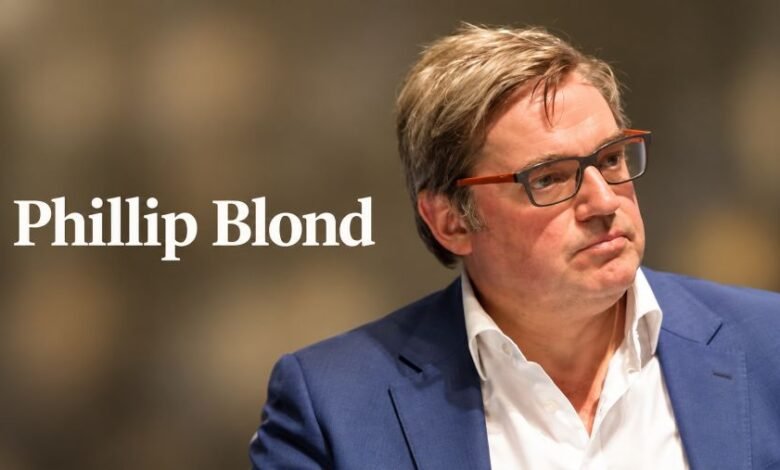
Phillip Blond is a British political philosopher, theologian, author and public-policy thinker. He is best known for the political idea called Red Toryism and for founding the London-based think tank ResPublica.
His career took an unusual route. First came philosophy and theology. Then university teaching. Later, he moved into public policy and political debate.
He became especially visible around 2009. His ideas attracted attention during the years before David Cameron entered Downing Street, though Blond’s own political thinking should not be treated as identical to Conservative government policy.
ResPublica currently lists him as its Director.
Quick Facts
| Fact | Details |
|---|---|
| Full Name | Phillip Blond |
| Born | March 1966 |
| Age | 60 in 2026 |
| Birthplace | Liverpool, England |
| Nationality | British |
| Profession | Political philosopher, theologian, author and policy thinker |
| Known For | Red Toryism |
| Organisation | ResPublica |
| Role | Founder and Director of ResPublica |
| Major Book | Red Tory |
| Book Published | 2010 |
| Academic Fields | Philosophy, theology and political thought |
| Education | University of Hull, University of Warwick and Peterhouse, Cambridge |
| Religion | Anglican / Church of England |
| Notable Family Connection | Daniel Craig is his stepbrother |
| Current Public Work | Policy research, writing, speaking and political thought |
Companies House records Phillip Blond as British and give his birth month as March 1966. The public record does not give his exact birth day.
Who Is Phillip Blond?
Phillip Blond has spent much of his working life asking a fairly big question: what happens when both government and large markets become too powerful?
His answer did not fit cleanly into standard left-versus-right politics.
He argued for stronger communities. More local control. Wider ownership. Smaller institutions should have room to work.
Basically, his argument challenged two things at once. He criticised excessive state control, but he was also critical of concentrated corporate and market power.
That thinking became closely linked with the phrase Red Tory.
His February 2009 essay in Prospect, “Rise of the red Tories,” described a communitarian conservatism that was socially conservative while being sceptical of neoliberal economics.
Early Life in Liverpool
Blond was born in Liverpool in 1966.
A Ludovika University profile confirms Liverpool as his birthplace and records his later studies in philosophy, politics and theology.
His early years were spent around Merseyside.
His father, Max Blond, worked as a painter and gallery owner. A long-form Guardian profile reported that Blond experienced both private and state education while growing up.
There is another interesting family link.
Actor Daniel Craig became Blond’s stepbrother after Max Blond’s second marriage. The relationship has been reported by The Guardian.
Still, Blond built his public identity far away from entertainment. Books, theology and politics became his main path.
Phillip Blond Education
His academic background helps explain his later political ideas.
He studied philosophy and politics at the University of Hull. He then studied philosophy at the University of Warwick before moving into theology at Peterhouse, University of Cambridge. Ludovika’s university profile confirms this academic route.
At Cambridge, he studied under theologian John Milbank, who became closely associated with the theological movement known as Radical Orthodoxy.
Blond completed doctoral work in theology.
His academic interests were already mixing religion, philosophy and questions about society. Those themes later appeared again in his political writing.
Religion and Theology
Religion became a serious part of Blond’s intellectual life.
He converted to the Church of England at the age of 27, according to a detailed interview published by The Guardian.
For him, theology was not separate from philosophy.
That connection can be seen in one of his early major academic projects, Post-Secular Philosophy: Between Philosophy and Theology.
Routledge published the collection in 1998, with Blond as editor. The book brought together essays examining major philosophers and their treatment of theological questions.
It came years before his Red Tory work.
So, his public-policy career had deep academic roots.
Academic Career
Before think tanks became his main public platform, Blond worked in universities.
ResPublica says he was a senior lecturer in theology and philosophy and taught at the University of Exeter and the University of Cumbria.
He taught and wrote about philosophy, theology and related intellectual questions.
This period matters.
His later writing about society did not appear from nowhere. Ideas about institutions, community, ethics and human association were already present in his academic work.
Then politics entered the picture.
Move Into Public Policy
Blond moved from academic work toward think tanks and political policy.
He became involved with the think tank Demos, where he headed its Progressive Conservatism project around the period when Conservative politics was changing under David Cameron.
His public profile grew fast.
In February 2009, Prospect published his essay “Rise of the red Tories.”
That piece became one of the main texts associated with Red Tory thinking. It argued for communitarian conservatism while questioning the economic assumptions of free-market politics.
The idea caught attention.
Some Conservatives liked parts of it. Others disagreed sharply.
That debate made Blond one of the better-known British political thinkers of that period.
What Is Red Toryism?
The phrase sounds contradictory.
That is partly the point.
Traditional Tory politics is linked with conservatism. “Red” is commonly linked with the political left.
Blond tried to pull ideas from different political traditions.
His version of Red Tory thinking argued that people can lose power when economic ownership becomes concentrated in too few hands. But he did not see a large central state as the simple fix.
Instead, he wrote about local communities, civil associations, shared ownership, mutual organisations and wider access to property and capital.
His 2010 book describes Red Toryism as combining economic concerns about inequality with socially conservative ideas.
It was a political argument, not an agreed economic formula.
Critics and supporters have interpreted Red Toryism differently. Some saw an attempt to rethink British conservatism. Others questioned whether the ideas could translate into workable government policy.
Founding ResPublica
Blond founded ResPublica in 2009.
The organisation became the main base for his policy work.
ResPublica describes itself as a public-policy think tank, and its current staff page still lists Blond as Director.
Its work has covered a lot of subjects.
Public services. Local government. Devolution. Manufacturing. Transport. Community assets. Economic policy.
Blond has written or co-written reports across these areas.
This gave him a way to move from political theory into specific policy proposals.
Red Tory Book
His best-known book arrived in 2010.
Its full title is:
Red Tory: How the Left and Right Have Broken Britain and How We Can Fix It
Faber & Faber published the book in 2010. Google Books lists editions of roughly 309 to 320 pages depending on format.
The book criticised both major political traditions.
Blond argued that large government institutions could weaken local responsibility, while concentrated markets could weaken ownership and economic independence.
He pushed for stronger local communities and wider ownership.
Simple idea. Hard politics.
The book received plenty of attention because it did not fit neatly inside the usual Conservative economic language of the period.
David Cameron and Conservative Politics
Blond became publicly associated with David Cameron’s Conservative modernisation project before the 2010 general election.
Cameron attended the launch of ResPublica in 2009, which attracted press attention at the time.
Blond’s work was discussed alongside ideas about localism, civil society and Cameron’s later Big Society agenda.
But there is an important distinction.
Blond was an intellectual and policy thinker. He was not simply writing government policy line by line.
Contemporary reporting itself questioned how directly his theories would shape Conservative government decisions. So it is safer to say his ideas formed part of the wider policy debate around Cameron-era conservatism.
Devolution and Local Power
Local control became one of Blond’s main policy interests.
Through ResPublica, he worked on reports dealing with the transfer of powers away from central government.
The organisation lists publications including Devo Max – Devo Manc from 2014, Restoring Britain’s City States from 2015 and Devo 2.0: The Case for Counties from 2017.
The basic argument was clear.
Places should have more control over decisions affecting local economies and public services.
For Blond, decentralisation was tied to a wider political idea: power should sit closer to communities where possible.
Other Policy Work
His ResPublica publications cover more than devolution.
They include work on community ownership, public services, manufacturing, transport, savings, social policy and regional economics.
Titles listed by ResPublica include The Ownership State, Asset Building for Children, To Buy, To Bid, To Build, Military Academies, Make or Break, Ticket to Ride and A New Bargain.
The subjects changed.
The basic questions often stayed similar.
Who owns things? Who makes decisions? How much power should stay in Westminster? How can local institutions work better?
Those questions run through much of his public work.
Work With Ludovika University
Blond’s academic work later gained another international connection.
In 2020, Ludovika University of Public Service in Budapest announced that he had joined as Chair of Christian Philosophy and Politics.
His work there connected with debates about conservatism, Christianity, liberalism and post-liberal political thought.
A Ludovika publication released in 2025 lists him as the founding director of ResPublica and a guest professor at the university.
Because university appointments can change, it is better not to describe the 2020 chair as a permanent current post without a fresh institutional confirmation.
Writing and Media Work
Blond has written beyond books and think-tank reports.
ResPublica says his work has appeared in publications including The Guardian, The Independent, The Observer, Financial Times, Prospect, New Statesman and The New York Times.
He has appeared in broadcast media as well.
This public-facing work helped take his ideas outside university departments.
Honestly, that matters in his story.
He was never only an academic writer. Much of his career has involved taking academic and political ideas into wider public debate.
Business Roles
Public UK company records give another clear part of his professional record.
Companies House lists Blond as an active director of Eidos Advisory Ltd, a company incorporated in June 2013. The company’s registered activity is management consultancy.
A confirmation statement was filed in July 2026, showing that the company remained active during 2026.
These are corporate facts.
They do not tell us how much Blond earns, what his personal wealth is or how much of his daily work comes from the business.
Phillip Blond Wife and Children
Reliable public information is limited here.
There is no strong source reviewed for this profile that clearly confirms Blond’s current wife, partner or number of children.
Companies House records once listed Maria Blond as a director of Eidos Advisory Ltd, with her directorship ending in November 2024. A shared surname or company link alone is not enough to state a personal relationship as fact.
So private family details should stay private unless a reliable public source confirms them.
Phillip Blond Net Worth
There is no reliable public figure for Phillip Blond’s net worth.
Celebrity wealth websites can publish estimates without showing enough evidence.
That is not good enough.
His exact salary is not publicly verified either.
Any article giving a specific net-worth number without strong financial evidence would be guessing.
Phillip Blond Height
His height is another unverified detail.
No trustworthy official or major biographical source reviewed for this article provides a confirmed measurement.
So there is no reason to invent one.
Where Is Phillip Blond Now?
As of 2026, ResPublica’s website continues to list Blond as its Director and describes him as a political thinker, commentator, author and consultant.
Companies House records also show him as an active director of Eidos Advisory Ltd.
His current public profile still centres on political thought, public policy, writing and consulting.
Red Toryism remains the idea most closely tied to his name.
Final Thought
Phillip Blond followed an unusual path.
Theology came first. Politics came later.
His move from Cambridge-era religious philosophy into British public policy gave him a different voice from many conventional political commentators.
Red Toryism made that voice widely known.
Some of his arguments have been praised. Others have faced strong criticism. That is normal for political ideas.
What can be said clearly is this: Blond has spent years arguing for local power, wider ownership and stronger civic institutions while questioning both highly centralised government and concentrated markets.
And he is still connected with that debate today.
Frequently Asked Questions
Who is Phillip Blond?
Phillip Blond is a British political philosopher, theologian, author and public-policy thinker. He founded ResPublica and is closely associated with Red Tory political thought.
How old is Phillip Blond?
Companies House records his birth month as March 1966, making him 60 years old in October 2026.
Where was Phillip Blond born?
He was born in Liverpool, England, according to Ludovika University of Public Service.
What is Phillip Blond famous for?
He is best known for Red Toryism and for founding the ResPublica think tank in 2009.
What book did Phillip Blond write?
His best-known book is Red Tory: How the Left and Right Have Broken Britain and How We Can Fix It, published by Faber & Faber in 2010.
Where did Phillip Blond study?
He studied at the University of Hull, University of Warwick and Peterhouse at the University of Cambridge.
Is Phillip Blond related to Daniel Craig?
Yes. Daniel Craig is his stepbrother through the second marriage of Blond’s father, Max Blond.
What is Phillip Blond’s net worth?
No reliable public source confirms his net worth, so a specific figure should not be stated as fact.