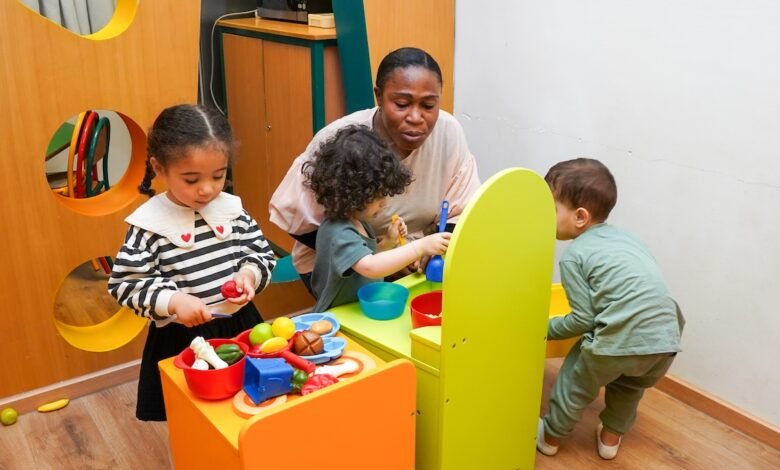
A nursery school is often a child’s first consistent learning community. It is where children begin forming friendships, listening to stories in groups, solving small problems, expressing ideas, and learning how classroom routines work.
These experiences may look simple, but they support important developmental foundations.
Nursery education is most effective when learning feels active, social, and enjoyable.
Language Grows Through Everyday Conversation
Children develop communication skills through repeated interaction.
Teachers can introduce new words during stories, songs, art, play, and ordinary conversations.
A nursery school should give children many opportunities to speak rather than expect them to remain quiet throughout the day.
Stories Support More Than Reading
Stories introduce vocabulary, imagination, sequence, and emotions.
Teachers can ask children what they think will happen next or how a character might feel.
These discussions make nursery school literacy more meaningful.
Early Mathematics Can Be Practical
Children discover mathematical ideas long before formal lessons.
They count objects, compare sizes, recognize patterns, and sort materials.
A nursery school can build on these experiences through games and hands-on activities.
Children often understand concepts better when they can see and touch them.
Creative Activities Build Flexible Thinking
Art, music, storytelling, construction, and pretend play all give children opportunities to make decisions.
A nursery school should allow creativity rather than making every activity look identical.
Families exploring nursery education in Kharadi can look for classrooms where children are encouraged to express their own ideas.
Mistakes Can Be Useful
When something does not work, children learn to adjust.
A block tower falls, a puzzle piece does not fit, or an art idea changes.
A supportive nursery school helps children see these moments as part of learning.
Social Skills Develop Daily
Children learn important social lessons from other children.
They practice sharing, taking turns, asking to join a game, and resolving small disagreements.
A nursery school provides repeated opportunities to develop these skills.
Teachers should guide without controlling every interaction.
Physical Development Is Essential
Young children need movement.
Outdoor play, dancing, balancing, running, and climbing support gross motor skills.
Drawing, puzzles, threading, and construction strengthen fine motor coordination.
Movement Supports Attention
Children often concentrate better after opportunities to move.
A balanced nursery school schedule should alternate quieter activities with active experiences.
This respects the developmental needs of young learners.
Independence Builds Confidence
Simple responsibilities can be powerful.
Putting away materials, carrying belongings, washing hands, or choosing an activity teaches children that they are capable.
A nursery school should give children time to attempt manageable tasks.
Adults can support without immediately taking over.
Emotional Learning Matters Too
Young children experience strong emotions but may not always have the words to describe them.
Teachers can help children identify feelings such as frustration, worry, excitement, or disappointment.
A nursery school that values emotional development can help children communicate more effectively.
Predictable Routines Create Security
Children often feel more comfortable when the day follows a recognizable pattern.
Arrival, activities, meals, movement, stories, and departure cues help children know what to expect.
A nursery school should combine predictability with enough flexibility to respond to individual needs.
Conclusion
The value of nursery school lies in everyday experiences.
A story builds language. A puzzle strengthens problem-solving. Outdoor play develops coordination. A disagreement teaches communication.
When children experience these moments in a caring environment, they build much more than academic readiness.
They develop curiosity, confidence, independence, social awareness, and resilience.
Those skills can support learning long after the nursery years are over.