The colour of smoke coming from your exhaust can give you useful clues about your car’s condition. Thin white vapour on a cold morning is often normal condensation, while persistent blue, black, grey or thick white smoke may point to a problem with the engine, fuel system or emissions equipment.
The key is to look at more than colour alone. When the smoke appears, how long it lasts, its smell and whether your car is losing oil or coolant can all help narrow down the possible cause. Some problems need prompt attention, especially if the engine is overheating or the smoke is heavy.
In this guide, we explain what different exhaust smoke colours can mean, the common faults behind them, how to recognise warning signs and when you should stop driving or arrange a professional inspection.
The Quick Reference: Exhaust Smoke at a Glance
Each colour points to a specific system failure. The sections below cover each one in detail, including what causes it, how to recognise it, and what happens if it is ignored.
White Smoke From the Exhaust 
When White Smoke Is Normal
Not all white smoke is a problem. On a cold morning in Aldershot or anywhere across Hampshire, a thin, wispy white vapour from the tailpipe for the first minute or two after starting is almost always normal condensation. Overnight, moisture builds up inside the exhaust system. When the engine starts and the exhaust heats up, that moisture evaporates and exits as a thin white steam. It is odourless, disappears quickly as the exhaust reaches operating temperature, and is of no concern.
The test is straightforward. If the white vapour clears within two to three minutes of start-up and your coolant level is stable, there is nothing wrong. If it continues once the engine has fully warmed up, or if it appears in thick clouds, the situation is different.
When White Smoke Is Serious
Thick, persistent white smoke that continues after the engine has reached operating temperature is one of the clearest warning signs a car can produce. The most likely cause is coolant entering the combustion chamber and being burned along with the fuel.
The tell-tale indicator is the smell. Coolant burning in the combustion chamber produces a distinctly sweet, slightly chemical odour that is quite different from normal exhaust. If you notice white smoke with a sweet smell, particularly if it is heavy and continuous rather than a thin wisp, treat it as urgent.
The most common cause is a failed head gasket. The head gasket seals the combustion chambers from the coolant passages that run through the cylinder head. When it fails, coolant can leak into the cylinders and be burned with the fuel. The signs of a head gasket failure extend beyond smoke: the coolant level may be dropping without any visible external leak, the oil may appear milky or creamy under the filler cap from coolant mixing with it, the engine may overheat, and there may be misfiring on one or more cylinders.
A cracked cylinder head or a cracked engine block can produce identical symptoms, as both allow coolant to enter the combustion area through different routes. On diesel vehicles, a failed EGR cooler can also allow coolant to enter the intake and produce white smoke.
The reason this is treated as urgent is straightforward. Running an engine with coolant entering the combustion chambers causes overheating, accelerated internal wear, and in severe cases complete engine seizure. Continuing to drive increases the damage with every mile.
| White smoke type | Smell | Coolant level | What it means |
| Thin, clears in 2 minutes | None | Stable | Normal condensation |
| Thick, persists when warm | Sweet, chemical | Dropping | Likely head gasket fault |
| Intermittent, on acceleration | Sweet | May be dropping | Head gasket or EGR cooler |
| White with milky oil | Sweet | Dropping | Serious head gasket failure |
Blue Smoke From the Exhaust
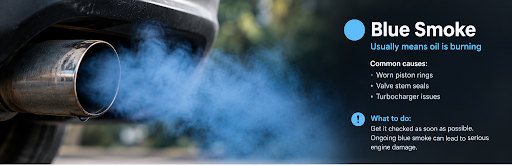
Blue smoke from the exhaust means one thing: the engine is burning oil. Engine oil is entering the combustion chamber and being burned alongside the fuel. The smoke has a characteristic blue or blue-grey tint and carries a distinct burnt oil smell that is recognisable once you have encountered it.
The oil level on a vehicle producing blue smoke will typically be dropping faster than normal. If you are topping up the oil more frequently than you used to without finding an external leak, blue smoke is likely the explanation even if you have not seen it clearly.
The specific timing of when the blue smoke appears offers useful diagnostic information about where the oil is entering the system.
Blue Smoke Only at Cold Start
Blue smoke that appears when the engine is first started in the morning, particularly as a brief puff that then largely clears as the engine warms, typically indicates worn valve stem seals. The valve stem seals prevent oil from being drawn down the valve stems into the combustion chamber. When they wear and harden, oil pools on top of the valves overnight and is burned off when the engine first starts.
Blue Smoke Under Acceleration
Blue smoke that appears specifically when the accelerator is pressed hard, particularly under load on a hill or during overtaking, usually indicates worn piston rings. The piston rings seal the combustion chamber from the crankcase below. When they wear, they allow oil to be pushed past into the cylinder under the increased pressure of hard acceleration.
Blue Smoke on a Turbocharged Engine
On turbo-equipped engines, which cover a significant proportion of modern UK cars, blue or blue-grey smoke can also result from failed turbocharger seals. The turbocharger is lubricated by engine oil, and when its seals wear, oil enters the intake air stream or the exhaust side directly. This typically produces blue-grey smoke that may be noticeable at idle or under boost and is often accompanied by a slight oily residue inside the intake system.
How Serious Is Blue Smoke?
The urgency of blue smoke depends on its severity. A faint, intermittent blue tint on a high-mileage engine that clears quickly can be monitored while an inspection is booked promptly. Persistent, heavy blue smoke indicates significant oil consumption that will rapidly deplete the engine’s oil level. Running an engine with low oil causes bearing damage and in serious cases complete engine seizure. Blue smoke should never be left without investigation.
Black Smoke From the Exhaust
Black smoke from the exhaust means the engine is running too rich, that is, burning too much fuel relative to the available air. Unburned fuel exits the exhaust as black, sooty smoke. The smell is noticeably petrochemical and more acrid than normal exhaust.
On petrol engines, black smoke is always a sign of a problem. On older diesel engines, a brief puff of black smoke during hard acceleration can occasionally occur under heavy load, but persistent or heavy black smoke on any modern diesel is abnormal and needs attention.
Common Causes of Black Smoke
A blocked or dirty air filter is one of the most straightforward causes. The engine needs a specific ratio of fuel to air for clean combustion. If the air filter is so blocked that the engine is starved of air, the mixture becomes too rich and unburned fuel exits as black smoke. This is also one of the more easily resolved causes: replacing the air filter is a basic service item.
Faulty fuel injectors that are delivering too much fuel, or that are leaking when they should be closed, disrupt the fuel-air balance and cause incomplete combustion. A failing mass airflow sensor that is sending incorrect air volume readings to the ECU causes the engine management system to miscalculate the fuel injection quantity, again producing a rich mixture and black smoke.
On diesel vehicles, a clogged or failing EGR valve can cause excessive exhaust recirculation that disrupts the combustion process. A blocked diesel particulate filter that is preventing proper exhaust flow can also contribute to black smoke conditions.
Black Smoke and the MOT
Black smoke is taken seriously during the MOT emissions test. According to the GOV.UK MOT inspection manual for cars and passenger vehicles, a vehicle emitting dense blue or clearly visible black smoke will fail the visual emissions check. For diesel vehicles fitted with a diesel particulate filter from the factory, any visible smoke of any colour during the test is classified as a major defect. Black smoke in any meaningful quantity means an MOT failure, alongside the deeper mechanical issue causing it.
Grey Smoke From the Exhaust
Grey smoke sits between blue and black in both appearance and diagnosis, and drivers sometimes confuse it with either. It tends to appear as a pale grey to blue-grey haze rather than the more clearly coloured blue or dense black.
On petrol engines, grey smoke typically indicates the same root cause as blue smoke: oil entering the combustion chamber. The slightly lighter appearance compared to clear blue smoke may reflect a smaller quantity of oil burning or a different point of entry.
On diesel engines, grey smoke has a slightly different range of causes. It can indicate unburned diesel from injector problems, poor compression in one or more cylinders, or a problem with fuel pressure that prevents the injectors from atomising diesel properly. Grey smoke from a diesel can also result from early-stage EGR valve problems or a partially blocked air intake.
In turbocharged engines of either type, grey smoke is a common early sign of a failing turbocharger oil seal. This is worth investigating early, as a turbocharger that develops a significant seal failure becomes a substantially more expensive repair than one caught while the issue is still in its early stages.
Smoke Behaviour as a Diagnostic Tool
Beyond the colour itself, the conditions under which smoke appears tell you considerably more about the likely cause.
Combining the colour with the timing gives a much more precise picture of the fault before a car even goes on a ramp.
Because similar smoke colours can have different causes, engine diagnostics and a physical inspection can help identify the underlying fault.
Exhaust Smoke on Petrol vs Diesel Engines
The same smoke colour can have a somewhat different significance depending on whether the car has a petrol or diesel engine. Understanding these differences helps drivers of both fuel types interpret what they are seeing accurately.
| Smoke colour | Petrol engine | Diesel engine |
| White, thin, cold start | Normal condensation | Normal condensation or glow plug issue |
| White, thick, persistent | Head gasket failure | Head gasket, injector fault, or EGR cooler |
| Blue | Valve seals, piston rings, turbo seal | Valve seals, piston rings, turbo seal |
| Grey | Oil burning, turbo seal | Injector, fuelling, or turbo issue |
| Black | Always a fault: air filter, injector, sensor | Can be normal on older engines under load, always investigate if persistent |
Diesel engines in particular have a complicated relationship with smoke. An older diesel producing a brief puff of black smoke under hard acceleration has historically been considered borderline normal due to turbo lag. On modern diesels fitted with a diesel particulate filter, any visible smoke during an MOT is an automatic failure. For diesel drivers around Aldershot and Surrey, understanding where your car sits on this spectrum is important before test day.
What Happens If You Ignore Exhaust Smoke?
Each colour of exhaust smoke represents a fault that will not resolve itself. Without exception, the consequences of ignoring them are more expensive than the cost of a timely inspection and repair.
White smoke from a head gasket failure, continued without repair, leads to sustained coolant loss, progressive overheating, and in time a warped cylinder head or seized engine. A head gasket repair that costs between £550 and £1,200 in the UK becomes an engine replacement that costs several times more if driving continues long enough.
Blue smoke from worn piston rings or valve seals indicates oil consumption that, left unaddressed, depletes the engine oil level. Running an engine with insufficient oil causes accelerated bearing wear and can result in catastrophic internal damage. The engine is essentially destroying itself from the inside.
Black smoke from a fuelling fault causes unburned fuel to enter the exhaust system, which accelerates damage to the catalytic converter and diesel particulate filter. Both are expensive components. A blocked air filter or faulty injector that causes black smoke will, if left long enough, turn a minor service item into a catalytic converter or DPF replacement.
Grey smoke from an early-stage turbocharger seal failure, addressed quickly, may allow a relatively straightforward turbo rebuild or seal replacement. A turbo that has been running with a failing seal for months will have allowed oil into the intake and exhaust systems in quantities that create secondary problems across multiple components.
Exhaust Smoke and the MOT
Exhaust smoke has a direct relationship with MOT outcomes that UK drivers need to understand before presenting their vehicles for test.
For petrol vehicles, a visual check is carried out alongside the metered emissions test. Dense blue or clearly visible black smoke is assessed as a major defect under the MOT inspection manual and results in a failure.
For diesel vehicles, the rules are strict. All diesel cars are subjected to a metered smoke opacity test using a smoke meter connected to the exhaust. For diesel vehicles fitted with a diesel particulate filter from the factory, any visible smoke of any colour during the test, including white or blue, is classified as a major defect. This is a significant point that catches many diesel drivers by surprise. It is not just excessive smoke that fails the test. Any visible smoke on a factory-DPF diesel will fail it.
When to Keep Driving and When to Stop
Not every type of exhaust smoke requires you to pull over immediately. The guidance below covers the most common scenarios.
Continue driving cautiously and book promptly:
Thin white vapour on a cold morning that clears within two minutes. Occasional very light blue tint on startup that disappears quickly on a high-mileage engine. A faint grey haze on a diesel under hard acceleration that does not persist.
Book an inspection within a few days, do not delay:
Persistent blue or grey smoke that is visible regularly, particularly under acceleration. Black smoke that appears consistently and is not clearing. White smoke after cold start that takes longer than a few minutes to clear.
Stop driving and arrange assessment before driving further:
Thick, sweet-smelling white smoke that continues once the engine is fully warm. Any smoke accompanied by overheating, coolant loss, or a milky oil filler cap. Heavy blue smoke that persists throughout normal driving. Any smoke alongside a sudden drop in oil level.
The Role of Servicing in Preventing Exhaust Smoke
Many of the faults that cause exhaust smoke are either preventable or detectable at an early stage through regular servicing. A thorough service includes checks on oil condition and level, coolant concentration and level, the condition of the air filter, injector performance indicators, and diagnostic scans for stored fault codes that may point to developing fuelling or emissions issues.
Valve seals, piston rings, and turbocharger seals wear gradually over time and mileage. A vehicle that is serviced regularly gives a technician the opportunity to notice when oil consumption is increasing, when coolant level is dropping more than expected between services, or when a stored code suggests a developing injector or sensor fault. These observations, made at a service, allow targeted preventative maintenance that avoids the far more disruptive and expensive scenario of a component failing completely.
Conclusion
Your exhaust pipe is a direct window into what is happening inside your engine. Blue smoke means oil is burning. Thick white smoke with a sweet smell means coolant is entering the combustion chambers. Black smoke means the fuel system is delivering too much fuel. Grey smoke typically means oil or a diesel fuelling issue. Thin white vapour on a cold morning is normal.
The key is knowing which category you are in and acting accordingly. Some exhaust smoke is a minor signal that an inspection is due. Some exhaust smoke means the car should not be driven until it has been properly assessed. The common thread is that none of these colours, when persistent, indicate a problem that will resolve itself without attention. Acting on what the exhaust is telling you is always less expensive than finding out what happens when you do not.
Before arranging a visit, you can read Ash Road Service Centre reviews on Google and check the garage information.
Frequently Asked Questions
Is white smoke from the exhaust always serious?
Not always. Thin white vapour on a cold morning that disappears within two or three minutes is normal condensation and is of no concern. Thick, sweet-smelling white smoke that continues once the engine has fully warmed up, or that appears heavily under acceleration, indicates coolant entering the combustion chamber and should be treated as urgent.
What causes blue smoke from the exhaust?
Blue smoke means the engine is burning oil. The most common causes are worn valve stem seals, which typically produce blue smoke on startup, worn piston rings, which produce blue smoke under hard acceleration, or a failing turbocharger seal on turbocharged engines. All require professional investigation as they indicate oil consumption that will deplete the engine oil level.
Will black smoke from a diesel fail the MOT?
Yes. Visible black smoke is assessed as a major defect during the MOT emissions test. For diesel vehicles fitted with a diesel particulate filter from the factory, any visible smoke of any colour, including white or blue, is classified as a major defect under current MOT guidelines.
What does grey smoke from the exhaust mean?
Grey smoke on a petrol engine typically indicates oil burning, similar to blue smoke, often from a turbocharger seal or valve issue. On a diesel, grey smoke can indicate unburned fuel from injector problems or low compression. It is worth investigating promptly rather than monitoring indefinitely.
How long should exhaust condensation last on a cold morning?
Normal condensation from the exhaust should reduce steadily and clear within two to three minutes as the exhaust system reaches operating temperature. If it continues beyond this point or is accompanied by a sweet smell, it is no longer normal condensation.
Can exhaust smoke damage other parts of the car?
Yes. Black smoke from excess fuel accelerates damage to the catalytic converter and diesel particulate filter. Blue smoke from oil burning can coat the catalyst with oil residue and damage the same components. White smoke from coolant burning can leave deposits in the combustion chambers and cause corrosion in the exhaust system over time.