Find out how often to rotate your tyres, which patterns to use, and whether tyre rotation really matters for wear, grip and tyre life.
Most drivers know to check their tyre pressures and tread depth, yet tyre rotation is one of those jobs that tends to slip down the list. It doesn’t cause a warning light, it doesn’t make a noise, and the car drives perfectly well without it, at least at first.A driver in Aldershot might run a set of tyres for years without ever moving them around, then find themselves buying new tyres in Aldershot for the front pair far sooner than for the rears. The cost of ignoring rotation is quiet and gradual, which is exactly why it’s worth understanding. Making it part of regular car servicing is one of the simplest ways to get more life and more consistent performance from a set of tyres.
This guide explains what tyre rotation is, why tyres wear unevenly, how often rotation should be done, which patterns to use, and whether it genuinely matters. By the end you’ll know when rotation is worthwhile, when it isn’t, and how to get the most from it.
What Is Tyre Rotation?
Tyre rotation means moving each wheel and tyre to a different position on the car in a planned sequence. A front tyre might move to the rear, and a rear tyre might move to the front, sometimes switching sides at the same time. The aim is to spread the wear across all the tyres rather than letting one axle take the brunt.
Rotation isn’t the same as replacing, balancing, or wheel alignment. It simply changes where each tyre sits, so that the different jobs each position does are shared out over the life of the set.
Why Tyres Wear at Different Rates
Each tyre position has a different workload. On a front wheel drive car, the front tyres steer, drive, and do most of the braking, so they wear faster than the rears. On a rear wheel drive car, the rears handle the drive while the fronts still steer and brake, so the pattern is different. Weight distribution matters too, because the engine’s weight sits over the front axle on most cars, increasing the load on the front tyres.
Electric and hybrid cars add another factor. Their extra weight and immediate torque can wear tyres faster than a comparable petrol car, which makes even wear more worthwhile. The flow below shows how rotation fits into the wear cycle.
Does Tyre Rotation Really Matter?
The honest answer is yes, in most cases, though the benefit varies with the car and how it’s driven. Rotation doesn’t transform performance overnight. Its value comes from steady, cumulative advantages over the life of a set of tyres.
- More even tread wear. Sharing the workload means the tyres wear down at a similar rate, rather than one pair reaching the legal limit while the other still has plenty of life.
- Longer overall tyre life. Because all four tyres wear out closer together, you get more of the usable tread from the whole set before replacement.
- More consistent handling and grip. Tyres with similar tread depth behave more predictably, particularly in wet weather, where tread depth has a strong effect on water clearance.
- A quieter ride. Uneven wear can create noise and vibration, and keeping wear balanced helps to avoid it.
- A regular opportunity to inspect. With the wheels off, damage, cuts, and bulges are far easier to spot.
There are situations where the benefit is smaller. If you replace tyres in pairs regularly and the car does modest mileage, uneven wear may never become a significant issue. Some cars also have different sized tyres front and rear, which limits what rotation can do. Even so, for most drivers with a standard set, rotation is a low effort habit with a worthwhile return. A driver in Farnborough who covers high mileage on a front wheel drive hatchback will see a more obvious benefit than someone who only makes occasional short trips.
How Often Should You Rotate Your Tyres?
A commonly used guide is every 5,000 to 8,000 miles, or at each service if that suits your mileage better. Your vehicle handbook may give a specific interval, and where it does, that figure takes priority. The right rhythm also depends on how the car is driven and what powers it.
| Vehicle Type | How Tyres Tend to Wear | Rotation Note |
| Front wheel drive | Front tyres wear faster because they steer, drive, and brake | Regular rotation makes a noticeable difference |
| Rear wheel drive | Rears wear from driving force while fronts wear from steering | Rotate to balance the two, within any limits on tyre sizes |
| All wheel drive | Wear is shared, but mismatched tread depths can strain the drivetrain | Rotate regularly and keep tread depths closely matched |
| Electric and hybrid | Extra weight and instant torque can speed up wear | Check wear often and rotate on schedule |
| High mileage or motorway use | Steady wear but rapid accumulation | Stick to the lower end of the interval |
Driving style matters too. Hard acceleration, heavy braking, and frequent cornering wear tyres faster and can justify a shorter interval. The overview below summarises the main timing cues.
| Pattern | How It Works | Typically Used For |
| Forward cross | Rear tyres move straight to the front, while front tyres move to the rear and swap sides | Front wheel drive cars with non directional tyres |
| Rearward cross | Front tyres move straight to the rear, while rear tyres move to the front and swap sides | Rear wheel drive and four wheel drive cars with non directional tyres |
| X pattern | Every tyre moves diagonally to the opposite corner | Some cars with non directional tyres, where the handbook allows |
| Front to back, same side | Tyres swap between front and rear on the same side only | Directional tyres, which must keep their rotation direction |
Your handbook or technician can confirm the correct pattern for your car. A driver in Farnham with a rear wheel drive saloon will usually follow a different sequence from a neighbour with a front wheel drive hatchback.
Tyres That Need Special Treatment
Not every set of tyres can be rotated in the standard way, and knowing the exceptions avoids mistakes.
- Directional tyres. These have an arrow on the sidewall showing the direction they should turn, and they only work correctly when rolling the right way. They can swap front to back on the same side, but not across the car, unless they’re removed from the wheel and refitted.
- Asymmetric tyres. These have a marked inner and outer side, and must keep the correct side facing outward. They can often move front to back on the same side.
- Staggered fitment. Some performance cars run different sized wheels or tyres front and rear, which makes front to back rotation impossible.
- Tyres with very different wear. If the front pair is far more worn than the rears, rotation can still help, but the gap may already be too large to fully correct.
- Mixed brands or types. Where tyres differ, a technician will advise which positions are safest.

A driver in Tongham with a performance car on staggered wheels shouldn’t assume rotation is available, and should ask what can be done instead. Regular checks and prompt replacement may matter more than rotation in that case.
Reading Your Tyre Wear Before You Rotate
Wear patterns tell a story, and some of them reveal problems that rotation won’t fix. The table below shows what common patterns usually mean.
| Wear Pattern | What It Often Indicates |
| Even wear across the tread | Healthy tyres and correct pressure |
| Wear down the centre | Overinflation |
| Wear on both outer edges | Underinflation |
| Wear on one edge only | An alignment problem, such as incorrect camber or toe |
| Feathered or saw tooth edges | Toe misalignment |
| Cupping or scalloped patches | Worn suspension parts or a balance problem |
| One tyre much more worn than the others | A localised fault, or tyres that were never rotated |
Rotation spreads normal wear around, but it can’t correct a mechanical cause. If one edge of a tyre is wearing faster than the rest, or you notice the car pulling or the steering wheel sitting off centre, the problem lies elsewhere. It’s worth understanding the difference between wheel balancing and wheel alignment, since alignment issues cause uneven wear that rotation would only mask, and balance issues cause vibration and cupping.
A driver in Ash Vale who sees the inner edge of a front tyre wearing smooth while the rest is fine should have the wheel alignment checked before moving the tyre to a new position, otherwise the same fault will simply damage another tyre.
Rotation Is the Perfect Time for an Inspection
With the wheels off the car, there’s an excellent chance to look closely at each tyre and the parts around it. A proper check covers tread depth, sidewall condition, cuts, bulges, embedded objects, valve condition, and tyre pressure. Brake components and suspension parts also become more visible, which can reveal wear early.
Tyre age matters as well as tread. The DOT code on the sidewall shows when a tyre was made, and rubber hardens and weakens over time even if the tread looks fine. Learning to read it is covered in this guide to DOT code tyre checks, and it’s a good habit to check the date on each tyre whenever it’s off the car. Many tyre makers advise having older tyres inspected regularly and replacing them once they reach around ten years, regardless of tread.
Tyre Rotation and the MOT
Rotation isn’t an MOT test item, but its effects show up at the test. The legal minimum tread depth is 1.6 millimetres across the central three quarters of the tread and around the whole circumference, and a tyre that has worn faster than the rest can fail while the others still pass. Rotation helps keep tread depth balanced so that one tyre doesn’t reach the limit early. The test also looks for cuts, bulges, and damaged sidewalls, all of which are easier to spot during a rotation.
If your car is due a test, checking the tyres beforehand saves a nasty surprise. Booking an MOT in Aldershot with time to rotate or replace tyres where needed makes the whole process smoother, and a driver in North Camp who has kept up with rotation is far less likely to find one tyre unexpectedly below the limit.
After Rotation: Torque, Pressures, and Sensors
A few follow up checks make sure the job is done properly. Wheel nuts or bolts should be tightened to the manufacturer’s specified torque, and it’s good practice to recheck them after a short distance. Tyre pressures should be set for each axle according to the vehicle’s recommended figures, since front and rear pressures often differ. Cars with tyre pressure sensors may need the system to recognise the tyres’ new positions, depending on how it works.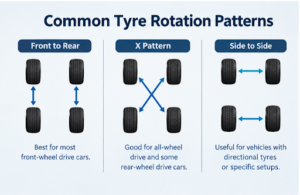
Rotating already balanced wheels doesn’t automatically require rebalancing. However, if a new vibration appears afterwards, a balance check is sensible. Anything unusual in how the car feels after rotation is worth mentioning straight away.
DIY or Professional?
Rotation can be done at home by someone with the right equipment, but it needs more than a basic jack. A car must be supported on proper stands on firm, level ground, wheel nuts need tightening with a torque wrench, and locking wheel nuts require the correct key. Getting any of these wrong creates a real safety risk.
Having the work done professionally brings lifting equipment, correct torque settings, and a trained eye for problems that a quick DIY job could miss. For most drivers, combining rotation with a routine service is the simplest and safest route.
Common Myths About Tyre Rotation
A few misunderstandings are worth clearing up.
Myth one, rotation fixes alignment or balance problems. It doesn’t, because it only moves tyres around, and a mechanical fault will keep wearing whichever tyre sits in the affected position. Myth two, new tyres don’t need rotating. Wear begins from day one, so rotating early helps establish even wear. Myth three, you can rotate any tyre to any position. Directional, asymmetric, and staggered fitments all have restrictions. Myth four, rotation is only for high mileage drivers. Any car benefits, although the gain is greater with more mileage. Myth five, if the tyres look fine, there’s no need to rotate. Uneven wear can build up unnoticed, and a quick tread depth check often reveals a gap that the eye misses. A driver in Fleet who assumes rotation can wait until the tyres look worn may find it’s already too late to even things out.
Conclusion
Tyre rotation is a small, inexpensive habit that pays back through longer tyre life, steadier handling, and a regular chance to inspect what’s keeping you on the road. Tyres wear differently depending on where they sit and how the car is driven, and rotating them on a sensible schedule, typically every 5,000 to 8,000 miles or at each service, shares that wear around rather than letting one axle take all of it.
The right pattern depends on your drivetrain and tyre type, and some fitments can’t be rotated at all, so it’s worth checking the handbook or asking a technician. Rotation also works best alongside other good habits: correct pressures, a proper look at wear patterns, attention to alignment and balance, and awareness of tyre age. For drivers around Aldershot and the wider area, making rotation part of routine servicing is one of the easiest ways to keep tyres safe, even, and lasting as long as they should.
Frequently Asked Questions
How often should I rotate my tyres?
A common guide is every 5,000 to 8,000 miles or at each service, but your vehicle handbook takes priority if it gives a specific interval.
Does tyre rotation really make a difference?
Yes, for most drivers. It evens out wear, extends the life of the set, and keeps handling more consistent, though the benefit is smaller if you replace tyres in pairs often.
Can all tyres be rotated?
Not always. Directional and asymmetric tyres have restrictions, and cars with different sized wheels front and rear can’t swap tyres between axles.
Will rotation fix uneven wear caused by poor alignment?
No. Rotation only moves the tyres, so an alignment fault needs to be corrected separately or it will keep wearing whichever tyre is affected.
Do I need to rebalance my wheels after rotating them?
Not automatically, since the wheels are already balanced, but a balance check is sensible if a vibration appears afterwards.
Is tyre rotation part of the MOT?
No, but rotation helps keep tread depth even, which reduces the chance of one tyre falling below the legal limit before the test.