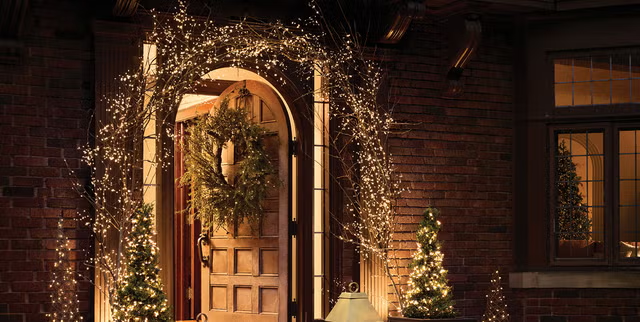
The outdoor Christmas display has moved steadily from novelty to expectation over the past decade, and this year looks set to continue the trend. Retailers report sustained demand for exterior decorations, with inflatables, illuminated figures and door wreaths among the strongest performers.
What was once a handful of houses on a street with lights along the guttering is now, in many neighbourhoods, a majority activity, and in some streets an organised one.
What Is Selling
The categories driving growth are consistent across retailers. Illuminated outdoor figures, particularly reindeer and polar bears in brushed wire with integrated lighting, have been among the fastest sellers, having largely replaced the inflatable as the centrepiece of choice in more design-conscious households.
Door wreaths remain the single highest-volume category, partly because they represent the lowest-commitment entry point. A wreath requires no electricity, no installation and no ladder, and it signals participation without requiring a weekend.
Garlands for porches and bannisters, oversized baubles for trees and planters, and freestanding figures for front gardens make up most of the remainder.
The Street-Level Effect
Community organisers report that co-ordinated street displays have grown, with some roads operating informal schemes where households agree a colour or a switch-on date. A number raise money for local charities, with collection points and advertised viewing evenings.
These arrangements are generally welcomed, though they are not universally popular. Residents of streets that attract visitors have in some cases reported congestion, parking difficulties and late-night noise, and a small number of well-known display houses have scaled back as a result.
Where Disputes Arise
Most outdoor decoration requires no permission of any kind. Temporary seasonal decorations on a private house are not generally a planning matter, and the vast majority of displays attract no official attention whatsoever.
Difficulties, where they arise, tend to involve light spill into a neighbour’s bedroom window, projectors aimed across a boundary, or displays that remain lit through the night. Local authorities can in principle treat persistent, severe light nuisance as a statutory nuisance, though action is rare and almost always preceded by an informal conversation.
Households in flats, listed buildings or conservation areas face more restrictions, particularly where fixings into a shared or protected structure are involved. Government guidance on when planning permission is required for alterations is the appropriate starting point for anyone unsure whether their property has additional constraints.
Practical Advice from Retailers
The most common error reported by sellers is buying indoor products for outdoor use. Decorations intended for exterior installation are built differently, with sealed housings, weather-rated cabling and UV-stabilised materials that resist becoming brittle in cold weather.
Shoppers are advised to check the IP rating on anything electrical. IP44 is generally considered the minimum for exterior use, with higher ratings appropriate for exposed positions. Products rated for indoor use only will fail outdoors, often within a single season, and present a genuine electrical risk in the meantime.
Fixings are the second common issue. Decorations attached with indoor adhesive hooks come down in the first serious wind, usually taking paint with them.
Timing the Purchase
Garden centres now stock Christmas ranges from early autumn, and the pattern of demand has shifted accordingly. Larger illuminated figures and premium wreaths sell through earliest, with the widest selection available well before the end of October.
Retailers including Dobbies’ outdoor Christmas decoration range carry the full spread from wreaths and garlands through to freestanding illuminated figures, and the advice offered to shoppers is consistently to buy the large statement pieces early and the consumable items, such as replacement fixings and spare bulbs, later.
Planting as Decoration
A quieter trend running alongside the illuminated displays is the use of winter planting as part of the exterior scheme. Containers of skimmia, hellebores, ivy and dogwood stems give structure and colour at the front of a house through the whole of winter rather than for six weeks.
The RHS publishes extensive advice on winter container planting, and the approach has the practical advantage of looking deliberate in early January, when illuminated reindeer begin to look a little stranded.
Running Costs
Concerns about the cost of running an outdoor display surface every autumn, and the picture is more reassuring than many households expect.
The shift to LED has been decisive. A modern LED set draws a small fraction of the power of the filament sets they replaced, and the cost of running a typical outdoor display for several hours each evening across December is modest in the context of a winter household bill. Larger displays with multiple illuminated figures and extensive runs of lighting add up more noticeably, but remain well below the cost of heating.
Timers are widely recommended, less for the saving than because they remove the need for anyone to remember.
Buying Second Hand
Resale sites see significant volumes of outdoor decorations each January and again in the autumn, and there are genuine bargains in larger illuminated figures, which are expensive new and bulky to store.
The advice from trading standards bodies on second-hand electrical goods applies: inspect cables and housings before use, check the item is rated for outdoor use, and do not buy anything with damaged insulation or missing covers on the assumption it can be patched up.
Safety Reminders
Fire and rescue services issue the same seasonal reminders each year. Outdoor electrical decorations should be connected through an RCD-protected socket, cables should not run across paths where they can be tripped over or damaged, and connections should be kept off the ground and clear of standing water.
Ladder falls account for a significant share of seasonal injuries, and the advice is straightforward: do not work at height alone, do not overreach, and do not install decorations in wet or windy conditions.
Storage and Reuse
Retailers note that the main reason households replace outdoor decorations is not failure in use but damage in storage. Items packed away damp in January corrode, grow mould or become brittle, and the problem is only discovered the following autumn.
The advice offered is to take displays down on a dry day, allow everything to dry fully indoors before boxing, store boxes off concrete floors, and coil cables loosely rather than tightly. Larger illuminated figures, which are among the most expensive items in a typical display, are also the most vulnerable to being crushed under other boxes.
Local Authority Displays
Alongside the domestic growth, many town centres have expanded their own schemes, with switch-on events returning to full scale in recent years. Several local authorities have moved to LED across their municipal displays, citing both running costs and maintenance.
For households, the practical consequence is timing: streets near town-centre displays often see increased foot traffic from late November, which some residents factor into when they put their own decorations up.
A Settled Fixture
Whatever view individual households take of the scale of modern displays, the outdoor decoration appears to be a permanent feature of the British winter rather than a passing enthusiasm.
For streets that have embraced it, the effect on a dark month is hard to argue with. For those that have not, the wreath on the front door remains the minimum viable gesture, and it continues to outsell everything else by a considerable margin.