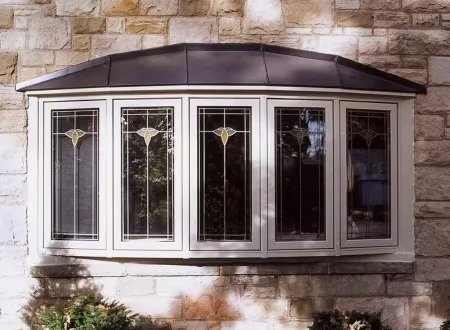
Walk down almost any street of Victorian or Edwardian terraces in Glasgow, and you’ll see the same feature again and again: a bay window pushing out from the front room, catching the light from three sides instead of one. Glasgow’s bay windows are one of the most recognisable parts of the city’s older housing stock, found on tenements, terraces and villas alike. But homeowners with bay windows tend to notice something their neighbours with flat windows don’t: more draughts in winter, and more condensation on the glass too.
There’s a reason for that, and it comes down to simple physics rather than bad luck or a faulty window.
Why Heat Escapes More Easily Through a Bay Window?
A bay window sticks out from the main wall of the house, creating exposure to wind and cold in three directions, as opposed to one. The wind will tend to hit a flat surface and just push against it. With a bay window, the wind hits a larger surface area and circulates all sides, losing more heat in the process.
There’s also the frame itself to consider. A bay window Glasgow typically has roughly three times the frame perimeter of a flat window covering the same floor space, and frames, even good modern uPVC ones, generally insulate less well than the glass sitting inside them. More frame means more of the weaker insulator relative to the stronger one. The corner posts where the angled panels meet are a particular weak point too, since getting a perfect seal at an angled joint is harder than sealing a single flat edge, which is why draughts often show up specifically at those junctions rather than in the middle of a pane.
All these additional components of a bay window (extra glazing, frames, corner joints, and sometimes insulation voids in the floor and/or roof above the bay) lead to heat loss in bay windows, which is as much as two to three times higher than that of a flat window of equivalent size.
Why Condensation Tends to Collect on or Around Bay Windows ?
As previously mentioned, the design of a bay window creates a greater potential for the window to collect water in the form of condensation. Being made up of more glass than other window designs and having frames made of materials of a greater thickness than other window designs leaves bay window designs more vulnerable to collecting water. Flat windows, on the other hand, are set in thicker wall designs and are therefore less exposed to it.
The shape of a bay also works against good airflow. The recessed area, especially if it’s dressed with curtains or blinds, traps a pocket of air that doesn’t move much. Moist air sitting still against cold glass overnight is exactly the condition condensation needs, and it’s often worse behind heavy curtains that are kept closed right through the evening and morning.
How the Age and Construction of a Home Plays a Part
Not all Glasgow properties handle heat and moisture the same way, and a lot of that comes down to how the building itself was put together.
Many of the city’s tenements and terraces were built with solid sandstone walls and no cavity for insulation. Solid walls like these behave very differently to the cavity-wall construction used in most homes built from the mid-20th century onward. Without a cavity to slow heat transfer, a solid stone wall loses warmth more readily, and the bay window set into it often ends up as the weakest point in that whole wall, since it already has more glass and frame than the stonework around it.
This is part of why bay windows in Glasgow’s older tenement stock tend to show heat loss and condensation issues more visibly than similar windows in a newer, cavity-wall property.
Practical Things a Homeowner Can Do
None of this means a bay window is a lost cause. A few simple habits make a real difference to how much condensation builds up day to day.
A major factor in controlling the amount of moisture that accumulates on the windows is making sure the air around the windows is not too cool. Leaving a window open for a short period of time helps achieve this, especially if it is done on a daily basis. A drip or fan vent helps achieve the same outcome by allowing air to escape from the window. If these elements are blocked, moisture will still build up on the windows and frames.
It’s important to clean the glass each morning to remove condensation that built up during the night. If it’s not cleaned, it will eventually run down into the window frame and possibly stain it. Also, if you slightly open your curtains or blinds during the day, it will help keep a constant circulation of air moving through the window frame, instead of allowing air to stagnate against the window.
According to Historic Environment Scotland, if the window is left open a small amount, it will also help to minimize condensation. It is also important to keep the window frames in good condition, because if they are in poor condition, it will allow condensation to build up even more.
When It’s Worth Having a Bay Window Assessed?
Day-to-day habits go a long way, but they won’t fix everything. A few signs suggest it’s time to get the window looked at by someone who knows what they’re dealing with, rather than continuing to manage the symptoms.
Persistent black mould around the frame or sill, even after regular ventilation and wiping down, usually points to a problem that basic habits alone won’t solve. The same goes for frames that feel soft or are visibly rotting, since that’s often moisture that’s already got into the timber over time. And if draughts are still noticeable after checking seals and closing off obvious gaps, the window itself may no longer be doing its job properly.
At that point, professional bay window installation is worth considering through a company like Trade uPVC Windows & Doors, since a professional can tell if the windows have surpassed the point of no return (meaning they cannot be maintained). Professional installation would help get a good assessment of the window frame and seals, and better window glazing if needed.
A Feature Worth Preserving
Bay windows are one of the things that give Glasgow’s older streets their character, and understanding why they behave differently to a flat window isn’t a reason to see them as a problem. It just helps explain what’s actually happening when the glass mists up on a cold morning, or a draught creeps in along the frame. With the right habits and the right advice when it’s needed, a bay window can stay both a practical part of the home and one of its nicest features.