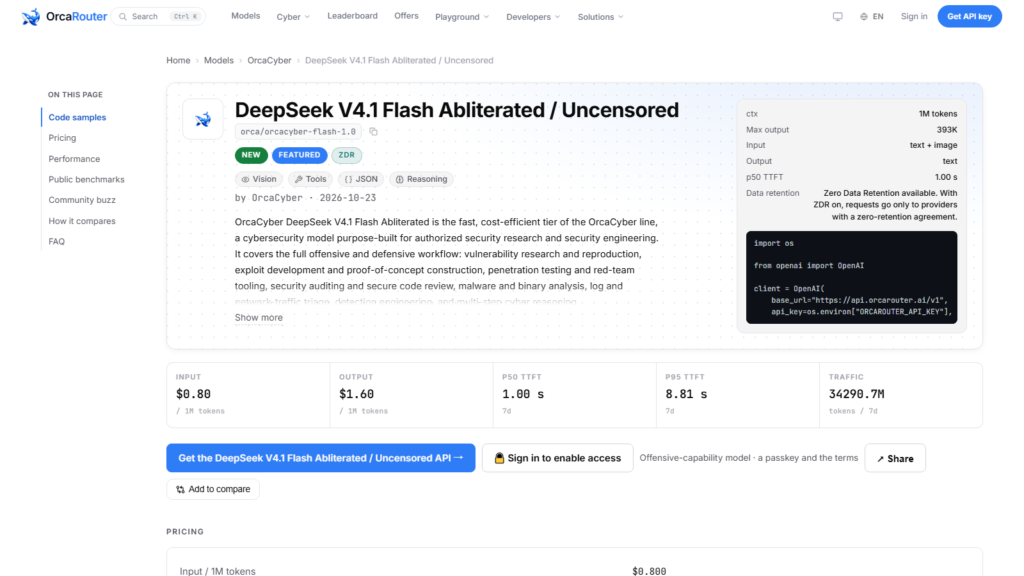
Two words sit on the same eleven cards, and they are not synonyms. “Abliterated” describes the weights: a directional edit applied to an open checkpoint to remove the behaviour that produces refusals. “Uncensored” describes what you get from the endpoint. On OrcaRouter, eight of the eleven cards on the cyber tier’s abliterated cards carry both words in the display name, and their model ids all start `orca/orcacyber-`, which is the prefix a buyer can actually filter on [OURS].
The distinction is not pedantry. It decides which benchmark rows mean anything, which error rate you are reading, and whether the thing you are buying can be reproduced from a public checkpoint.
What abliteration does to the weights
A refusal is a behaviour the model has learned, and it is largely carried by one direction in the residual stream. The abliteration procedure estimates that direction from a set of harmful and harmless prompts, then projects it out of the weight matrices. Nothing is retrained, nothing is added, and no new data enters the model.
Two properties follow, and both are visible on our cards.
The checkpoint is the same size. DeepSeek V4.1 Flash abliterated carries 1,048,576 tokens of context and a 393,216-token output ceiling against the base checkpoint’s 384,000 — equal or slightly larger, never smaller [OURS]. An edit that removed capacity would show up in those two rows. It does not.
The capability scores are inherited. Every benchmark row on that card was evaluated on 2026-09-09, before the card existed; they are the base checkpoint’s numbers with the base checkpoint’s capability profile [VENDOR].
What “uncensored” adds at the endpoint
The endpoint layer is separate, and it is where most buyer confusion lives. A hosted “uncensored” model still passes through a provider’s request path: authentication, tier checks, a use band, sometimes content classification.
Our eight abliterated cards are all `locked: true`, `required_tier: sec-uncensored`, `required_band: offensive` [OURS]. That is an access control, not a refusal. A call that clears it reaches the weights, and the weights no longer contain the refuse direction.
The practical consequence is that “uncensored” describes a path that has been opened, not a model that has been changed. If you move the same weights to an endpoint with a different gate, the weights are unchanged and the experience is not.
Why the two words get merged
Because in practice, on most surfaces, they arrive together. A card that has had its refusals removed is usually offered behind a gate that a general-purpose card is not, so the buyer experiences one change: they can now get answers they could not get before.
Our telematic rows show the merge from the other side. GLM 5.3 abliterated reports a 16.110% error rate over the seven days to 2026-11-15, against its base checkpoint’s 0.582% [OURS]. That gap is not a model defect. The gate rejects requests it will not serve, and a rejected request is counted as an error. The card’s error rate is therefore a measure of onboarding friction, not of reliability.
Kimi K3.1 Pro abliterated sits at 1.306% against its base’s 6.545% — the opposite direction, because its base is the noisier endpoint [OURS]. Two cards, two signs, one explanation: the row is about the path, not the weights.
What the label does not tell you
It does not tell you the model can do the security job. Every one of the eight is a general-purpose checkpoint with a direction projected out. CyberGym is reported on four of them, at 88.1, 95.1 and two cards with no rows at all; SEC-Bench Pro on two, at 62.8 and 47.5 [VENDOR].
Those gaps are large enough that the label is not a quality signal. It says what has been removed, not what remains.
It also does not tell you the model is safe to expose. Removing refusal behaviour removes the model’s own brake, and an endpoint that is reachable by a compromised key has no brake left except the gate in front of it.
The three rows that move, and the five that do not
Across the eight abliterated cards, three serving rows move in both directions and five do not.
Median latency improves on six of the eight cards relative to their base checkpoints and worsens on two — Kimi K3.1 Pro at 1,989 ms against 1,588 ms, GLM 5.3 Flash at 3,919 against 3,750 [OURS]. Throughput falls on five of the eight and rises on three: Hy4 goes from 39.9 tokens a second to 173.7, MiniMax from 54.7 to 129.9, DeepSeek from 183.8 to 186.1. Error rates move by factors, not percentages: GLM 5.3 from 0.582% to 16.110%, MiMo from 60.595% to 0.938%, Kimi from 6.545% to 1.306% [OURS].
The five rows that do not move are context window, output ceiling, modality set, tool support and parameter surface. Seven of the eight cards keep at least one of their checkpoint’s two size limits exactly; six keep both. GLM 5.3 Flash gains 3,072 output tokens and 48,576 context tokens, DeepSeek gains 9,216 output tokens, Hy4 gains 1,536, and MiniMax loses both by 75%.
That distribution is the useful part of the label. An abliterated card is not a weaker product in general; it is a product that has moved along three serving axes and stayed still along five capability axes. Which of the three mattered is a question about your workload, and the label cannot answer it for you.
What to ask before you buy one
Three questions, in order, and each has an answer in the public payload.
Does the card keep its checkpoint’s context and output ceiling? If a workflow needs a million tokens and the card has 262,144, the price is irrelevant. Does its error rate come from the gate or from the model? Compare it against the base checkpoint’s rate — a card that errors less than its base is a card whose base was the noisier endpoint. Does its benchmark block belong to it? Look at the evaluation date against the release date on the same page.
None of these require the vendor to answer anything, and all three are on the card before you spend a token.
The short version
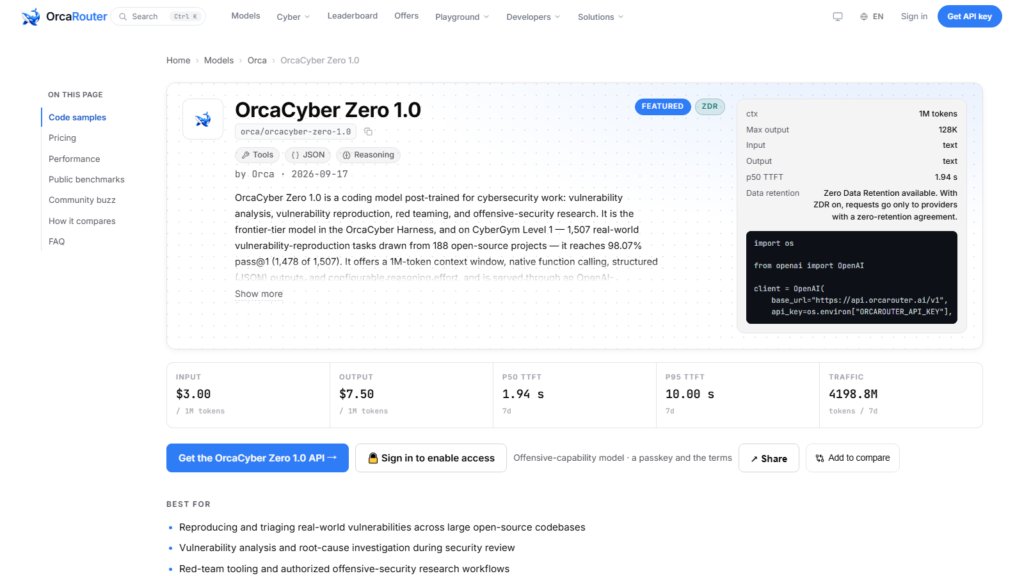
Abliterated is a fact about the weights; uncensored is a fact about the endpoint. On our tier the eight cards that carry both words are open checkpoints with one direction projected out, sitting behind a tier and band gate, at prices from $0.80 to $4.00 in.
Three cards on the same shelf — Zero 1.0, Zero 1.5 and Ultra 1.0 — are post-trained security models. Their cards never use either word, and their benchmark rows describe themselves rather than a base checkpoint [OURS, VENDOR for the rows].
If you take one thing from the label, take this: it tells you what was subtracted. It does not tell you what is left, and the row that would tell you — an independent capability score for the abliterated build — does not exist on any public leaderboard we could find.
Sourcing note: prices, context windows, output ceilings, modalities, quality scores, latency, throughput, error rates and traffic are read from the eleven cards’ public model data on 2026-11-15, with seven-day windows ending that day [OURS]. Access flags are read from the same payload. Benchmark rows are OrcaCyber’s own and are dated where quoted [VENDOR]. No independent score for any abliterated build was found; the rows quoted are inherited from the base checkpoints.