Two founders launch skincare brands in the same month.
The first invests in branding: a clever name, a soft palette, scroll-stopping reels. Traffic pours in. But the app hides prices behind a sign-up, and the OTP never arrives. Most visitors leave at checkout.
The second invests in UI/UX: a fast, clean app with three-tap checkout. But it looks like every other store. Customers buy once with a coupon, then move on.
Both lose customers, for opposite reasons. One won attention but couldn’t serve it. The other served people well but was easy to forget.
Wishbox Studio is a branding agency with more than 15 years and over 700 brands behind it. It is also a UI UX design company in Delhi NCR. Here it explains why businesses need both.
UI/UX vs Branding: What’s the Difference?
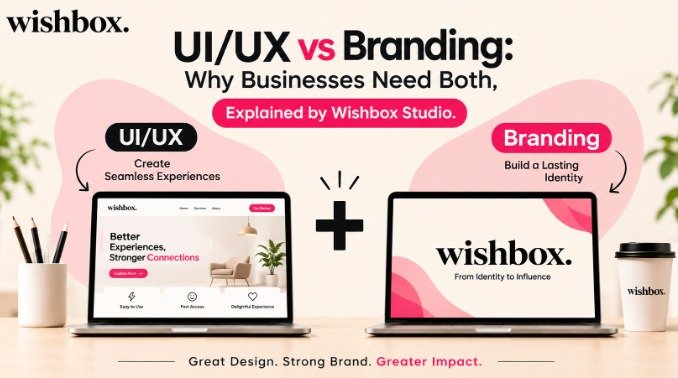
Branding is what people think and feel about your business. It covers your name, story, voice, logo, colours and values. It answers one question: Why should I choose you?
UI/UX is how people use your website or app. UI (user interface) is what they see and tap: layout, text and buttons. UX (user experience) is how easily they get things done: the steps, the flow and the effort. It answers a different question: Can I easily do what I came here for?
Simply put, branding makes a promise. UI/UX delivers it.
Why Businesses Need Both UI/UX and Branding
Each one does a job the other can’t. Here is what goes wrong when you have only one, and what changes when you have both.
1. Branding Brings Customers In. UI/UX Turns Them Into Buyers.
Branding creates interest. But every rupee spent on awareness lands on a screen, and if that screen confuses people, the interest is wasted. Baymard Institute puts average cart abandonment at about 70%. It estimates the average online store could raise its conversion rate by 35% through better checkout design alone.
The test: Is traffic growing while sales stay flat? Then your branding is working and your interface isn’t.
2. UI/UX Makes You Easy to Use. Branding Makes You Hard to Replace.
Features can be copied. What competitors cannot copy is the trust people feel for you. In Salsify’s 2026 survey of nearly 3,000 shoppers, 68% said they had paid more for a product in the past year because they trusted the brand. Without a brand, even a great experience ends up competing on discounts.
The test: If a rival copied your app tomorrow, why would customers stay with you?
3. Customers Judge Your Brand and Your Interface Together
Businesses treat branding and UX as separate departments. Customers don’t. Carleton University researchers found people form a view of a website’s visual appeal within the first 50 milliseconds. That first reaction then shapes how usable and credible they believe the site is. A dated, off-brand design makes even a good product seem harder to use.
The test: Show your homepage to someone new for five seconds. Can they tell what you sell and whether it looks easy to use?
4. Your Interface Must Keep the Promise Your Brand Makes
Branding raises expectations. If the experience falls short, customers don’t just leave. They feel misled. Salsify also found that 45% of shoppers had returned a product because its content didn’t match reality. If your ads say “effortless” and your app needs nine steps, trust breaks.
The test: List three promises your ads make. Can a new user experience each one in their first minute?
5. Designing Both Together Saves Time and Money
When one agency creates the brand and another builds the app, the brand’s intent gets lost in the handoff, and fixing it later costs money. When the two are designed together, the brand idea shapes the interface itself.
For Soorahi, a homegrown whisky from Uppal Brewers & Distillers, Wishbox built the name from the Hindi words for “good” and “traveller”. Its website uses a discovery-led layout, so browsing feels like the journey the brand stands for.
The payoff shows in the numbers. McKinsey tracked the design practices of 300 listed companies over five years. The top design performers had revenue growth 32 percentage points higher than their industry peers.
The test: Do your developers build new screens from a design system, or from a logo file and guesswork?
How Wishbox Studio Brings Branding and UI/UX Together
Because Wishbox is a branding agency first, its UI/UX work starts from your brand strategy, not a template. The team researches real users and maps the flows before designing screens. It shapes every interface around your identity and tests prototypes with real users before development. It then hands over a design system so future screens stay on-brand.
Are you launching, redesigning or stuck with flat conversions? Share a short brief with the UI UX design company in Delhi NCR behind Soorahi, and get an honest audit of where your brand and your interface disconnect.
FAQs
Can a small business afford both branding and UI/UX?
Yes, if you size it to your stage. Clear positioning and a core identity, plus one simple, tested buying or booking flow, will outperform a lavish logo on a clumsy website.
Which should come first, branding or UI/UX?
Brand strategy should lead, because the interface draws on it. But the two should overlap, not run as separate projects months apart.
How long does a UI/UX project with Wishbox take?
A UX audit takes one to two weeks. A single feature or flow takes three to five weeks. A full product, from research to design system, takes eight to twelve weeks.