Why Retirement Savers Are Looking at Silver
In more than twenty years of working with American retirement savers, I have never seen as much interest in silver IRAs as I have in 2026. Silver has been trading well over $50 an ounce much of this year and many investors desire to have a portion of their retirement funds invested in a hard asset they can easily measure by the ounce, not the dollar.
Most silver IRA advice ends with a mention of “purchase approved coins. The criteria that will determine if a silver IRA is successful are the qualification requirements, any fees associated with the above metal value and the process for storing and ultimately withdrawing it. Here are the first things that experienced buyers ask about.
What “IRA Approved” Really Means
The IRS does not approve or stamp any coin or bar. The term “IRA approved” is industry shorthand for metal that meets Section 408(m) of the Internal Revenue Code. That section treats most collectibles held in an IRA as a taxable distribution. It then makes two important exceptions.
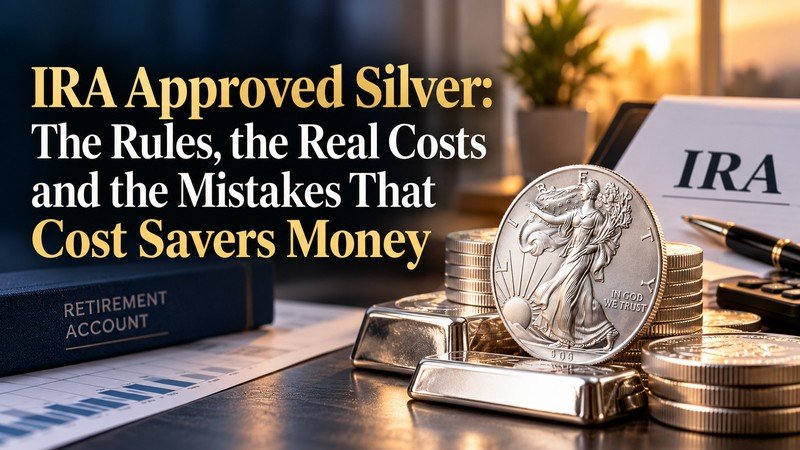
The first covers certain US Mint coins, including the American Silver Eagle. The second covers silver bullion that is at least .999 fine and held by a qualified trustee or custodian. That second rule is why the Canadian Maple Leaf, Austrian Philharmonic, Australian Kangaroo and bars from accredited refiners qualify.
This is also where many buyers get caught out. Pre-1965 “junk” silver, Morgan dollars and Peace dollars are 90% silver, so they do not qualify, however classic they are. Before you fund an account, work from a list of IRA approved silver that matches both the fineness rule and your custodian’s own accepted-product list.
The Cost Math Inside a Silver IRA
If you’re keeping your investment in a taxable account, a collector premium might be a way to pay off later when you sell to another collector. Metals are typically sold or distributed in an IRA at close to the bullion value. This is a case for paying the highest price possible for the car when you buy it. Always compare to the current spot price of silver, not other coin prices.
Since silver is now selling for $54.47, here are a few BOLD Precious Metals listed prices:
| Product | Listed price (USD) | Premium over spot |
| 2026 Canadian Maple Leaf, 1 oz | $57.87 | ~6% |
| 2026 Australian Koala, 1 kilo | $1,873.47 | ~7% |
| 2026 American Silver Eagle, 1 oz | $58.42 | ~7% |
| 1987 American Silver Eagle, 1 oz | $68.97 | ~27% |
| 2013 American Silver Eagle, 1 oz | $70.97 | ~30% |
| 2026 British Britannia, 1/10 oz | $7.33 | ~35% |
It’s a simple rule: “don’t buy into the story; buy the ounces.” The extra premium inside an IRA, for a dated 1987 or 2013 Eagle, makes sense for a personal collection but remains mostly with the seller. The fractional coins are the same.
Fees are also based on the same principles. Many custodians and depositories have a flat annual fee, a burden on smaller accounts. For example, $250 a year is a 2.5% annual drag on a $10,000 account, but only 0.25% on $100,000. Request the complete fee schedule prior to opening an account.
Four Mistakes I See Every Year
-
Storing IRA Silver at Home
“Home storage IRA” pitches still circulate, but the US Tax Court rejected the idea in McNulty v. Commissioner (2021). When the account owner took personal possession of the metal, the court treated it as a taxable distribution. IRA metal belongs in an approved depository, held by your custodian.
-
Buying the Metal Yourself First
Buying the coins in person and transferring them into your IRA isn’t possible. The custodian is required to purchase the metal on the account and to ship it directly to the depository.
-
Doing the Wrong Kind of Rollover
A 60-day indirect rollover falls under the once-per-year rule and has a strict deadline. A direct trustee-to-trustee transfer avoids both problems and is the cleaner way to move retirement funds into silver.
-
Ignoring the Withdrawal Phase
Required minimum distributions begin at age 73 for most savers. You can sell metal to cover them or take coins out “in kind” and pay tax on their value. Holding standard 1 oz coins and bars makes either choice simpler than holding one large, hard-to-split bar.
The Bottom Line
A silver IRA is best used as a bullion account rather than a coin collection. Select a .999 fine product that is accepted by your custodian, ensure premiums are at premium close, store the metal appropriately and exit planning should be done in advance. Take those four steps and silver can take a disciplined part in your retirement dollars.
BOLD Precious Metals has a variety of coins and bars that are eligible, ships directly to IRA depositories fully insured, and can match you up with trusted custodians.
This article is provided with no expectation of it being tax, legal or financial advice. Speak with a qualified tax expert and your IRA custodian before making IRA decisions.