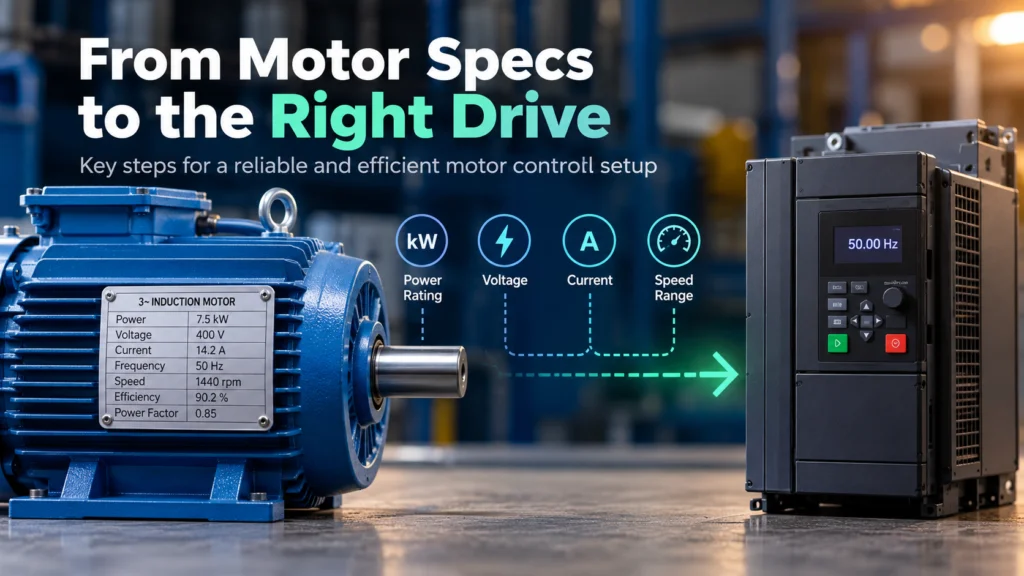
Choosing a VSD based on the kilowatt rating of the motor is an important step in designing a reliable motor control system. However, matching the drive to the motor includes more than choosing two components with the same power rating. Rated current, supply voltage, motor characteristics, load profile, acceleration requirements, and operating environment all affect the drive selection.
An incorrectly sized variable speed motor can trip under normal operating conditions, struggle to start a loaded motor, or experience excessive thermal stress. Conversely, an unnecessarily oversized drive can increase installation costs without delivering meaningful performance benefits.
Step 1: Understand the Relationship Between Motor kW and Drive Rating
A motor’s kW rating represents its rated mechanical output power at the shaft. A variable speed drive controls the electrical supply to the motor, adjusting output frequency and, where appropriate, voltage to regulate the speed of the motor.
However, the motor and drive ratings are closely related; their kW values do not show the full calculations.
The input power is higher than the mechanical output because of electrical and mechanical losses. For a three-phase motor, approximate input power can be calculated using:
P = √3 × V × I × PF
Where:
- P = electrical input power in watts
- V = line-to-line supply voltage in volts
- I = line current in amperes
- PF = motor power factor
For a more complete calculation of input power, the efficiency of the motor must also be considered when starting with mechanical power output.
Step 2: Check the Motor Nameplate
Before choosing a drive, it is important to document the motor nameplate as it provides the electrical data which is required to select a compatible drive. Before comparing products, record the following parameters.
| Motor Parameter | Why it matters for drive selection |
| Rated power (kW) | Establishes the motor’s nominal mechanical output |
| Rated voltage (V) | Must be compatible with the drive’s output voltage and supply configuration |
| Rated current (A) | Determine whether the drive can supply the motor’s required current |
| Rated frequency (Hz) | Establishes the motor’s base operating frequency |
| Rated speed (rpm) | Helps determine the required speed range and control settings |
| Power factor | Helps explain the relationship between current and real electrical power |
| Efficiency | Influences the motor’s electrical input power and operating losses |
| Connection configuration | Star or delta configuration must be compatible with the supply and drive output |
For dual-voltage motors, the nameplate may specify different voltage and current values for star and delta connections. The correct configuration depends on the drive’s output voltage and the motor manufacturer’s instructions.
A motor rated for 230 V delta and 400 V star, for example, must be connected appropriately when used with a drive supplying 400 V three-phase output. Incorrect wiring can result in unsuitable voltage being applied to windings.
Step 3: Match the Drive’s Rated Output Current to the Motor
Rated output current is one of the most important criteria when choosing a drive. A motor’s current demand depends on the power rating, voltage, efficiency, power factor, and operating load.
The drive output current must be checked against:
- The motor’s rated current
- The drive’s continuous output current rating
- The overload current and duration required by the application
- Any derating caused by ambient temperature, altitude, switching frequency, or enclosure conditions
A drive’s input current rating is not an alternative for its output current rating. The two describe different parts of the electrical system.
When comparing motor inverter drives, check the manufacturer’s technical datasheet for the exact model, supply voltage, and duty rating.
Step 4: Calculate the Required Drive Capacity
A practical drive-sizing assessment starts with the motor nameplate and progresses to the application’s operating requirements.
- Establish the motor’s rated power
- Confirm the supply and output voltages
- Compare rated currents
- Assess overload requirements
- Check the speed range
- Apply installation derating
- Verify protection and control requirements
This process helps prevent a common selection error: buying a drive that matches the kW rating of the motor but cannot support its current demand or application duty.
Step 5: Understand Constant Torque, Variable Torque, and Low-Speed Operation
For a conventional induction motor that is operating below its base frequency, a suitable scalar control strategy can maintain an approximately constant voltage-to-frequency ratio. This can support approximately constant torque within the motor and drive’s operating limits.
A standard self-cooled motor relies on a shaft-mounted fan. When the motor operates continuously at low speed, the fan slows down, reducing cooling airflow. The motor may therefore need to be derated or fitted with independent cooling to deliver sustained torque at low speeds.
Above the motor’s base frequency, the drive may reach its voltage limit and enter field weakening. Available torque generally decreases as speed rises, and the motor’s permissible mechanical speed must be respected.
Before selecting a drive for wide-range speed control, establish whether the motor is suitable for inverter operation and whether its insulation systems, bearings, cooling, and mechanical limits meet the application’s requirements.
Step 6: Consider Supply Voltage, Phases, and Installation Conditions
Drive compatibility also depends on the electrical supply and the installation environment. A 400 V three-phase drive is not automatically interchangeable with a 230 V single-phase-input drive, even if both products list a similar motor power rating. Input supply, rectifier design, DC bus voltage, and output-current capability differ between models. Other considerations include:
- Supply phase: Verify whether the drive needs single-phase or three-phase input.
- Protective devices: Select fuses, circuit breakers, and cable sizes according to the manufacturer’s instructions and applicable electrical standards.
- EMC requirements: Assess electromagnetic compatibility, cable screening, earthing, and any required filters.
- Motor cable length: Long motor cables can increase voltage stress and reflected-wave effects, potentially requiring an output reactor or a suitable dV/dt or sine-wave filter.
- Enclosure and cooling: Confirm the drive’s IP rating, ambient temperature limits, and ventilation requirements.
- Harmonics: Consider the effect of the drive’s input rectifier on the supply network, particularly in installations with multiple drives.
Common Mistakes When Matching a Drive to a Motor
It is crucial to avoid these frequent errors when specifying a replacement drive or designing a new motor control system.
| Common Mistake | Potential Consequences | Correct Approach |
| Matching kW ratings only | Drive may be undersized for the actual current demand | Compare rated output current along with duty class |
| Ignoring overload requirements | Trips during starting or load changes | Assess acceleration torque and overload duration |
| Confusing input and output current | Incorrect model selection | Use the drive’s output-current specification |
| Overlooking low-speed cooling | Motor overheating during continuous low-speed operation | Verify cooling and permissible torque |
| Ignoring supply configuration | Electrical compatibility | Check input voltage, phase, and output ratings |
| Selecting a drive without considering derating | Reduced available output current | Apply manufacturer-specified derating |
| Assuming every motor supports inverter operation | Insulation, bearing, or thermal problems | Verify motor suitability and operating limits |
Variable Speed Drives vs. Motor Inverter Drives: Which One to Choose
The terms variable speed drive, variable frequency drive, and inverter drive are often used interchangeably for AC motor applications. In practice, product terminology varies by manufacturer and product range.
A conventional AC VFD changes the output frequency and voltage supplied to an AC motor. Depending on the control method, it can regulate speed, manage acceleration and deceleration, and support different torque requirements.
DC motor controllers are a different product category. They regulate the armature voltage and, where applicable, field current of DC motors. An AC inverter drive should not be assumed to be a direct replacement for a DC drive.
Where to Buy Inverter Drives Online
Engineers and maintenance teams who are looking to buy inverter drives online should prioritise suppliers that provide clear technical specifications, model-level documentation and access to compatible accessories.
Before buying, establish the motor’s kW rating, full-load current, supply voltage, load type, overload requirement, and operating speed range. These details help narrow the product selection and reduce the risk of buying a drive that is electrically compatible but unsuitable for the application.
If you need to buy variable frequency drives, compare the manufacturer’s continuous output-current rating, overload capability, control modes, braking options, and installation requirements. Also check whether the selected model needs an EMC filter, line reactor, braking resistor, or additional thermal management.
A technically suitable drive should meet the requirements of the application without relying on unverified assumptions about nominal kW ratings.
Conclusion
Matching a variable speed drive to a motor’s kW rating needs a structured assessment of electrical ratings, load characteristics, and installation conditions. The motor’s rated current, continuous output of the drive, overload capacity, supply configuration, and thermal limits are all essential parameters.
The most reliable approach is to begin with the motor nameplate, assess the actual load profile, and verify the selected drive against the manufacturer’s technical documentation. This helps in establishing a compatible motor-drive system that delivers the required speed and torque control without unnecessary oversizing.
If you are replacing an existing controller or specifying a new installation, use the complete application requirements to guide your selection process when you buy variable speed drives from UK suppliers or buy inverter drives online. A correctly specified drive supports reliable operation, predictable commissioning, and long-term equipment performance.