On 14 August 1822 the royal yacht dropped anchor off Leith in pouring rain, and a small boat put out from the harbour carrying the most famous Scotsman alive.
King George IV was on deck. He was sixty, enormously fat, widely disliked in London, and the first reigning monarch to come to Scotland in a hundred and seventy years. When he was told who was in the boat he shouted, “Sir Walter Scott! The man in Scotland I most wish to see. Let him come up!” Whisky was called for. The King drank the novelist’s health, and Scott asked if he might keep the glass His Majesty had drunk from. He wrapped it carefully and put it in the tail pocket of his coat. Scott was about to dress a king and a kingdom in tartan, though the red Scott tartan that bears his own name was one he would have nothing to do with.
He then went home, found an unexpected guest waiting in his drawing room, sat down to greet him, and gave a yell. He had forgotten the glass. It was the only thing that went wrong for him in the whole fortnight.
The King’s jaunt
Scott had been given a few weeks to organise the visit, and he treated it as the greatest work of fiction of his career.
He decided that Scotland would present itself to its King as a Highland nation. This was a bold idea. Only a lifetime earlier the Highland clans had marched on London to overthrow this King’s great-grandfather, and tartan had been banned by law. Most Scots were Lowlanders who had never worn a kilt and regarded Highlanders with suspicion. Scott swept all that aside. He wrote an anonymous pamphlet instructing the citizens of Edinburgh how to behave and what to wear. He summoned the Highland chiefs to the capital with their “tails” of armed clansmen. He had the gentlemen of the city scrambling to find out what their family tartan was supposed to be, and the weavers of Bannockburn working their looms day and night to supply them.
Then he dressed the King. At the great levee at Holyroodhouse on 17 August, George IV appeared in the full Highland dress of a chief, in bright red Royal Stewart tartan, with pistols, dirk and broadsword. The outfit had been made by George Hunter & Company of Edinburgh and the bill came to £1,354 and eighteen shillings, the price of a good house. The kilt, unfortunately, had been cut rather short for a man of the King’s build, and to preserve the royal dignity he wore under it a pair of flesh-coloured tights.
Edinburgh society was torn between awe and hysterics. One lady, asked what she thought, replied with perfect composure: “Since he is to be among us for so short a time, the more we see of him the better.”
Scott’s own son-in-law thought the whole business a “hallucination.” It did not matter. For two weeks there were processions, balls, banquets and reviews, all of them drenched in tartan, and when the King sailed away the thing was done. The kilt, which had been the dress of a feared and defeated minority, had become the national costume of all Scotland. It has been ever since.
A Border name
The man who brought this off was not a Highlander. He was about as far from one as a Scot can be.
The Scotts are a riding family of the Borders, the hill country along the English frontier. From their strongholds in Teviotdale and Ettrick they took a hearty part in the raiding of the sixteenth century, when cattle, sheep and prisoners went back and forth across the line by moonlight and the families who lived that way were called reivers. Their chiefs were the Scotts of Buccleuch, who rose from lairds of Branxholme, near Hawick, to be earls and then dukes. The present Duke of Buccleuch is chief of the name. The gathering cry was “A Bellendaine!”, from the hill where the clan mustered. The crest is a stag, and the motto is a single word: Amo, I love.
The best-loved story in the family’s history dates from 1596. A notorious reiver called Kinmont Willie Armstrong had been seized by the English on a day of truce, against all Border law, and locked in Carlisle Castle. Walter Scott of Buccleuch, the Keeper of Liddesdale, asked politely for him back and was refused. So he rode to Carlisle on a black, wet night with eighty men, got into the castle by a postern gate, carried Kinmont Willie out in his irons, and was back across the border by dawn. By the traditional account not a life was lost on either side. Queen Elizabeth was furious. When Buccleuch was later presented to her and she asked how he had dared, he is supposed to have answered: “What is it that a man dare not do?”
Sir Walter, born in Edinburgh in 1771, descended from a junior branch, the Scotts of Harden. He collected the old Border ballads before he ever wrote a line of his own, and the ballad of Kinmont Willie was one of them.
The tartan he turned down
Seven years after the King’s visit, in 1829, a friend wrote to Scott with thrilling news. Sir Thomas Dick Lauder had been shown a manuscript, said to be centuries old, that gave the true ancient tartans of the Scottish families. It included the Lowland and Border names. There was one for Scott.
Sir Walter’s reply was brisk. He would like to see the original manuscript, which somehow was never produced. And he pointed out that the Scotts were Borderers, that Borderers had never worn tartan in their lives, and that he wanted nothing to do with it. His clansmen ignored him, and today plenty of them order the red sett as an outfit kilt, the kilt sold complete with jacket, sporran and hose.
So the man who had put all Scotland into tartan refused one for himself. He was right about the manuscript, too. It belonged to two brothers calling themselves Sobieski Stuart, who published it in 1842 as the Vestiarium Scoticum, and scholars have long since shown it to be a fabrication.
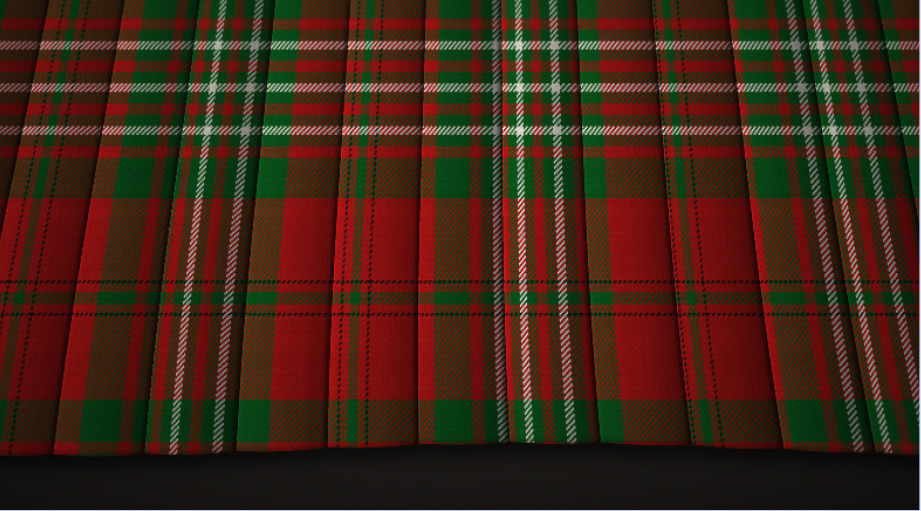
His clansmen have been happily ignoring his advice ever since. The red Scott from that book is, in the words of the tartan register, “the most popular Scott tartan in modern times.” It has a bright red ground with broad green bands, the green crossed by narrow lines of red and white, and a fine black line for definition. The tartan historian Jamie Scarlett spotted something delightful about it: the design seems to be derived from the MacGregor tartan recorded in 1819. Scott, through his novel Rob Roy, was the greatest publicist Clan Gregor ever had. His family’s tartan may be a quiet compliment borrowed from theirs.
There is a Green or Hunting Scott for those who want something darker, and a black and white check based on the Border shepherd’s plaid, which Sir Walter really did wear. But when people say Scott tartan they mean the red, and retailers stock it widely, in Modern, Ancient and Weathered colours, as kilts, trews, skirts, waistcoats and scarves, and by the yard.
Melrose, a Saturday in May
The wedding is at two o’clock in the ruins of Melrose Abbey, a few miles down the Tweed from the house Sir Walter built at Abbotsford. The groom is Andrew Scott, thirty-one, from Toronto. His great-grandfather left Hawick in 1911. Three generations of Scott men are getting dressed in a hotel on the square, and they have made three different decisions.
Andrew worked out early that a kilt is only half a story. Highland dress is a system, and once the kilt itself is chosen, everything else follows from one question: how formal is the day? At the top of the scale is the Prince Charlie jacket, short and black with satin lapels and silver buttons, worn with a bow tie, which is the equivalent of black tie. One step down is the Argyll jacket, longer and plainer, with an ordinary collar and a long tie, right for nearly any wedding. Below that is tweed, for the country.
Putting all that together piece by piece from different shops is how men end up with a waistcoat one shade off the kilt. So Andrew did what most grooms now do. He went to a specialist that sells complete packages for grooms, groomsmen, fathers and guests, with the outfit kilt, jacket, waistcoat, sporran, hose and accessories all supplied together, and the tartan pieces cut from a single run of cloth so that every red matches. One set of measurements, one delivery. He had the whole party measured the same week and ordered three months ahead.
For himself he chose the Argyll package, in charcoal, over the red Scott kilt, with bottle-green hose, red flashes and a black leather sporran. It is an afternoon wedding in a ruined abbey, and a Prince Charlie would have been too much before six.
His younger brother, the best man, is in the same.
His father is sixty-four, was born in Ontario, and announced in January that he had not shown his knees in public since 1978 and did not intend to start. Andrew had an answer ready, and Sir Walter would have approved of it. Borderers never wore the kilt. What Lowland gentlemen and Lowland regiments have worn for centuries is trews: close-cut tartan trousers, which as a garment are in fact older than the kilt. Trews with an Argyll or Prince Charlie jacket are fully accepted as formal Highland dress, and the same outfitters sell trews packages alongside the kilted ones. So his father is in red Scott trews with a black Argyll jacket, looks like a retired colonel, and is more pleased with himself than he will admit.
And then there is Andrew’s grandfather, who is ninety and has flown the Atlantic for this. He is wearing a dark suit, because at ninety he will wear what he likes. But his tie is red Scott, and so is the rug over his knees in the wheelchair.
At ten to two they walk across the square to the abbey, a kilt, a kilt, a pair of trews and a tartan rug. The piper strikes up. A coachload of tourists stops to take photographs.
The grandfather looks round at the three of them with great satisfaction.
“Sir Walter said we had no business wearing this,” he says.
“He did,” says Andrew.
“Man was a fool,” says his grandfather. “Wrote a good book, mind.”
The invention of tradition
Walter Scott knew better than anyone that traditions are made by people. In August 1822 he took a costume that most of his countrymen had never worn, put it on a fat Hanoverian king in pink tights, and by sheer force of imagination turned it into the dress of a nation. Seven years later, on a point of historical accuracy, he refused to wear it himself.
He won the first argument and lost the second. The Borderers did not wear tartan in the days of Kinmont Willie. They have worn it now for the better part of two hundred years, at every wedding from Hawick to Toronto, and the red sett that Sir Walter turned down has been to far more of them than he ever was.