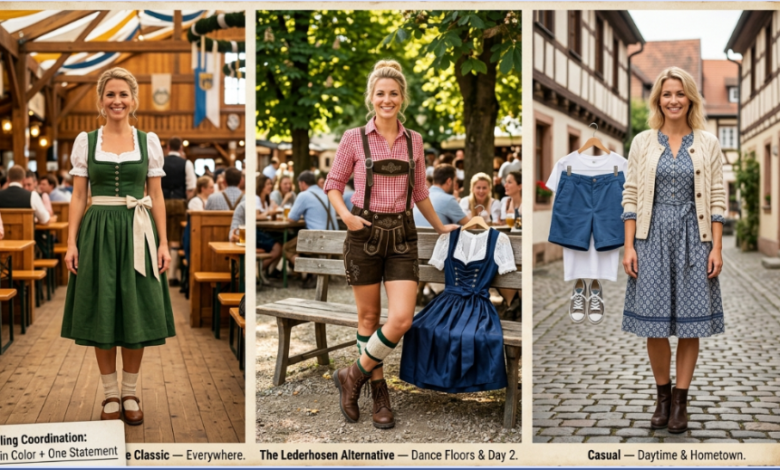
The women’s festival wardrobe is richer than the single-image version suggests — and easier, once it’s laid out as the register it actually is. Oktoberfest outfits for ladies run a full range with proven builds at every point: the classic dirndl look that owns the photographs, the lederhosen alternative that owns the dance floor, the elevated builds for evening tables and weddings’ festival events, and the genuinely casual configurations for daytime grounds, hometown festivals and the second day of a long weekend. This guide specifies the whole register — each build with its pieces named and its occasions mapped — then adds the casual register’s own rules (the range most guides skip), the coordination system that ties any build together, and the practical layer that carries a ten-hour festival day.
The Classic Build: The Dirndl Standard
The register’s anchor, fully specified. The list: a midi dirndl (knee-length — the modern standard) with structured bodice in a classic color story (forest green, navy, burgundy, or the floral traditions), the proper cropped Dirndlbluse beneath (gathered round neck as the universal), the apron bowed on the code side — wearer’s left single, right taken — cream hosiery, and flat leather Mary Janes or low block heels. The coordination pre-solved: apron as the outfit’s second color (cream over everything, rose over green as the romantic signature), jewelry minimal and traditional-adjacent, hair up or braided for the all-day hold.
Where it serves: everywhere — Munich to the hometown lot — the build with no wrong room, and the correct first outfit for the same reason the men’s Classic is.
The Lederhosen Alternative and the Elevated Builds
The register’s other statement looks. The lederhosen build: female-cut leather shorts (fitted waist, hip room — the re-drafted pattern, never relabeled men’s), cropped gingham or white blouse, suspenders up or down by taste, cream knee socks with a green flash or ankle socks, boots or clean sneakers — the fully traditional alternative that photographs distinctively and dances better than any dress; the fastest-growing choice among returning festival-goers for exactly those reasons. The elevated builds: the longer dirndl (calf length) in deeper tones with a lace or heart-neck blouse and taffeta apron for evening tables and festival-season weddings — or the premium-hide lederhosen with a refined blouse for the dressed leather register. Both statements share the standard’s authenticity line: genuine garments (real hide, woven cotton, proper separate blouse and apron) at whatever tier the budget sets — the line every register of the wardrobe draws identically.
The Casual Register: Relaxed Done Right
The range guides skip deserves its own specification, because a casual oktoberfest outfit has rules of its own — relaxation with the tradition still legible. The casual dirndl build: the midi worn with the blouse sleeves pushed, flat boots or clean sneakers replacing the Mary Janes, hair down, cardigan over for the evening — the dress relaxed, never stripped (the blouse and apron stay; their absence is the half-outfit read). The casual lederhosen build: the female-cut shorts with a plain fitted tee or relaxed gingham, suspenders down, ankle socks and sneakers — the daytime-grounds configuration that reads local at every hometown festival. The traditional-adjacent build for the lightest events: a dirndl-style dress or checked shirt with quality basics — the office-party and beer-garden answer where full Trachten overshoots. The casual register’s one law: relax the styling, keep the genuine pieces — casual is a configuration, not a quality tier.
The Coordination System
Any build ties together by the same short system. The two-color rule: the outfit runs a main color (dress or leather) plus one statement (apron or blouse accent), with everything else neutral — the discipline behind every put-together festival photograph. The code details that read as fluency: the apron bow on the correct side and tied full, the blouse framing clean inside the bodice, socks folded at height in the leather builds. The register echo: metals and leathers in one family (bag, shoes, jewelry), the green thread lit once in the Alpine builds. And the group note the women’s register handles best: coordinating without matching — shared palette, one echo across friends’ outfits (matched aprons, coordinated flowers) — the squad photograph solved without the uniform effect.
The Practical Layer: Ten Hours, Comfortably
The register’s finishing layer is logistics, and it decides the day’s second half. Footwear reality: broken-in flats or low blocks — the standing marathon retires new shoes and real heels by mid-afternoon, every festival, without exception. Weather plan: opaque tights and the traditional cardigan or Trachten jacket for the October builds, the breathable configurations for September sun. Carry plan: a small crossbody or the dirndl’s apron-adjacent pockets — nothing that can’t dance. The multi-day rotation: blouses and aprons swap overnight (the consumables) while the dress or leather airs — two visibly different days from one foundation, by the wardrobe math the tradition wrote. And the timing rule above them all: order weeks ahead — the women’s sizes and popular colorways sell through first every season, and every build in this guide depends on arriving dressed.
Frequently Asked Questions
What’s the classic Oktoberfest outfit for women?
The midi dirndl with proper cropped blouse, code-side apron bow, cream hosiery and flat leather shoes — correct at every festival on earth.
Are lederhosen a real option for women?
Fully — the female-cut leather build is the tradition’s fastest-growing women’s look: fitted by the re-drafted pattern, styled with cropped blouse and boots or sneakers.
What makes a casual Oktoberfest outfit still look right?
Relaxed configuration, genuine pieces: the dress or leather stays real, the blouse and apron stay on — casual styling, never the half-outfit.
Which apron side means what?
Wearer’s left — single; right — taken; the bow tied full at the natural waist, read actively at every festival.
What shoes survive the festival day?
Broken-in flats, Mary Janes or low block heels — the ten-hour standing reality outranks every heel ambition.
How do friends coordinate outfits?
Shared palette with one echo — matched aprons or flowers — coordinating without the uniform effect.