Cherie Blair: Law, Leadership and Global Advocacy
From the British Bar to International Law and Women’s Economic Advocacy

Introduction
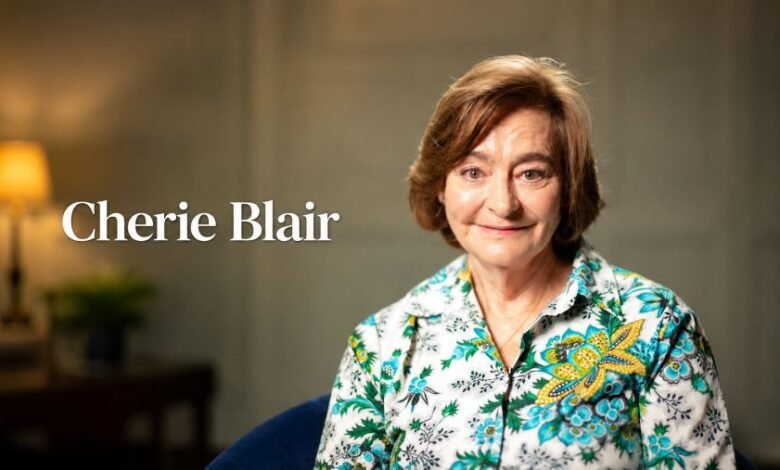
Cherie Blair is often introduced as the wife of former British prime minister Tony Blair. That is accurate, but it puts the most familiar part of her public identity ahead of the career she had already built before Tony Blair entered Downing Street.
Born Cherie Booth in 1954, she became a barrister in 1976 and Queen’s Counsel in 1995, two years before her husband became prime minister. Her work has since stretched from British employment and public law to human-rights litigation, international arbitration, mediation and representation of governments. She also founded the Cherie Blair Foundation for Women, which focuses on women entrepreneurs in low- and middle-income countries.
That chronology matters. Cherie Blair did not acquire a legal career because she became politically prominent. By the time the Blair family moved into Downing Street in 1997, she was already one of Britain’s senior barristers.
Quick Facts
| Fact | Details |
|---|---|
| Full name | Cherie Blair, née Booth |
| Born | 23 September 1954 |
| Birthplace | Bury, Lancashire, England |
| Profession | Barrister, international lawyer, arbitrator and mediator |
| Education | Law, London School of Economics |
| Called to the Bar | 1976 |
| Became Queen’s Counsel | 1995; styled King’s Counsel since 2022 |
| Matrix Chambers | Co-founder, 2000 |
| Omnia Strategy | Founded in 2011; Co-Founder and Chair |
| Cherie Blair Foundation for Women | Founded in 2008 |
| Spouse | Tony Blair |
| Children | Four |
| Honour | CBE, 2013 |
| Current university role | Chancellor, Asian University for Women |
Her birth date and upbringing in the Liverpool area are documented in contemporary profiles, while the National Portrait Gallery records her as born in 1954 and identifies Tony Blair as her husband.
Her Legal Career Came Before Her Political Fame
Blair grew up around Liverpool after being born in Bury. Her father was actor Tony Booth and her mother, Gale, also worked as an actor. Her parents separated during her childhood, and she was largely brought up by her mother and grandmother.
Education became the route into a very different world.
She studied law at the London School of Economics, graduating with a first-class degree. She was called to the Bar in 1976. According to Counsel, the magazine of the Bar of England and Wales, she initially worked across several areas because barristers at the time were less narrowly specialised than many are today.
Her practice increasingly developed around employment law, discrimination, judicial review and public law. She took silk in 1995, becoming a Queen’s Counsel, and was appointed a Recorder in 1999.
The dates make the sequence clear: her appointment as QC came before Tony Blair’s 1997 general-election victory.
That distinction became harder to maintain in public life. Once her husband became prime minister, almost everything Cherie Blair did could be viewed through a political lens, even when she was acting professionally as a barrister.
Matrix Chambers Reflected Her Approach to Legal Practice
In 2000, Blair was among the founders of Matrix Chambers.
The significance was not simply that she joined another set of chambers. Matrix was designed around a less traditional organisational structure at a time when human-rights law in Britain was becoming increasingly important following the Human Rights Act 1998.
Blair later explained that she was interested in breaking down some of the divisions between different areas of legal practice and creating a less hierarchical, more business-like chambers structure.
That fits the broader pattern of her career. She did not remain confined to one branch of English law. Her later work moved increasingly toward international disputes, arbitration, state representation and mediation.
The Shabina Begum Case Shows the Substance of Her Human-Rights Work
One of Blair’s best-known cases was R (Begum) v Headteacher and Governors of Denbigh High School.
The dispute involved Shabina Begum, a Muslim student who wanted to wear a jilbab to school. The case raised difficult questions about school uniform rules and freedom of religion under Article 9 of the European Convention on Human Rights.
Blair, practising professionally as Cherie Booth QC, appeared for Begum.
The official House of Lords judgment lists Cherie Booth QC, Carolyn Hamilton and Eleni Mitrophanous as counsel for Begum. The House of Lords ultimately ruled in favour of the school in March 2006, overturning Begum’s earlier Court of Appeal success.
The result is important when assessing Blair’s legal career. Representing a claimant does not mean winning every major case. What the Begum litigation demonstrates is that she was appearing at the highest level of the British judicial system in cases dealing with contested questions of individual rights, public authority and religion.
Downing Street Put an Independent Career Under Political-Level Scrutiny
Tony Blair served as prime minister from 1997 until 2007, making Cherie Blair one of Britain’s most visible political spouses.
Yet “First Lady” is not an official British position.
A House of Commons Library briefing states that the spouse of a UK prime minister has no official role, receives no salary for being the prime minister’s spouse and has no prescribed official duties.
That constitutional detail helps explain why Blair’s situation was unusual.
She was living at the centre of British political power but remained an independently practising lawyer. Her clients, earnings, speeches and professional decisions consequently attracted public attention that an ordinary barrister would rarely encounter.
Her political connections also pre-dated Tony Blair’s premiership. Cherie Booth herself stood for Labour in North Thanet at the 1983 general election. She received 6,482 votes, or 14.13%, and finished third. Tony Blair entered Parliament for Sedgefield at the same election.
She did not go on to build a parliamentary career. Her principal professional path remained law.
Omnia Strategy Shifted Her Work Onto the International Stage
Blair founded Omnia Strategy in 2011 and left Matrix Chambers in 2014 to concentrate on the firm and on international arbitration.
Contemporary legal-industry reporting confirms both dates: Omnia was founded in 2011, and Blair left Matrix in 2014 after 14 years there.
Omnia currently lists her as Co-Founder and Chair. Her practice covers public international law, human rights, employment law, international arbitration and mediation. The firm says she has represented more than 30 governments as well as multinational companies in international disputes. Because that figure comes from Omnia itself, it is best treated as a firm-reported professional record rather than an independently compiled count.
The move marked a clear evolution in her career. The lawyer associated in Britain with employment rights, judicial review and the Human Rights Act increasingly became involved in disputes between states, investors and major organisations.
That change also created criticism at times when Omnia acted for governments facing questions over human rights or governance. The distinction between representing a client and endorsing that client’s politics, however, is essential when assessing such work. Lawyers routinely act for parties whose policies or behaviour they do not personally support.
The Cherie Blair Foundation Put Economic Independence at the Centre
Blair established the Cherie Blair Foundation for Women in 2008 to support women entrepreneurs in low- and middle-income countries.
Its focus is not simply encouraging women to “start businesses.” Its programmes address practical barriers around business skills, mentoring, finance, markets, digital tools and professional networks.
The Foundation reported that during 2025 it supported 29,190 women across 40 countries. Among participants, 80% said their revenue increased and 38% reported creating new jobs. Its chief executive wrote in August 2026 that the organisation had worked alongside more than 319,000 women entrepreneurs across 120 countries over nearly two decades.
Those numbers require careful interpretation.
They are reported by the Foundation and describe outcomes among its participants. They should not be rewritten to claim, for example, that Foundation programmes independently caused revenue growth for 80% of participants. Demonstrating causation would require stronger evaluation designs and comparison groups.
That qualification does not make the figures unimportant. It simply defines what they can reliably tell us: the scale of the programmes and the outcomes participants reported.
Technology Has Been a Long-Running Part of Her Foundation’s Work
The Foundation’s current interest in artificial intelligence might look like a recent shift, but technology has been part of its work for more than 15 years.
In 2010, the Foundation and the GSMA Development Fund published Women & Mobile: A Global Opportunity. The report estimated that women in low- and middle-income countries were 21% less likely than men to own a mobile phone and identified a gap of around 300 million female mobile subscribers.
Those figures are historical and should not be presented as today’s mobile-phone gender gap. Their importance is different: they show that the organisation was investigating how access to technology affected women’s economic opportunities long before AI became a mainstream business issue.
The same question now appears in a new form.
In 2025, Foundation research based on responses from 2,870 women entrepreneurs across 96 low- and middle-income countries examined digital payments, social media, AI, e-commerce, internet access and online gender-based violence. The researchers explicitly acknowledged that the digital survey used convenience sampling and was not representative of every woman entrepreneur across those countries.
That methodological disclosure matters because it prevents an interesting survey from becoming an exaggerated global claim.
The 2026 AI Research Shows Rapid Adoption — With an Important Catch
The Foundation’s 2026 report, Adopted not embedded: AI, productivity and uneven gains for women entrepreneurs, gives perhaps the clearest indication of where Blair’s advocacy is now heading.
The study surveyed 3,072 women entrepreneurs across 66 low- and middle-income countries. AI use among respondents had risen sharply, from 38% in the previous year’s survey to 82%, with 45% reporting daily use.
The headline is striking, but the sample matters just as much.
Every respondent was active online, nearly two-thirds had post-secondary education, and the ten most represented countries accounted for 91% of completed surveys. The report itself says that it captures a digitally connected and relatively well-educated segment of women entrepreneurs rather than all women business owners in lower-income economies.
So the defensible conclusion is not that “82% of women entrepreneurs in developing countries use AI.”
It is that AI adoption has become very high within the digitally connected group surveyed by the Foundation.
That distinction is small in wording but large in meaning.
It also points to a deeper issue in Blair’s current work. Access to technology is only the first stage. The Foundation is increasingly concerned with whether women can apply digital tools deeply enough to improve finance, operations, productivity and access to markets rather than limiting them to basic marketing tasks.
Her Public Life Has Also Included Serious Controversy
A credible account of Cherie Blair cannot treat criticism as either irrelevant or automatically incriminating.
One of the most damaging episodes came in 2002, when convicted fraudster Peter Foster became involved in negotiations connected with Blair’s purchase of two flats in Bristol.
The political problem grew after Downing Street initially gave journalists an incomplete picture of Foster’s involvement. Blair later said she was responsible for the misunderstanding between the No. 10 press operation and the media. Contemporary reporting established that Foster had assisted with the transaction, but some wider allegations surrounding the affair remained disputed.
A different controversy emerged through the 2021 Pandora Papers.
The Guardian reported that Tony and Cherie Blair acquired a London office building by purchasing the offshore company that owned it rather than buying the building directly. That structure meant approximately £312,000 in stamp duty was not payable.
The legal distinction is important: the reporting did not allege that the Blairs had committed tax evasion. The Guardian stated there was no suggestion of wrongdoing and described the structure as lawful. Blair said she had wanted the company and property brought into the UK tax and regulatory system.
The episode nevertheless became part of a wider debate over whether tax rules allowed wealthy property purchasers advantages unavailable in ordinary transactions.
Her Recognition and Public Roles Extend Beyond Legal Practice
Blair was appointed Commander of the Order of the British Empire (CBE) in the 2013 New Year Honours for services to women’s issues and charity in the UK and overseas.
She has also served as Chancellor of the Asian University for Women since 2011. The university currently continues to list her as its Chancellor and describes the position as the titular head of the institution, with responsibilities that include international advocacy and participation in commencement ceremonies.
Her public activity continues in 2026. In July, her office announced that she had become a patron of 50:50 Parliament, an organisation campaigning for equal representation of women in UK politics.
Taken together, these roles show that the period after Tony Blair left Downing Street did not represent a retreat from public life. Her work instead became less connected to the formal machinery of British government and more international in scope.
Why Cherie Blair’s Career Is More Complicated Than Her Public Label
Cherie Blair sits at an unusual intersection of law, politics and advocacy.
Her marriage placed her inside one of the most closely watched political households in modern Britain. Yet the professional record runs on its own timeline: Bar in 1976, QC in 1995, Matrix Chambers in 2000, the Foundation in 2008 and Omnia Strategy in 2011.
That is why reducing her to either “Tony Blair’s wife” or simply “a human-rights lawyer” misses too much.
The legal work changed substantially over time. Domestic public and employment law gave way to increasingly international disputes and arbitration. Her charitable work also developed from an emphasis on access to mobile technology and business mentoring into wider questions about markets, finance, internet access and now artificial intelligence.
There are legitimate criticisms and controversies within that record. Some concern the boundaries between professional independence and political proximity. Others concern clients, property transactions or the way charitable impact is measured. They deserve precise treatment rather than omission or exaggeration.
The strongest evidence supports a simpler assessment: Cherie Blair built a serious legal career before Downing Street, continued it while living there, and has spent the years since extending that work into international law and women’s economic participation.
FAQ
Who is Cherie Blair?
Cherie Blair is a British barrister and King’s Counsel, Founder and Chair of Omnia Strategy, founder of the Cherie Blair Foundation for Women and wife of former UK prime minister Tony Blair.
Is Cherie Blair still a lawyer?
Yes. Omnia Strategy currently lists her as Co-Founder and Chair and says she continues to practise as a barrister while also working as an arbitrator and mediator.
When did Cherie Blair become a QC?
She became Queen’s Counsel in 1995. Following the accession of King Charles III in 2022, the title became King’s Counsel, so she is now styled Cherie Blair CBE KC.
Did Cherie Blair ever run for Parliament?
Yes. As Cherie Booth, she stood for Labour in North Thanet in the 1983 general election, receiving 6,482 votes and finishing third.
What is the Cherie Blair Foundation for Women?
It is an organisation Blair established in 2008 to support women entrepreneurs in low- and middle-income countries through training, mentoring, technology, research and advocacy.
Was Cherie Blair officially Britain’s First Lady?
No. The UK does not give a prime minister’s spouse an official “First Lady” position. The House of Commons Library states that the prime minister’s spouse has no official role, salary or specified duties.
What does Cherie Blair do in 2026?
Her current roles include Chair of Omnia Strategy, founder of the Cherie Blair Foundation for Women and Chancellor of the Asian University for Women. In July 2026 she also became a patron of 50:50 Parliament.