Stephanie Flanders: The Economist Who Made Big Money Stories Easy to Understand
From BBC Economics Editor to Bloomberg leadership, a closer look at Stephanie Flanders' early life, education, career, family and achievements.

Introduction
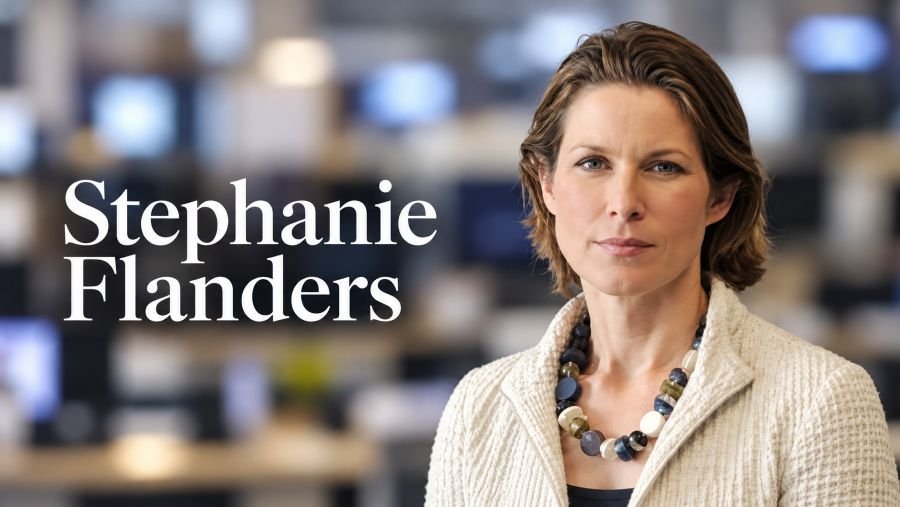
Stephanie Flanders is a British economist, journalist and financial commentator. She has spent years explaining economic news to the public. Many people remember her BBC reports. Others know her work at Bloomberg.
Her career has taken several turns. She started with economic research, moved into journalism, worked at the US Treasury and later became a familiar face on British television.
Today, she holds a senior position at Bloomberg. Her work still centres on economic policy, markets and the decisions affecting everyday life.
Quick Facts About Stephanie Flanders
| Detail | Information |
|---|---|
| Full Name | Stephanie Hope Flanders |
| Date of Birth | 5 August 1968 |
| Age | 58 years old (2026) |
| Nationality | British |
| Profession | Economist, journalist and editor |
| Current Position | Head of Economics & Government at Bloomberg |
| Famous For | Former BBC Economics Editor |
| Father | Michael Flanders |
| Mother | Claudia Cockburn |
| Sister | Laura Flanders |
| Education | St Paul’s Girls’ School |
| University | Balliol College, Oxford |
| Higher Education | Harvard Kennedy School |
| Degree | Philosophy, Politics and Economics |
| Postgraduate Qualification | Master of Public Administration |
| Children | Two |
| Son | Stanley |
| Daughter | Claudia |
| Career Experience | BBC, Bloomberg, J.P. Morgan, Financial Times and US Treasury |
Early Life and Family Background
Stephanie Hope Flanders was born on 5 August 1968. She grew up in a family connected to journalism, music and public affairs.
Her father was Michael Flanders. He was a British actor, writer and comic singer. Many people knew him through his musical partnership with Donald Swann.
Her mother, Claudia Cockburn, came from a family of writers and journalists.
Her childhood included an early loss. Her father died in 1975, when she was just six years old.
She later spoke about this experience in interviews. She explained that her memories of him were limited, partly because she was so young when he died.
Her sister, Laura Flanders, also built a career in journalism.
Another notable family connection is her grandfather, Claud Cockburn. He was a journalist known for his political writing.
So, writing and public discussion were already part of her family history. Stephanie took a somewhat different route, choosing economics as her main professional subject.
Education and University Years
Education became an important part of her life.
She attended St Paul’s Girls’ School in west London. The school has a long academic history.
After finishing school, she studied at Balliol College, University of Oxford.
Her chosen subject was Philosophy, Politics and Economics, usually called PPE.
She earned a first-class degree.
The course helped her study government decisions, economic systems and political ideas.
Her studies continued in America.
She attended Harvard University’s John F. Kennedy School of Government as a Kennedy Scholar and earned a Master of Public Administration.
This gave her further training in public policy and administration.
Those subjects later appeared throughout her working life. She would explain government budgets, discuss financial markets and report on economic decisions affecting millions of people.
How Her Professional Career Started
Stephanie Flanders did not begin as a television presenter.
Her early work focused on economics.
She worked as an economist at the Institute for Fiscal Studies and London Business School.
Both roles were connected with economic research and analysis.
She then moved into financial journalism.
In 1994, she became an editorial writer and economics columnist at the Financial Times.
This was an important move.
Writing for a major financial newspaper meant explaining complicated economic questions to readers who wanted clear information.
Her work covered financial developments and economic policy.
The experience also helped build her reputation as a journalist who understood the technical side of economics.
Working at the US Treasury
Her career later took her to Washington.
Between 1997 and 2001, Flanders worked as a senior adviser and speechwriter to Lawrence H. Summers, who served as US Treasury Secretary.
The role involved communication around major financial and economic questions.
It was different from newspaper reporting.
Instead of simply reporting government decisions, she worked within a major government department.
She gained direct experience of economic policymaking.
After her Treasury work, she also worked as a reporter for The New York Times.
She served as principal editor of the United Nations’ 2002 Human Development Report.
These positions added international experience to her professional background.
Joining BBC Newsnight in 2002
Her broadcasting career began to attract wider attention in 2002.
That year, she joined BBC Newsnight as an economics correspondent.
Newsnight covers politics, current affairs and major public issues.
Flanders brought her economics background to the programme.
She reported on government spending, financial developments and the British economy.
The job required a different approach.
A newspaper article could explain an issue over several paragraphs. Television often offered just a few minutes.
She had to make the information clear without losing the main facts.
Her background helped her handle those demands.
She also worked on other BBC programmes, including Panorama, where she examined economic conditions across Britain.
Becoming BBC Economics Editor
In 2008, Stephanie Flanders became the BBC’s Economics Editor.
She succeeded Evan Davis.
The appointment gave her a leading position in British economic broadcasting.
Her timing was unusual.
The global financial crisis was developing, and financial markets were facing serious pressure.
Banks were struggling. Economic confidence was falling. Governments were responding to a major international financial problem.
Flanders took maternity leave during part of the crisis in 2008.
She returned to work in January 2009, as Britain entered a period of serious economic difficulty.
Her reporting helped viewers understand the wider effects of the financial crisis.
She discussed recession, employment, interest rates and public finances.
During her BBC years, she also appeared on radio and television programmes covering financial affairs.
Many viewers came to know her through these reports.
Television and Radio Programmes
Flanders worked on several BBC productions.
One of her best-known programmes was Masters of Money, broadcast in 2012.
The documentary series examined the economic thinking of three influential figures:
- Karl Marx
- John Maynard Keynes
- Friedrich Hayek
The series looked at their different ideas about markets, government and economic systems.
She also worked on BBC Radio 4.
In 2007, she presented Flanders on Flanders, a documentary about the life and work of her father.
Her radio work included Stephanomics, which discussed economic ideas and events.
These programmes gave her opportunities to explain economic subjects in greater detail.
Why She Left the BBC
In September 2013, news emerged that Flanders would leave the BBC.
She accepted a position at J.P. Morgan Asset Management.
The decision marked another career change.
She was moving from public-service broadcasting to the investment industry.
At J.P. Morgan, she became Chief Market Strategist for Europe.
She held that position from 2013 to 2017.
Her work focused on economic conditions and their relationship with financial markets.
She discussed issues such as interest rates, European economic developments and investment conditions.
The job drew on her earlier experience in research, public policy and journalism.
Moving to Bloomberg in 2017
In October 2017, Stephanie Flanders joined Bloomberg.
She became Senior Executive Editor for Economics and head of Bloomberg Economics.
Bloomberg provides financial news, economic analysis and market information to audiences around the world.
Her position involved overseeing economic coverage and analysis.
She worked with economists and journalists examining national and international economic developments.
Her career had now moved through several connected fields.
She had worked in research. She had reported economic news. She had advised government officials. She had also worked in investment management.
Bloomberg brought much of that experience together.
Her Bloomberg Role in 2026
As of October 2026, Bloomberg identifies Flanders as Head of Economics & Government.
Her official professional profile also describes her as Senior Executive Editor for Economics and head of Bloomberg Economics.
Her work concerns major economic questions.
These include inflation, financial markets, government policy, global trade and economic growth.
She also hosts Bloomberg’s Trumponomics podcast.
The programme examines economic policies and their effects on markets, businesses and households.
In 2026, Bloomberg published episodes discussing artificial intelligence, financial conditions and US economic policy.
She continues to work in economics and financial journalism.
Career Timeline
| Year | Career Event |
|---|---|
| 1968 | Born on 5 August |
| Early career | Worked at the Institute for Fiscal Studies and London Business School |
| 1994 | Became an editorial writer and economics columnist at the Financial Times |
| 1997–2001 | Worked as an adviser and speechwriter at the US Treasury |
| 2002 | Joined BBC Newsnight |
| 2008 | Became BBC Economics Editor |
| 2012 | Presented Masters of Money |
| 2013 | Joined J.P. Morgan Asset Management |
| 2016 | Became Chair of the RSA Inclusive Growth Commission |
| 2017 | Joined Bloomberg Economics |
| 2019 | Elected an Honorary Fellow of Balliol College |
| 2026 | Listed as Head of Economics & Government at Bloomberg |
Awards and Professional Achievements
Her work has received recognition beyond broadcasting.
In 2016, she was appointed Chair of the Inclusive Growth Commission at the Royal Society of Arts.
The commission studied ways to make economic growth benefit more people and communities.
Its final report appeared in March 2017.
She was also elected an Honorary Fellow of Balliol College, Oxford, in 2019.
The appointment recognised her professional achievements and connection with the college.
Flanders has held other public and professional positions.
Balliol College identifies her as a chair of Artichoke, a nonprofit arts organisation in the United Kingdom.
Her career has also included work connected with economic education and public discussion.
Stephanie Flanders’ Family and Personal Life
Flanders has discussed parts of her family life in newspaper interviews.
She has two children.
Her son, Stanley, was born in 2006.
Her daughter, Claudia, was born in 2008 and was named after her mother.
Older newspaper profiles describe journalist John Arlidge as her partner.
Those interviews do not establish her present marital status, so it would be inaccurate to make a definite claim about her current marriage.
In a 2009 Guardian interview, she spoke about the difficulty of combining a demanding broadcasting career with motherhood.
Her work sometimes required long days, especially during major economic events.
She also explained that family responsibilities influenced her decisions during the 2008 financial crisis.
For her, work and family were both serious commitments.
How Her Family Influenced Her Career
Her family history gives an interesting view of her background.
Her father worked in entertainment and writing.
Her mother came from a family closely connected with journalism.
Her grandfather, Claud Cockburn, was also known for his writing.
Stephanie chose economics.
Still, there was a connection between her chosen subject and the family’s involvement in public discussion.
She wanted to explain events affecting people’s lives.
Her professional work gave her a way to do that through financial reporting and economic analysis.
Public Speaking and Economic Commentary
Flanders has spoken at professional conferences and public events.
Her subjects generally involve economics, business and government policy.
She can explain technical financial issues to different audiences because her career covers both research and journalism.
Her Bloomberg role also places her in discussions involving international economic developments.
Over the years, she has interviewed experts and examined changing economic conditions.
These activities remain part of her public career.
What Makes Her Career Different?
Flanders has worked on several sides of the same subject.
At the Institute for Fiscal Studies, she worked in economic research.
At the Financial Times and BBC, she explained economic developments through journalism.
At the US Treasury, she gained experience inside government.
At J.P. Morgan, she worked with investment-market analysis.
Then Bloomberg gave her a senior editorial and economic leadership role.
Each job involved economics, but the responsibilities were different.
That breadth of experience helps explain why her career has lasted across several major institutions.
Frequently Asked Questions
1. Who is Stephanie Flanders?
Stephanie Flanders is a British economist, journalist and Bloomberg executive. She previously worked as the BBC’s Economics Editor.
2. How old is Stephanie Flanders?
She is 58 years old as of October 2026. She was born on 5 August 1968.
3. Where was she educated?
She attended St Paul’s Girls’ School, Balliol College at Oxford University and Harvard Kennedy School.
4. What does she do at Bloomberg?
She is listed as Head of Economics & Government. Her work focuses on economic news and analysis.
5. Who was Stephanie Flanders’ father?
Her father was Michael Flanders, a British actor, writer and comic singer known for his partnership with Donald Swann.
6. Does she have children?
Yes. She has two children, Stanley and Claudia.
7. When did she leave the BBC?
She left in 2013 to become Chief Market Strategist for Europe at J.P. Morgan Asset Management.
8. What is her net worth?
A reliable, publicly confirmed personal net worth is not available.
Final Thought
Stephanie Flanders has spent much of her career explaining the economy.
Her path has not been limited to television. She has worked in research, government, investment and international financial journalism.
Her years at the BBC made her familiar to British audiences.
Her later work at J.P. Morgan and Bloomberg brought new responsibilities.
Today, she remains an established figure in economic reporting, with experience reaching from Oxford and Harvard to Washington, London and global financial news.