Somebody is going to see you in these. That’s the part people skip when they’re buying sweatpants — you picture the couch, not the Tuesday morning when the dog needs walking and the coffee place is four blocks off, and you’re in whatever you slept beside. The pants filed under Essentials Clothing are cut closer to that second situation than the first, which means the hard part isn’t the pants. It’s the eight inches above your shoe and whatever goes on top.
Which is usually where the whole thing goes sideways, and not for the reason people assume.
Length settles it before anything else does
An inch either way is the whole difference between looking dressed and looking mid-laundry, which sounds dramatic right up until you’ve watched a long hem pool over somebody’s sneaker and soak up every wet patch between a front door and the corner — and the opposite isn’t any better, since elastic riding up your calf makes the leg look borrowed off a shorter person.
With an open hem you want it grazing the top of the shoe and stopping there, touching but not folding, while a cuffed pair can carry an extra inch or so because the gathered elastic swallows it — which is honestly the only real reason to prefer one over the other. If you’re 5’8″ and a pair comes up long, push the cuff twice so the stack looks like a choice, or hand it to a tailor for fifteen dollars and quit thinking about it.
Color does more work than the cut
Look down that pants grid and the palette splits into two camps. There’s black, dark brown, gray and light gray on one side. Cream, beige, tan, light oatmeal and sycamore on the other, plus a coral and a yellow sitting off by themselves.
Black asks nothing of you — any top, a crowded train, and you’ll stop noticing it inside a week. The pale side is louder than people expect, because nobody wears something that stainable unless they planned the day a little. It also shows everything. Sit on a painted bench in a Brooklyn park, and you’ll know inside a second.
So what goes on top
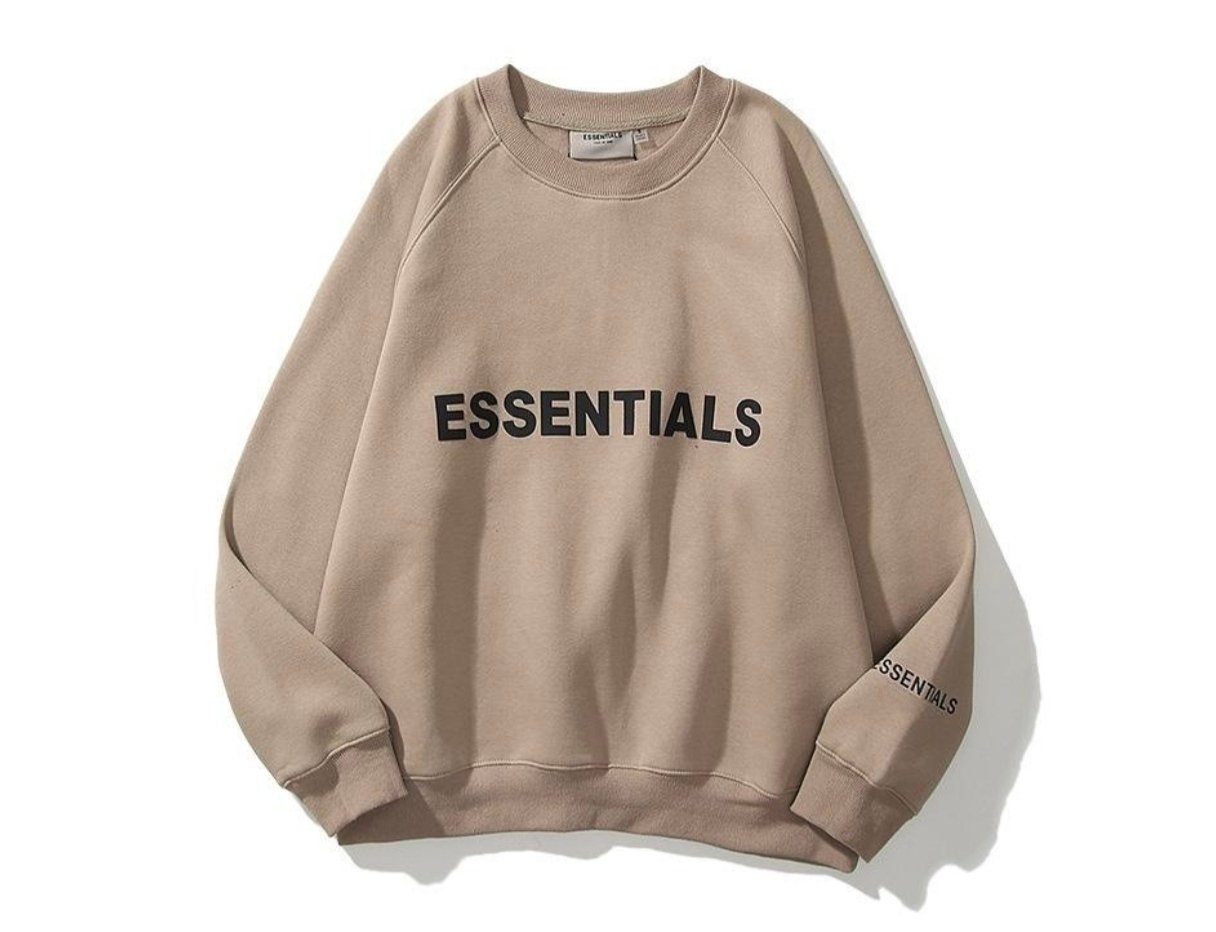
Roughly how I’d pair the pants against what sits above the waist in there — crewneck sweatshirts from $80, tees from $75, Essential hoodie across a much wider spread.
| Pant | Works above it | Leave it alone |
| Black | Off-white crew, heather gray crew, a plain white tee | A second black top in a different black |
| Cream or light oatmeal | Olive, dark green, black | Light gray — washes it out |
| Heather gray | Black tee, dark brown crew | Another gray in a near-identical tone |
| Coral or yellow | White or black, nothing printed | A second bright color anywhere on you |
None of that is a rule. It’s just which pairings stop looking accidental by the third wear.
Shoes carry the outfit, not the pants
Swap a low white sneaker for a chunky running shoe under the same pair and the whole read changes. The low shoe keeps the leg line going, while a bulky sole cuts it at the ankle — fine in February with a brown boot, less fine with a cream sweatpant in July.
Boots work too, and a relaxed black pair over a brown leather boot is about the only way sweatpants get through a cold-weather errand without reading as gym clothes.
Matching top to bottom, and when it tips over
Same color up and down is the quickest way to look pulled together and also the quickest way to look like you’re in a uniform, and what separates those two is texture more than anything else — a ribbed crewneck over fleece-back sweatpants in the same gray gets away with it because the surfaces throw light differently, whereas matching cotton with the hood up just reads as one garment with a seam across the middle.
If you want the matched look, break it somewhere. A white tee under an open hoodie. A different shade of the same family — dark gray pant, smoky gray top. Something that tells people two decisions happened.
Twelve of the twenty-one cost the same
Worth knowing before you fall for a color. The Essentials Pants category runs twenty-one listings, and twelve of them are priced at $95 — black, brown, cream, white, beige, coral, yellow and a relaxed cut among them. Above that it’s $105 to $110 for light oatmeal and tan, $120 for gray and a light brown, $124 for the 1977 pair, and $129 at the ceiling.
A thirty-four dollar spread, then, with nothing on the listings explaining it as construction — so mostly you’re picking colors:
- Most of that $95 dozen are the simplest colors to style anyway — black, gray, cream, beige
- Paying $120 or more mostly buys a specific shade, not a different pant
- Coral and yellow sit at the bottom of the band, unusual for loud colors
A 40 °F morning changes the math
Sweatpants are a shoulder-season garment in most of the country, which people forget when they shop in October. A Chicago morning at 40 °F with wind off the lake wants a crewneck and a shell over the pant, and by then the pant is insulation nobody sees. Houston in August, unwearable by nine.
The real window is 50 to 65 °F — April, late September, a mild January south of Atlanta. Sweatpant and a tee, and you’re done thinking about it.
Frequently Asked Questions
Can I wear sweatpants to an office?
A relaxed black pair with an open hem, a plain crewneck and a leather shoe will pass in a lot of casual workplaces. A cuffed pair in cream with a logo across the hip will not. The difference is the hem and the color.
Which color should the first pair be?
Black, pretty much every time. It pairs with everything above the waist, it hides the coffee you’ll spill on it, and it doesn’t make you plan the day around it. Buy the cream second.
Cuffed or open hem — does it really matter?
More than the fabric weight does, I’d say. Cuffed sits higher and throws attention down onto your shoes, which is why it holds up with boots in February, while an open hem hangs straighter and reads less like athletic wear — that’s the one to reach for if anybody where you’re going is wearing a collar.
Most of this stops mattering the second you quit filing sweatpants as indoor clothing. Get the length sitting on your shoe, pick a color you won’t have to plan a whole outfit around, and go easy on matching the top exactly, because a near-match beats an exact one most days. Then just leave the house in them, which was sort of the point of owning a pair you can.