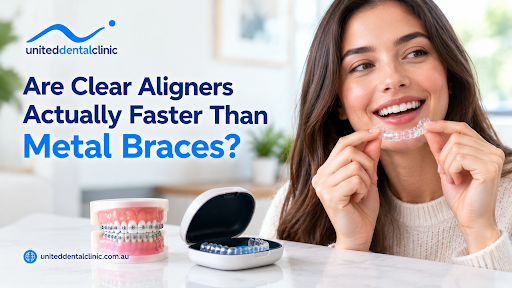
For mild alignment issues, Invisalign can often straighten teeth faster than traditional braces. However, metal braces are quicker and more effective for complex bite corrections.
The truth is that neither system holds a permanent speed record. Instead, your treatment timeline depends almost entirely on the specific movements your teeth need.
If you are considering Invisalign treatment Warriewood options, simple fixes like closing a minor gap often happen faster with clear aligners. Complex tasks like rotating premolars or correcting a deep bite require the constant, precise force that traditional braces deliver best.
Understanding how each option works for your situation will help you pick the fastest path to a confident, healthy smile.
What Are the Rough Timelines?
Most people just want ballpark numbers, so start here:
- Invisalign: usually 6 to 18 months
- Braces: usually 18 months to 3 years
On paper, that makes Invisalign the obvious winner. But those ranges hide a catch. Invisalign finishes fast only when the case suits it. Braces look slower partly because they take on the hard cases that were never going to be quick in the first place.
Why Do Simple Cases Favour Invisalign?
Mild crowding, small gaps, a few teeth slightly out of line. This is Invisalign’s home turf.
The aligners apply steady, gentle pressure, and for minor movements that’s plenty. You switch trays every week or two, with no tightening appointments and no waiting on wire adjustments. For a straightforward fix, this is often where Invisalign faster than braces genuinely holds true.
A lot of adults choosing clear aligners are in exactly this boat. They want a modest correction done discreetly and quickly, and the treatment delivers.
Why Do Complex Cases Favour Braces?
When the problem has real weight, braces take the lead.
Fixed brackets and wires grip every tooth, pushing, pulling, and rotating with a force aligners struggle to match. Braces handle these heavy jobs better:
- Severe bite problems
- Badly rotated teeth
- Large gaps to close
- Teeth that must travel a long way
It isn’t that Invisalign is weak. Braces were simply built for this kind of heavy lifting. Forcing a complex case through aligners can take longer, which is the opposite of what people expect.
The Factor Nobody Talks About: You
Here’s the part that quietly decides everything, and it has nothing to do with brackets or trays.
Invisalign only works if you wear it around 22 hours a day, every day. If you take the trays out too often or forget them overnight, your treatment stalls. Braces never ask this, because they’re glued on and working whether you think about them or not.
So the fastest treatment isn’t always the one with the shorter textbook timeline. It’s the one you’ll actually stick to. A disciplined person flies through aligners. Someone who knows they’ll forget might finish sooner with braces.
Invisalign vs Braces: Side by Side
Sometimes it’s easier to just see it laid out.
| Factor | Invisalign | Braces |
| Best for | Mild to moderate cases | Complex, severe cases |
| Typical time | 6 to 18 months | 18 months to 3 years |
| Speed depends on | Wearing them 22 hrs/day | Nothing you have to do |
| Appointments | Fewer, spaced out | Regular adjustments |
| Visibility | Nearly invisible | Noticeable |
So Which Should You Choose?
Forget speed for a second, because it’s the wrong first question. The right ones are simpler:
- What does your mouth actually need?
- How disciplined will you realistically be?
If your case is mild and you’re organised, aligners will likely be both faster and more comfortable. If your case is complex, braces get you a better result in less time than a struggling aligner ever could. And if you know you won’t wear trays religiously, let that honesty steer you.
A proper assessment settles it in minutes. A family dentist in Narrabeen can look at your teeth, tell you which case you fall into, and give a realistic estimate for each option.
The Bottom Line
Treatment speed is not a fixed advantage that belongs exclusively to one option. Ultimately, the ideal choice depends on your orthodontic complexity and your personal lifestyle. Simple alignment adjustments combined with consistent wear often favor clear aligners. Conversely, complex bite corrections or cases that require zero daily management often lean toward traditional braces.
Rather than relying on general timelines, get a personalised assessment tailored to your specific needs. Book a consultation to discuss Invisalign treatment in Warriewood and braces at United Dental Clinic, and receive a precise treatment plan built for your smile.
Frequently Asked Questions
Can I switch from braces to Invisalign partway through?
Sometimes, yes. If the hardest movements are done, a dentist may finish with aligners. It depends entirely on how your treatment is progressing.
Does faster treatment mean a worse result?
Not if it’s the right fit. A simple case that finishes quickly can be just as stable as a slower one. Rushing an unsuitable case is the real risk.
Do braces hurt more than Invisalign?
Both cause mild soreness after adjustments or new trays. Braces can also irritate the cheeks with their brackets, which aligners avoid.
Will my teeth move back afterward?
They can, which is why a retainer is essential. Skipping it undoes the work, no matter which treatment you choose.