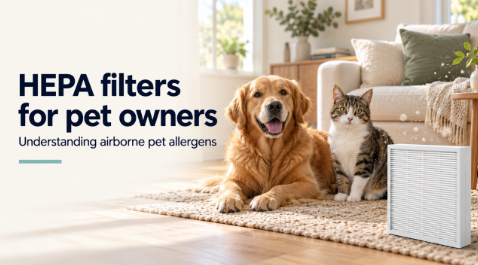
A HEPA filter helps pet owners by capturing fine particles, such as pet dander, from the air passing through an air purifier. It can’t reach the hair on your sofa, so it works best alongside grooming and cleaning. As the heating goes on in autumn 2026 and windows stay shut, here is what the filter does and how to get the most from it.
What are pet allergens, and why do they stay in the air?
Pet allergens are proteins rather than the hair itself. Allergy UK explains that pet allergy is caused by a protein in a pet’s saliva, urine, or dander, which is made up of shed skin particles. The NHS lists animals, particularly cats and dogs, among common allergens.
Dander becomes airborne as a pet grooms and loses hair, then collects on furniture and other surfaces, according to Allergy UK. The UK Health Security Agency (UKHSA) adds that cleaning, moving around and having pets can stir allergens back into the air. Allergy UK also notes that cat allergen is particularly persistent and can stay in a home long after the cat has gone.
How does a HEPA filter capture pet dander?
HEPA stands for high-efficiency particulate air. It is a dense mat of fine fibres folded into pleats, and it is designed to capture fine particles, including dander, as air passes through.
Larger particles hit the fibres or are caught as they pass close by, while the smallest drift about and stick when they touch one. Filters are graded under EN 1822 at the size they find hardest to catch, so the rating describes a worst case rather than a cut-off. Allergy UK says an air purifier may help reduce indoor airborne allergens.
What do the other filter layers do in a home with pets?
Most purifiers stack several layers, and each one has a job in a pet household. The pre-filter catches hair and fluff first, so less of it reaches the main filter, while a deodorisation layer of activated carbon can help reduce some pet odours.
How you clean the pre-filter depends on the model. On a Coway air purifier such as the Airmega 150, Mighty or Jet, the pre-filter is a separate mesh that you can vacuum. If it is heavily soiled, you can wash it and then dry it fully in the shade. On the Airmega 50, 100, 350 and 450, it forms the outer layer of a 3-in-1 filter, so it needs a vacuum or a dry cloth instead.
The HEPA and deodorisation filters can’t be washed and reused, so they are replaced rather than cleaned. When your dog or cat is moulting, check the pre-filter more often, as loose fur builds up there first.
Where should an air purifier go if you have a cat or dog?
Start with the room where your pet spends most of the day. If someone in the household is allergic to pets, Allergy UK advises keeping pets out of the bedroom, which also makes the bedroom a sensible place for a purifier.
Give the unit the clearance its manual specifies, and keep the cable out of reach of puppies and rabbits that chew. Avoid spots where a cat could use the top as a perch or a dog might lie against the air inlet, as a blocked inlet reduces airflow.
If you are comparing models for an air purifier for pets, check the filter type in the specification and how easily the pre-filter comes out for cleaning. A sensor-led Auto Mode, as on the Airmega 100, adjusts the fan speed to the indoor air quality.
What can’t a HEPA filter do for pet allergies?
A purifier only treats the air that passes through it, so hair and dander on sofas, carpets and clothes still need cleaning. Allergy UK recommends a vacuum cleaner with a HEPA filter and advises washing pet bedding regularly on a hot wash. If symptoms persist around pets, speak to your GP.
An air purifier supplements ventilation and source control. It does not replace them and is not a medical treatment.
FAQs
Can a HEPA filter capture cat allergen?
Allergy UK says cat allergen is found on the skin and fur. The filter is designed to capture fine airborne particles such as dander, but cat allergen is persistent, so regular cleaning still matters.
Do I need an air purifier in every room?
Not usually. Start in the room your pet uses most, or in the bedroom if pets are kept out of it and symptoms are worse at night. A purifier treats the air in the room it is in.
How often should I clean the pre-filter if my dog is moulting?
Follow the cleaning interval in your manual, and check the pre-filter more often while your dog is moulting, as loose fur collects there first. Dry a washable mesh pre-filter fully before you refit it.
Can HEPA help with pet smells?
Not on its own. HEPA captures particles, while smells need the deodorisation layer, usually activated carbon. Washing pet bedding on a hot wash, which Allergy UK advises for pet allergy, also deals with a common source of smells.
Does every air purifier use a HEPA filter?
No. Check the specification rather than the product name. Coway’s compact Airmega 50, for example, uses a particulate filter, while the Airmega 100, 150, Mighty and Jet use a HEPA filter.
The short version
A HEPA filter is designed to capture airborne pet dander, while the pre-filter takes the hair and the carbon layer helps with smells. Pair it with grooming, hot washes and a HEPA vacuum, and place it where your pet spends the day.