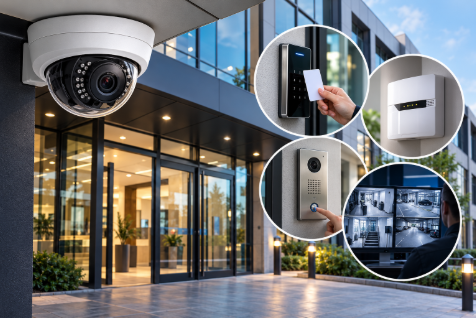
Businesses face different security challenges depending on their premises, staff, equipment and daily operations. An office may need controlled access to sensitive areas, while a warehouse might require constant monitoring of stock and delivery points. Investing in reliable commercial security systems helps businesses manage these risks through a combination of CCTV, access control, intruder alarms and intercoms. When these technologies work together, they provide better visibility across a property and help staff respond more effectively to potential security concerns.
Why Business Security Requires a Tailored Approach
Every commercial property has its own layout and security requirements. A small retail shop has different priorities from a school, healthcare facility or large industrial site. Choosing equipment without considering these differences can leave important areas unprotected.
A well-planned security setup starts with an assessment of the property, its entrances, operating hours and potential vulnerabilities. Security professionals can then recommend suitable equipment and decide where each component should be installed.
For example, a business with valuable stock may benefit from cameras covering storage areas and loading bays. An office handling confidential information might need access restrictions for meeting rooms, server rooms and other sensitive locations.
This tailored approach helps businesses invest in the protection they actually need rather than paying for unnecessary equipment.
Essential Components of Commercial Security Systems
Modern security solutions combine several technologies to create a more complete level of protection. Each component serves a different purpose, but integrating them can make day-to-day security management easier.
1. CCTV Surveillance
CCTV cameras allow businesses to monitor activity across their premises. Depending on the layout, cameras can cover entrances, reception areas, car parks, corridors, stockrooms and external boundaries.
The main benefits of commercial CCTV include:
- Visual monitoring: Staff can observe activity in important areas without being physically present at every location.
- Recorded footage: Video recordings may help clarify incidents, subject to appropriate retention policies and data protection requirements.
- Incident investigation: Relevant footage can assist with reviewing unauthorised access, property damage or workplace disputes.
- Deterrence: Visible cameras may discourage opportunistic theft and other unwanted behaviour.
Camera placement is particularly important. Poor positioning can create blind spots, while unsuitable lighting or low-quality equipment may reduce the usefulness of recorded footage.
2. Access Control Systems
Access control allows businesses to decide who can enter particular areas and when. Instead of relying entirely on traditional keys, authorised staff can use access cards, PIN codes, mobile credentials or other approved methods.
This technology is useful for offices, educational buildings, warehouses and healthcare premises where different people require different levels of access.
Businesses can also remove access permissions when employees leave or change roles. This makes it easier to manage entry rights without replacing multiple locks and distributing new keys.
For properties with several departments or restricted rooms, access control provides a practical way to improve accountability and reduce unnecessary access.
3. Intruder Alarm Systems
Intruder alarms help detect unauthorised entry when a property is closed or when restricted areas should remain undisturbed. Depending on the installation, the system may use door contacts, motion detectors and other sensors to identify suspicious activity.
When an alarm is triggered, the response may involve a local sounder, remote notification or a connection to an appropriate monitoring service.
Businesses should consider their opening hours, building layout and likely entry points when selecting alarm equipment. Regular testing and maintenance are also necessary to identify faults before they affect the system’s performance.
4. Intercom Systems
Intercoms allow staff to communicate with visitors before granting entry. Audio or video intercom systems can be installed at gates, reception entrances, delivery points and other controlled access locations.
They are particularly useful for buildings where visitors cannot enter freely. Staff can verify a visitor’s purpose, communicate instructions and release an entrance remotely where the system supports that function.
Combining intercoms with access control can create a more organised entry process while reducing the need to leave secure areas unattended.
The Advantages of Integrating Security Technologies
Using separate security products can work for smaller premises, but larger or more complex properties may benefit from an integrated solution.
When commercial security systems are planned to work together, businesses can manage different security functions more efficiently.
Key advantages include:
- Better coordination: Cameras, alarms and access control can provide complementary information during an incident.
- Simplified management: Depending on the equipment, staff may be able to oversee multiple functions through a shared platform.
- Improved visibility: Security teams can gain a clearer picture of activity across entrances and restricted areas.
- Flexible expansion: A properly designed system can accommodate additional cameras, doors or sensors as business requirements change.
Integration should be based on practical needs, compatibility and the skills available to manage the equipment. A complicated setup is not necessarily better if staff cannot operate it confidently.
Choosing a Security Company for Your Business
Selecting the right installation company is just as important as choosing the equipment. Businesses should look for a provider that understands commercial properties and can recommend solutions based on an assessment of the site.
Pedris is a UK security company serving businesses in London and Essex. Its services cover the design, installation and maintenance of commercial security systems, including CCTV, access control, intruder alarms and intercoms.
When comparing providers, consider the following factors:
- Site assessment: The installer should identify vulnerable areas and explain why particular equipment is suitable.
- Installation quality: Devices need appropriate positioning, reliable connections and correct configuration.
- Future requirements: The proposed setup should account for possible changes to the building or business operations.
- Maintenance support: Ask how faults, inspections and routine servicing will be handled.
- Data protection: CCTV and access records should be managed in accordance with applicable privacy and data protection obligations.
Businesses should also request a clear explanation of the proposed equipment, installation costs and ongoing service arrangements before making a decision.
Keeping Security Equipment Reliable Over Time
Installing security equipment is only the beginning. Cameras can become obstructed, sensors may develop faults, and software or network issues can affect connected devices. Without routine checks, these problems may go unnoticed until the equipment is needed.
A maintenance schedule should include testing alarms, checking camera views, inspecting access control devices and confirming that intercoms operate correctly. Businesses should also review user permissions regularly and remove access that is no longer required.
For sites with changing security needs, periodic reviews can identify areas that require additional coverage or updated equipment. Construction sites, for example, may need different arrangements as entrances move and new buildings or storage areas are introduced.
A dependable security setup should continue to reflect how the premises are used, not simply how the building looked on installation day.
Building a Safer Working Environment
From a small office to a large warehouse, effective security begins with understanding how people enter, move through and use a property. Combining suitable surveillance, controlled entry, alarms and visitor communication helps businesses address different risks without treating every location the same way.
With careful planning and ongoing maintenance, businesses can create a security arrangement that supports everyday operations while protecting staff, visitors, equipment and premises. The best starting point is a site assessment that identifies the most important risks and turns them into a practical plan for long-term protection.