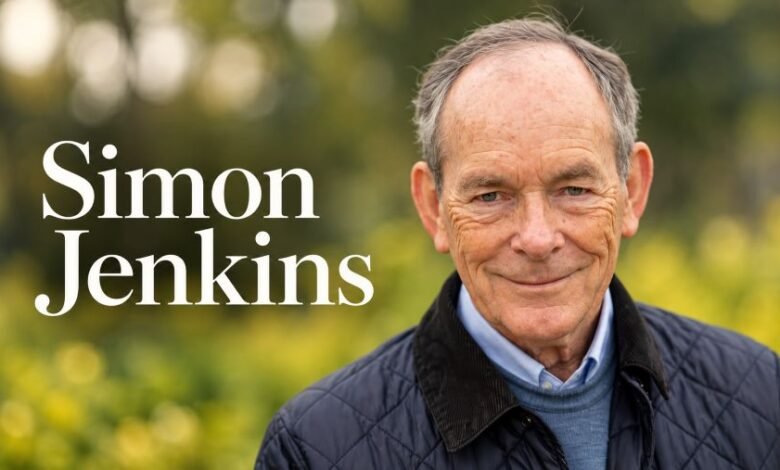
Simon Jenkins: The Journalist Who Became One of Britain’s Best-Known Writers
From editing major British newspapers to writing about politics, history and architecture, Simon Jenkins has spent more than six decades working with words.

Introduction
Simon Jenkins is a British journalist, author, political commentator and former newspaper editor. He is best known for editing The Times and the Evening Standard. He also writes columns for The Guardian.
His career goes beyond newspapers. He has written books about British history, architecture and historic places. He also chaired the National Trust from 2008 to 2014.
Born on 10 June 1943, he is 83 years old as of October 2026. His long career has taken him through journalism, publishing, broadcasting and public service.
Quick Facts
| Detail | Information |
|---|---|
| Full Name | Sir Simon David Jenkins |
| Known As | Simon Jenkins |
| Date of Birth | 10 June 1943 |
| Age | 83 years (October 2026) |
| Birthplace | Birmingham, England |
| Nationality | British |
| Profession | Journalist, author and columnist |
| Education | Mill Hill School |
| University | St John’s College, Oxford |
| Degree | Philosophy, Politics and Economics |
| Father | Daniel Thomas Jenkins |
| First Wife | Gayle Hunnicutt |
| Second Wife | Hannah Kaye |
| Children | One son |
| Famous For | Editing The Times and Evening Standard |
| Former Position | National Trust chairman |
| Award | Knight Bachelor, 2004 |
| Current Work | Journalism and writing |
Early Life and Family Background
Simon David Jenkins was born in Birmingham, England, on 10 June 1943.
Britain was still fighting the Second World War. His early childhood came during a period of major social and political change.
His father was Daniel Thomas Jenkins, a Welsh theologian and academic.
Daniel worked as a professor of systematic theology at Princeton Theological Seminary. He was also associated with the Congregational Church and later the United Reformed Church.
That gives Simon a clear Welsh family connection, despite his English birthplace.
His family background is publicly documented, though many details about his childhood remain private.
He later grew up in London. The capital became an important part of his personal and professional life.
Years later, he would write extensively about London’s buildings, history and public spaces.
Education and University Years
His education began at Mill Hill School.
Located in London, Mill Hill is an independent school with a long history.
He later attended St John’s College at the University of Oxford.
There, he studied Philosophy, Politics and Economics, commonly called PPE.
The course covers government, economics and political ideas.
These subjects were closely connected to the kind of work he would later pursue.
His university education ended before he entered professional journalism.
He went on to build a career that combined political reporting, newspaper editing and historical writing.
How His Journalism Career Began
His career started at Country Life magazine.
The publication covers subjects such as Britain’s countryside, buildings and cultural heritage.
It was an early introduction to professional publishing.
He then worked for the Times Educational Supplement, gaining further experience in journalism.
Other early positions followed.
He worked at The Sunday Times, where he served as books editor, and later became political editor of The Economist.
These jobs gave him experience across several areas.
Politics was one. Literature was another.
He also learned how major British publications worked.
That background prepared him for senior editorial appointments.
Becoming Editor of the Evening Standard
One of his first major appointments came in the 1970s.
He became editor of London’s Evening Standard, serving from 1976 to 1978.
The newspaper covered politics, business, culture and daily life in London.
His appointment placed him in charge of an established metropolitan newspaper while still in his thirties.
It was an important career step.
After leaving the paper, he continued working in political journalism.
Between 1979 and 1986, he served as political editor of The Economist.
That job placed national and international politics at the centre of his daily work.
His Years at The Times
A bigger editorial appointment arrived in 1990.
He became editor of The Times, one of Britain’s oldest newspapers.
He held the position until 1992.
During those years, British politics was changing. Margaret Thatcher left office in November 1990, and John Major became prime minister.
The newspaper covered those events alongside international news, economic issues and public debate.
Editing such a publication carried substantial responsibility.
The job involved overseeing journalism, managing editorial decisions and helping determine how major stories were presented.
His time at the newspaper lasted two years.
Still, it became one of the most recognised appointments of his career.
Building a Career as a Columnist
After his newspaper editorships, he remained active in journalism.
He wrote opinion columns for major British publications, including The Times, The Guardian and the Evening Standard.
Column writing gave him room to address a wide range of subjects.
Some were political. Others concerned ordinary life.
His published work has examined local government, public services, transport, historic buildings and foreign policy.
He often questions how decisions made by national institutions affect local communities.
Readers may agree or disagree with those arguments.
That is part of opinion journalism.
His work is presented as commentary rather than straightforward news reporting.
Writing for The Guardian
His association with The Guardian became a major part of his later career.
He continues writing for the newspaper in 2026.
His columns cover current political events, public policy and cultural subjects.
One article published on 9 October 2026 discussed plans for a third runway at Heathrow Airport.
Another, published on 2 October, addressed the ownership and return of historic cultural objects.
His recent articles also cover education, national identity and international relations.
He has remained active in public debate well into his eighties.
Readers can find his recent articles through his official Guardian author page.
His Work With the National Trust
Journalism was never his only interest.
British history and architecture have been major parts of his professional work.
He became chairman of the National Trust in 2008.
The organisation protects important historic buildings, landscapes and natural spaces across England, Wales and Northern Ireland.
He held the position until 2014.
His work with the organisation connected closely with his books about historic churches, houses and buildings.
He had also served as deputy chairman of English Heritage.
Those appointments brought his interest in conservation into public service.
He has supported the preservation of places that form part of Britain’s architectural history.
Other Public Appointments
His career also includes work outside publishing.
He served on the British Railways Board between 1979 and 1990.
He was a board member of London Transport from 1984 to 1986.
Between 1985 and 1990, he was deputy chairman of English Heritage.
He also served on the Millennium Commission from 1994 to 2000.
The commission supported projects connected with the arrival of the year 2000.
His public work included involvement with architecture and heritage organisations.
In 2000, he chaired the judging panel for the Booker Prize.
That appointment connected his journalism and literary interests.
Books and Writing Career
Simon Jenkins has published many books.
His subjects range from newspaper politics to architecture and European history.
Some of his best-known works examine British churches, country houses and railway stations.
Others tell the history of entire countries.
His writing often makes historical subjects easier for general readers to understand.
Rather than staying with one subject, he has written across several related fields.
Here are some of his published books.
| Book | Publication Year |
|---|---|
| Education and Labour’s Axe | 1969 |
| Here to Live | 1971 |
| Landlords to London | 1975 |
| Newspapers: The Power and the Money | 1979 |
| The Battle for the Falklands | 1984 |
| The Market for Glory | 1986 |
| Accountable to None | 1995 |
| England’s Thousand Best Churches | 1999 |
| England’s Thousand Best Houses | 2003 |
| Thatcher & Sons | 2006 |
| Wales: Churches, Houses, Castles | 2008 |
| A Short History of England | 2011 |
| England’s Hundred Best Views | 2013 |
| England’s Cathedrals | 2016 |
| Britain’s 100 Best Railway Stations | 2017 |
| A Short History of Europe | 2018 |
| A Short History of London | 2019 |
| Europe’s 100 Best Cathedrals | 2021 |
| The Celts: A Sceptical History | 2022 |
| A Short History of British Architecture | 2024 |
| A Short History of America | 2025 |
Some works have appeared in multiple editions.
Publication dates can differ between hardback, paperback and electronic versions.
His book A Short History of America: From Tea Party to Trump was first published in 2025, with a paperback edition released in 2026.
It examines American history, from the country’s origins to its later political and economic development.
His publisher, Penguin Books, provides details about the publication.
Why Architecture Matters to His Career
His interest in architecture is easy to see.
He has written about churches, railway stations, historic houses, cathedrals and city buildings.
His work treats buildings as records of the past.
They help explain how people lived, worked and worshipped.
For example, England’s Thousand Best Churches examines historic religious buildings across the country.
Britain’s 100 Best Railway Stations turns attention towards railway architecture.
These books give readers a different view of British history.
Rather than focusing only on kings and governments, they look at places people can still visit.
His conservation appointments followed similar interests.
Awards and Professional Recognition
His long career has received several honours.
He was recognised as Journalist of the Year and Columnist of the Year during his newspaper career.
In 2003, he was elected a Fellow of the Royal Society of Literature.
A major national honour followed in 2004.
He was appointed a Knight Bachelor for services to journalism.
That award entitled him to use the title Sir.
He was later elected a Fellow of the Learned Society of Wales in 2022.
These honours recognise different parts of his professional work.
His journalism received national recognition, while his literary and academic associations reflect his writing and public interests.
First Marriage to Gayle Hunnicutt
His personal life has occasionally appeared in newspaper coverage.
In 1978, he married American actress Gayle Hunnicutt.
She was known for her work in British and American television and film.
Her acting credits included Dallas and The Adventures of Sherlock Holmes.
The couple had one son, Edward Jenkins.
Their marriage lasted for several decades.
They separated in 2008 and divorced in 2009.
Gayle Hunnicutt died on 31 August 2023, aged 80.
The relationship remains part of his publicly documented family history.
Second Marriage to Hannah Kaye
He married Hannah Kaye in 2014.
She has been publicly described as an events producer associated with Intelligence Squared.
Their wedding was reported in the British press.
Unlike his professional life, relatively little information about their private family arrangements is publicly documented.
That distinction matters.
His writing and public appointments are well recorded, but not every detail of his family life is available.
Children and Family Life
He has one publicly documented son, Edward Jenkins, from his marriage to Gayle Hunnicutt.
Information about his son appears in established coverage of the family.
Jenkins was also stepfather to Hunnicutt’s son from her earlier marriage to actor David Hemmings.
He generally receives more media attention for his writing than for his personal life.
As for other private family details, reliable public records are limited.
Political Views and Public Opinions
He is a political commentator, but his writing covers far more than party politics.
He has written about government power, local democracy, public spending, foreign military intervention and British institutions.
His columns often argue for stronger local decision-making.
He has also criticised particular government policies and international military actions.
These are his published opinions.
They should not be confused with established facts or the editorial position of every publication carrying his work.
His long career has involved addressing different political questions as events changed.
Readers wanting to understand his views can check his original dated columns.
Personal Interests and Connection to Britain
His published books suggest a lasting interest in Britain’s buildings, towns and historic spaces.
London has been especially important.
He has lived in the city for much of his life and written about its history.
His Welsh family background also forms part of his public identity.
He has published a book examining historic places in Wales.
His writing frequently connects the past with buildings and communities that remain part of everyday life.
That interest has continued for decades.
Is He Still Working in 2026?
Yes. He remains professionally active.
As of October 2026, he continues publishing commentary in The Guardian.
His articles address current affairs and public policy.
He also remains associated with his historical publications.
His 2025 book A Short History of America received a paperback edition in 2026.
At 83, he has maintained a career stretching back to the 1960s.
His public work now centres mainly on writing and commentary rather than editing a daily newspaper.
Career Timeline
| Year | Career Event |
|---|---|
| 1943 | Born in Birmingham |
| 1960s | Began his journalism career |
| 1976 | Became editor of the Evening Standard |
| 1979 | Became political editor of The Economist |
| 1990 | Became editor of The Times |
| 1992 | Left The Times editorship |
| 1999 | Published England’s Thousand Best Churches |
| 2000 | Chaired the Booker Prize judging panel |
| 2003 | Elected Fellow of the Royal Society of Literature |
| 2004 | Received a knighthood |
| 2008 | Became chairman of the National Trust |
| 2014 | Completed his National Trust chairmanship |
| 2018 | Published A Short History of Europe |
| 2022 | Elected Fellow of the Learned Society of Wales |
| 2024 | Published A Short History of British Architecture |
| 2025 | Published A Short History of America |
| 2026 | Continues writing for The Guardian |
Final Thought
Simon Jenkins has built a career around writing.
He started in magazines, moved into major newspaper roles and later became a familiar voice in British political commentary.
His books tell another story.
They show his long interest in history, historic buildings and the places people live.
His career has lasted more than sixty years, covering newspapers, books, broadcasting and conservation.
And he is still writing.
That continued activity makes him an established figure in British journalism and historical publishing.
Frequently Asked Questions
1. Who is Simon Jenkins?
Simon Jenkins is a British journalist, author and former newspaper editor. He is known for editing The Times and the Evening Standard and writing for The Guardian.
2. How old is Simon Jenkins?
He is 83 years old as of October 2026. He was born on 10 June 1943.
3. Where was he born?
He was born in Birmingham, England.
4. Who is Simon Jenkins’ wife?
He married Hannah Kaye in 2014. His first wife was American actress Gayle Hunnicutt.
5. Does Simon Jenkins have children?
Yes. He has one publicly documented son, Edward Jenkins.
6. Where did he study?
He attended Mill Hill School and later studied Philosophy, Politics and Economics at St John’s College, Oxford.
7. What books has he written?
His books include A Short History of England, A Short History of Europe, Britain’s 100 Best Railway Stations and A Short History of America.
8. Is Simon Jenkins still a journalist?
Yes. He continues writing columns for The Guardian in 2026.