Messeregge Guide: What This Farming Tool Actually Does
A clear look at the German soil-working tool, its blades, uses, settings, parts, and place in seedbed preparation

Introduction
Messeregge sounds unfamiliar to many people.
That makes sense.
The word comes from German farming.
It refers to agricultural equipment.
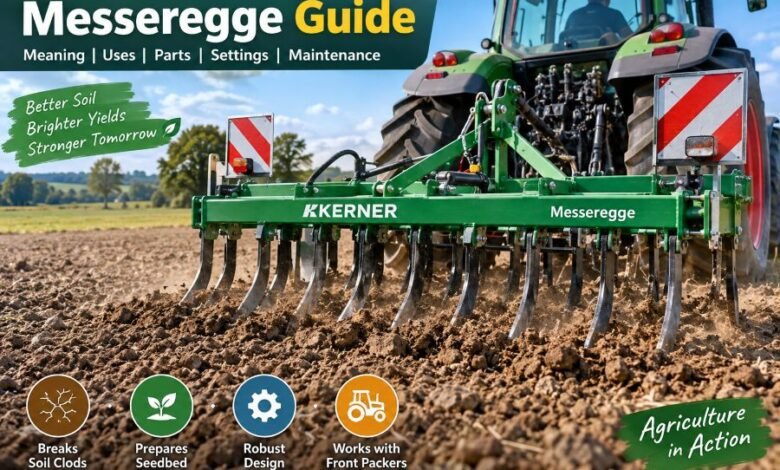
More specifically, it describes a blade-type harrow used for working soil near the surface.
Its main job is simple.
It breaks larger soil clods.
That can help prepare the ground before later field work or sowing.
There is some confusion online.
Some pages give very different meanings.
But established German dictionaries and farm-machinery manufacturers connect Messeregge with agriculture.
So, basically, that is the meaning farmers should know.
Quick Facts
| Fact | Details |
|---|---|
| Term | Messeregge |
| Language | German |
| Field | Agriculture |
| Main purpose | Breaking larger soil clods |
| Equipment family | Harrow / soil-working equipment |
| Working parts | Knife or blade-like elements |
| Common setup | Front-mounted soil-working attachment |
| Current manufacturer examples | Kerner and Fliegl |
| Adjustable depth | Yes, on documented Kerner systems |
| Replaceable blades | Yes, on documented Kerner models |
What Is a Messeregge?
A Messeregge is agricultural equipment.
The German word gives clues.
“Messer” means knife or blade.
“Egge” means a harrow.
That makes the basic idea clear.
It is a harrow using blade-like working parts.
The exact design can vary.
Some units work as attachments.
Others form part of larger soil-working machines.
Current Kerner equipment uses a Messeregge as a front tool on its TORON front packer.
Fliegl also sells a front-mounted Messeregge for its Profiwalze system.
So this is not one brand.
It is an equipment type.
What Does a Messeregge Do?
Its main task is clod breaking.
Large soil lumps can remain after previous field work.
Those lumps may make the surface rough.
A Messeregge attacks those clods.
The blades meet the soil first.
They break larger pieces apart.
This can leave smaller soil particles.
That makes later preparation easier.
Fliegl describes its current Messeregge as a front-mounted unit used to break larger soil clods.
Kerner gives a similar purpose.
Its TORON documentation says the Messeregge breaks clods and soil chunks.
Pretty straightforward.
Where Is It Used?
The tool works in agriculture.
It is linked with soil preparation.
A common use is before sowing.
Farmers often want an even seedbed.
Large hard clods can get in the way.
Breaking them can improve surface preparation.
A Messeregge may work before a roller.
It may also sit ahead of a front packer.
That lets several jobs happen during one field pass.
The exact result depends on soil.
Machine settings matter too.
Field conditions matter as well.
How Does a Messeregge Work?
The working idea is mechanical.
No mystery there.
Steel blades contact the soil.
As the tractor moves forward, those working parts hit and cut into larger clods.
The clods break into smaller pieces.
A following roller can then work them further.
On a combined front-packer system, the machine may also level and press the soil.
The Messeregge itself mainly handles the clod-breaking stage.
That distinction matters.
It should not be treated as every soil tool at once.
Main Parts of a Messeregge
Designs differ between manufacturers.
Still, documented Kerner equipment shows several common parts.
These can include:
- Main carrying frame
- Blade holders
- Left-hand blades
- Right-hand blades
- Straight blades
- Bolts and nuts
- Adjustment parts
- Spindles
- Grease points
- Mounting structure
The blades are working parts.
They can wear over time.
Replacement parts are sold separately for some machines.
That can make repairs simpler.
Left, Right, and Straight Blades
One useful detail appears in Kerner parts information.
The company lists different blade types.
These include left blades.
Right blades are listed too.
Straight blades are another option.
That tells us something important.
A Messeregge is not simply one long cutting bar.
It can use many separate steel working pieces arranged across the machine.
The exact blade count depends on model and width.
Current Kerner TORON Example
Kerner gives a good current example.
Its TORON is a front packer.
Several front tools can be fitted.
Messeregge is one of them.
Other choices include a spring-tine harrow and Crossboard.
The current TORON specifications list working widths of:
- 2.5 metres
- 3 metres
- 3.5 metres
The published machine data gives a working-depth range of 0 to 10 cm.
Kerner lists 24 working elements for the Messeregge configuration.
Its stated line spacing is 125 mm.
The Messeregge attachment is listed at 200 kg.
These figures relate to the documented TORON setup.
They should not be treated as universal Messeregge specifications.
Different machines can use different measurements.
Current Fliegl Example
Fliegl offers another real example.
Its Agro-Center lists a Messeregge made for the Profiwalze.
The documented version has a width of 2,600 mm.
It is made for front mounting.
Its listed weight is 200 kg.
Fliegl says it is used for breaking larger soil clods.
A wider 3,000 mm setup is also referenced with the Profiwalze range through Fliegl-related equipment information.
Again, sizes can differ.
Always check the exact model.
Working Depth Adjustment
Depth changes how the tool works.
Too shallow may give limited contact.
Too deep may not suit the job.
Kerner addresses this directly.
Its current TORON documentation allows Messeregge working depth to be adjusted by a spindle.
Hydraulic adjustment is optional.
That gives the operator more control.
Field conditions are rarely identical.
So adjustment makes practical sense.
Why Soil Clod Size Matters
Rough soil can cause problems.
Large chunks leave an uneven surface.
They can interfere with seedbed preparation.
Smaller crumbs are easier to level.
That is why clod breaking matters.
The Messeregge handles this early.
Then other machine parts can follow.
A roller may press the soil.
A packer may firm it.
Another tool may level it.
Each part has its own job.
Messeregge vs Federzinkenegge
These tools are related.
But they are not identical.
A Federzinkenegge uses spring tines.
Kerner says its spring-tine setup breaks clods while also levelling and distributing organic material.
The tine angle can be changed.
The Messeregge uses blade-style working elements.
Its documented focus is clod breaking.
So the working parts differ.
Their field behaviour can differ too.
Messeregge vs Crossboard
A Crossboard works differently.
Its main focus is levelling.
Kerner describes its Crossboard as working on the soil surface and allowing changes to its engagement angle.
The Messeregge has another job.
It goes after clods.
Think of them as different front-tool choices.
The right choice depends on conditions.
Messeregge vs Roller
A roller is not a Messeregge.
A roller usually works after soil disruption.
It presses or firms the surface.
A Messeregge uses blades first.
On some systems, both work together.
Kerner’s TORON is one example.
Its front-tool section handles the soil before the roller section continues the job.
So the two tools can complement each other.
They should not share one definition.
Is a Messeregge a Scarifier?
Langenscheidt translates Messeregge as “scarifier.”
That is a valid dictionary translation.
But context matters.
“Scarifier” can describe different equipment in English.
So using “Messeregge” alongside “knife harrow” or “blade harrow” can make an English article clearer.
For machinery searches, keeping the original German word is useful.
That helps readers find exact parts.
It also helps with manuals.
Is Messeregge a Brand?
No evidence supports that idea.
Messeregge is used as an equipment term.
Kerner uses the word.
Fliegl uses it too.
Parts sellers use it as well.
So it should not be presented as one company or one product brand.
A company may sell a Messeregge.
That is different.
Is Messeregge an Exhibition Term?
This causes online confusion.
German word splitting matters here.
“Messe” can refer to a trade fair.
But Messeregge is not simply “Messe” plus another established exhibition word.
The documented agricultural term links “Messer” and “Egge.”
German dictionary evidence supports the farming meaning.
Agricultural manufacturers support it too.
So an article should not present Messeregge as a standard exhibition-booth term without strong specialist evidence.
The agricultural meaning is clearly documented.
Is Messeregge a Knife Edge?
No, that definition is misleading.
“Messer” does mean knife.
But the complete word matters.
“Egge” refers to agricultural harrowing equipment.
Langenscheidt places Messeregge directly in the agriculture category.
So the whole term cannot be translated by looking at “Messer” alone.
Context clears it up.
Replaceable Messeregge Blades
Wear parts are available commercially.
BayWa lists replacement blades for Kerner Messeregge equipment.
One listed replacement size is:
468 × 60 × 6 mm.
The documented blade has a 12.5 mm mounting hole.
BayWa lists left and right versions.
A straight version is listed too.
These details apply to specified Kerner equipment.
Do not assume every machine uses them.
Check the part number first.
Maintenance Basics
A Messeregge works directly in soil.
Wear is normal.
Blades need regular checks.
Bolts can also need inspection.
Look for bent working parts.
Check loose fasteners too.
Watch adjustment components carefully.
Grease points should follow the manual.
Damaged blades can change performance.
Uneven wear can do the same.
Replacement parts should match the machine.
Do not guess blade dimensions.
Use the maker’s parts information.
Safety Points
Farm equipment can be dangerous.
A Messeregge has heavy steel parts.
Its blades can cause injury.
Keep people away during operation.
Never work beneath unsupported equipment.
Secure the machine before servicing.
Release hydraulic pressure where required.
Follow the tractor instructions too.
Use the machine’s own manual.
Exact safety procedures can differ.
That part is important.
Choosing a Messeregge
Start with machine compatibility.
Check the working width.
Then check the mounting system.
Look at adjustment options.
Blade availability matters too.
So does replacement-part support.
Field conditions are another factor.
Heavy clods may need different settings.
Lighter soils may react differently.
The tractor must also suit the complete machine.
Do not select equipment from one specification alone.
Buying Replacement Parts
Start with the machine model.
Find its original part number.
Then compare blade orientation.
Left and right can differ.
Straight blades may differ again.
Check thickness and hole size.
Look at the mounting bolt.
Manufacturer documentation should come first.
That can prevent wrong orders.
Why Messeregge Searches Get Confusing
The word is not common English.
That creates room for mistakes.
Some writers split it incorrectly.
Others guess from similar words.
A better method is simple.
Check German dictionaries first.
Then check actual farm manufacturers.
Look at current machine manuals.
Parts catalogues help too.
When all these sources agree, the meaning becomes much clearer.
Who Uses a Messeregge?
The tool is relevant to farmers.
Agricultural contractors may use one.
Farm-machinery operators may also handle it.
Parts dealers need the term too.
It can matter to machinery buyers.
People reading German equipment listings may see it often.
English-speaking buyers can run into the word when checking imported machinery.
Knowing the meaning saves confusion.
Common Messeregge Search Terms
People may search for:
- Messeregge meaning
- Messeregge English meaning
- Messeregge farming tool
- Messeregge harrow
- Messeregge blades
- Messeregge parts
- Kerner Messeregge
- Fliegl Messeregge
- Messeregge front packer
- Messeregge replacement blade
These searches usually point back to farm machinery.
Final Thought
Messeregge has a clear farming meaning.
It is a soil-working harrow.
Blade-like parts break larger clods.
Current Kerner and Fliegl equipment confirms that use.
Some models work ahead of rollers.
Some are part of front packers.
Settings and dimensions vary.
So always check the exact machine.
That is the safest approach.
Frequently Asked Questions
What does Messeregge mean?
Messeregge is a German agricultural term. Langenscheidt translates it as “scarifier.” In machinery use, it describes a blade-type harrow used for soil work.
What is a Messeregge used for?
Its main documented job is breaking larger soil clods. This can help prepare a more workable soil surface.
Is Messeregge a farming machine?
Yes. German dictionary and manufacturer sources place the term in agriculture.
Does a Messeregge use blades?
Yes. Documented Kerner systems use separate blade-style working elements, including left, right, and straight replacement blades.
Can Messeregge depth be adjusted?
It depends on the machine. Kerner’s current TORON setup offers spindle adjustment and optional hydraulic depth adjustment.
How wide is a Messeregge?
There is no single standard width. Kerner documents TORON systems at 2.5, 3, and 3.5 metres. Fliegl lists a 2.6-metre Messeregge for its Profiwalze.
Is Messeregge the same as a spring-tine harrow?
No. A Messeregge uses blade-style parts. A Federzinkenegge uses spring tines and has different working characteristics.
Can Messeregge blades be replaced?
Yes, on documented machines. Replacement blades are sold for specific Kerner Messeregge equipment.