Susie Wolff: From the Williams F1 Garage to Leading F1 ACADEMY
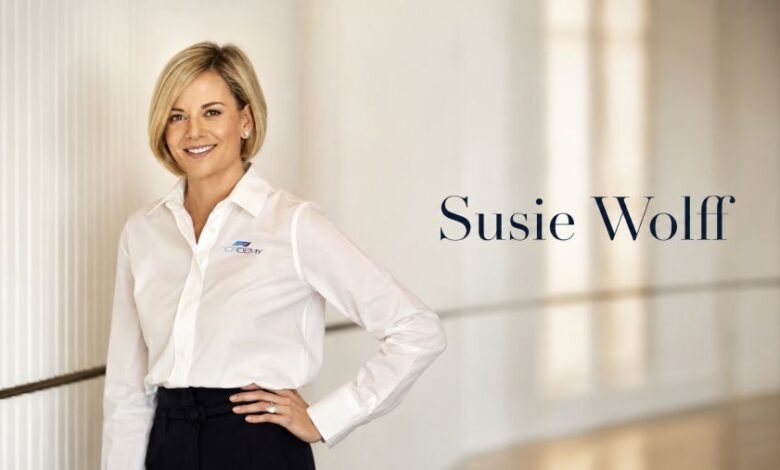
Susie Wolff never started a Formula 1 Grand Prix, but her four official practice appearances with Williams made history. Her influence has since moved far beyond the cockpit, through Formula E leadership, women-in-motorsport programmes and her current work building F1 ACADEMY into a credible route for young female drivers.

Introduction
More than a decade later, that appearance at Silverstone is no longer the most important part of Wolff’s story.
The Scottish former driver now runs F1 ACADEMY, Formula 1’s female-only development championship. Between those two points came seven seasons in DTM, four F1 free-practice appearances, an MBE, the creation of Dare to be Different, and senior management roles at Venturi Racing in Formula E.
Her career has effectively moved in the opposite direction from most racing stories. The driving stopped in 2015. Her influence grew afterward.
Quick Facts About Susie Wolff
| Fact | Details |
|---|---|
| Full name | Suzanne Wolff, née Stoddart |
| Date of birth | 6 December 1982 |
| Birthplace | Oban, Scotland |
| Nationality | British / Scottish |
| Profession | Motorsport executive and former professional racing driver |
| Started karting | Age 8 |
| DTM career | 2006–2012 |
| Formula 1 team | Williams |
| Williams role | Development driver, later test driver |
| Official F1 practice appearances | 4 |
| First F1 weekend appearance | 2014 British Grand Prix |
| Retired from racing | 2015 |
| Dare to be Different launched | 2016 |
| Honour | MBE for services to women in sport |
| Venturi Racing | Team Principal from 2018; later CEO |
| Current role | Managing Director of F1 ACADEMY |
| F1 ACADEMY appointment | March 2023 |
| Husband | Toto Wolff |
| Child | One son, Jack |
Her birth date and birthplace are confirmed in a contemporary BBC profile, while Formula 1’s career history documents the progression from karting through junior single-seaters, DTM and Williams.
Growing Up in Oban and Starting Racing at Eight
Wolff was born Suzanne Stoddart in Oban on Scotland’s west coast in 1982. Motorsport entered her life unusually early. She began karting at eight and soon developed beyond recreational competition.
By 1997, she was winning significant karting honours, including the 24-Hour Middle East Kart Championship and Scottish Junior Intercontinental A titles. Formula 1’s official history also records her recognition as a leading female kart racer before she progressed into cars.
The early years matter when looking at Wolff’s later work with female drivers. She did not enter motorsport through a programme specifically designed for girls. She followed the conventional karting route, competing in environments where female drivers were a small minority.
That experience would become relevant decades later when she began arguing that the absence of women near the top of motorsport cannot be solved only at Formula 1 level. The pool has to be larger much earlier.
Formula Renault Showed She Could Compete in Single-Seaters
Wolff moved into Formula Renault in the early 2000s.
Her results improved over successive seasons. Formula 1 records that she reached the podium in her second campaign and then collected three podium finishes while taking fifth in the standings in her next season.
British Formula 3 followed in 2005. The field included drivers such as Bruno Senna and Charlie Kimball, but Wolff’s season was disrupted by an ankle injury.
At that point, her career changed direction.
Instead of continuing through the usual European single-seater ladder toward GP2 and Formula 1, she moved into Germany’s Deutsche Tourenwagen Masters, better known as DTM.
Seven Years in DTM Changed Her Career
From 2006 through 2012, Wolff built the longest sustained racing chapter of her professional career in DTM.
She initially competed for Mücke Motorsport before moving to Persson Motorsport. Her strongest individual results included seventh-place finishes at the Lausitzring and Hockenheim in 2010.
She did not become a DTM title contender, and a credible account of her career should not portray the period that way. The significance was longevity and experience. She spent years competing professionally in one of Europe’s strongest touring-car championships while maintaining a relationship with Mercedes machinery.
Then, in 2012, an unexpected route back into single-seaters opened.
Williams signed her as a development driver.
Williams Put Susie Wolff Back on the Formula 1 Path
Wolff initially combined Williams duties with her final DTM season.
Her job was not ceremonial. Williams used her for simulator work, aerodynamic development and testing. The team gradually expanded her responsibilities, and by 2013 she was working full-time with the Formula 1 operation at Grove.
The opportunity attracted scrutiny partly because Wolff had married Toto Wolff in 2011. At the time of her original Williams appointment, he was involved with the team.
Williams explicitly stated, however, that Toto Wolff had recused himself from the appointment process and that the board approved Susie’s position independently.
Her work eventually led to something much more visible than simulator development.
Williams gave her an FP1 seat.
Silverstone 2014 Made Formula 1 History
At the 2014 British Grand Prix, Wolff drove the Williams FW36 during Friday practice.
She thereby became the first woman to participate in an official Formula 1 Grand Prix weekend session since Giovanna Amati’s unsuccessful qualifying attempts in 1992.
This is also where one of the most common descriptions of Wolff needs correcting.
She did not race in a Formula 1 Grand Prix.
An FP1 appearance is an official Grand Prix weekend session, but it is not a race start. Lella Lombardi, whose final F1 start came in 1976, remains the most recent woman to have started a Formula 1 World Championship Grand Prix.
That qualification does not diminish Wolff’s achievement. It makes it accurate.
Her second 2014 practice opportunity came at Hockenheim in Germany. There, she finished only a couple of tenths behind regular Williams driver Felipe Massa, giving the appearance more sporting weight than a symbolic run.
Williams promoted Wolff to official test driver for 2015. She completed two more FP1 appearances, in Spain and Britain, alongside testing and simulator work. In total, she participated in four Formula 1 FP1 sessions.
Yet a race seat did not follow.
Why Wolff Ended Her Driving Career
Wolff announced in November 2015 that she would retire from competitive motorsport at the end of the season.
By then she had spent four years working with Williams but had not secured a route to a full-time F1 race seat. Her final competitive driving appearance came at the Race of Champions.
Retirement could easily have been the closing chapter of her public motorsport career.
Instead, it became a transition.
Wolff began moving from the question of whether she could progress further in racing to the question of why so few women were entering and remaining in motorsport in the first place.
Dare to Be Different Shifted Her Focus to the Next Generation
In 2016, Wolff founded Dare to be Different, an initiative created to encourage more girls and women into motorsport, not only as drivers but also through engineering, media, technical and other professional roles.
The programme worked at grassroots level rather than concentrating solely on producing an F1 driver.
That distinction remains central to Wolff’s approach today.
Dare to be Different eventually began cooperating with the FIA’s Girls on Track programme. In July 2020, Motorsport UK announced that the two would be fully united under the FIA Girls on Track name.
By November 2021, the Girls on Track UK community had reached 5,000 members, according to Motorsport UK.
Wolff’s work was also recognised formally. She was named an MBE in the 2017 New Year Honours for services to women in sport.
But advocacy was only one part of her post-driving career.
She also wanted to run a racing team.
Venturi Proved Wolff Could Lead a Motorsport Organisation
In June 2018, Venturi appointed Wolff Team Principal and shareholder of its Formula E team.
It was her first major move from driver and campaigner into day-to-day senior racing management.
The role matters because it provides important context for her later F1 ACADEMY appointment. Wolff did not move directly from being a former driver into control of Formula 1’s female development championship.
She accumulated executive experience first.
Under her management, Venturi improved competitively. Its 2020–21 campaign produced two victories and five podiums, while Edoardo Mortara finished second in the Drivers’ Championship, seven points behind champion Nyck de Vries. Wolff was promoted from Team Principal to CEO in November 2021.
Venturi went further in the following season. The team scored 295 points and finished second in the 2021–22 Teams’ Championship, only 24 points behind Mercedes-EQ.
Wolff left the organisation and Formula E in 2022.
By then her résumé contained something unusual: professional driving experience, F1 testing, grassroots advocacy, team ownership and executive management.
Formula 1 soon gave her a much larger platform.
F1 ACADEMY Existed Before Wolff Took Charge
Formula 1 announced F1 ACADEMY in November 2022 as a Formula 4-level championship designed to develop young female drivers.
Wolff therefore did not found F1 ACADEMY, another point sometimes misstated in online profiles.
Formula 1 appointed her Managing Director on 1 March 2023, shortly before the championship’s inaugural season. Her job was to develop its structure and strengthen the pathway from karting into higher levels of single-seater racing.
The first year demonstrated why that task involved more than organising races.
F1 ACADEMY initially had limited visibility. It was not yet fully integrated into Formula 1 weekends, and Wolff later recalled arriving at its Paul Ricard event and noticing how little activity surrounded the circuit.
The response was to bring the championship much closer to Formula 1 itself.
Every F1 team became involved by supporting a driver and applying its branding to a car. The series moved onto Formula 1 race weekends, gained wider broadcasting, expanded its grid and built a much stronger commercial presence.
The grid grew to 18 cars for 2025, with Hitech Grand Prix becoming the sixth team.
F1 ACADEMY Has Grown — but Audience Numbers Need Context
By the end of the 2025 season, Formula 1 reported that F1 ACADEMY had approximately 1.5 million followers across its social platforms, a 54% year-on-year rise.
A Nielsen study cited by Formula 1 also estimated that the series’ fanbase had increased 31% year-on-year.
Those figures show substantial commercial growth, but they should not be treated like independent academic measurements of motorsport participation. They come from Formula 1’s own season review and commissioned audience research.
A separate 2025 Global F1 Fan Survey placed F1 ACADEMY second only to Formula 1 among racing series followed by its respondents. In 2026, the championship entered its fourth season.
Visibility is only half the issue, though.
The harder question is whether the system produces drivers who can progress after leaving.
The Real Test Is What Happens After F1 ACADEMY
Wolff has repeatedly described F1 ACADEMY as a development category rather than an end destination.
That makes graduate performance more useful than social-media numbers when assessing whether the championship is working.
Inaugural champion Marta García moved into the Formula Regional European Championship with financial support. Abbi Pulling, the dominant 2024 champion, progressed into GB3 with a funded programme and went on to become the first woman to score a podium in that championship.
The system is therefore beginning to produce movement into faster mixed-gender competition.
But the pathway remains difficult.
A particularly revealing example emerged in 2026. Maya Weug, runner-up in the 2025 F1 ACADEMY championship with three victories and nine podiums, struggled to obtain a full-time racing programme for the following season. Wolff publicly expressed frustration about the situation.
That case exposes an uncomfortable reality: a development championship can prepare drivers, but it cannot by itself remove the enormous funding requirements and shortage of seats farther up the motorsport ladder.
F1 ACADEMY’s long-term credibility will depend partly on solving that transition.
Why the Female Driver Pipeline Is So Small
There is evidence that the problem begins well before Formula 3, Formula 2 or Formula 1.
More Than Equal’s Inside Track research examined responses from nearly 13,000 people across 147 countries, alongside more than 70 executive interviews. The study identified several recurring barriers facing female participants, including funding, limited track time, stereotypes, developmental support and retention.
The report should be understood as industry research rather than a peer-reviewed longitudinal study, but its scale makes it useful.
It also helps explain why Wolff concentrates so heavily on increasing the number of girls entering karting.
Simply searching for one exceptional female F1 prospect near the top of the ladder ignores the mathematics of the talent pool. Thousands of boys begin racing; only a tiny fraction ever reach Formula 1. If dramatically fewer girls start and continue through the same system, the number reaching elite categories is likely to remain small.
F1 ACADEMY therefore combines racing with grassroots programmes, testing opportunities and driver-development work.
Wolff has said explicitly that its success should not be judged only by whether it produces a female Formula 1 driver. In 2026 she continued to describe growth of the overall female talent pool as the priority.
That is a more defensible benchmark in the short term.
Commercial Survival Matters as Much as Sporting Ambition
There is another lesson in recent women’s motorsport history.
A racing series cannot survive on good intentions.
F1 ACADEMY’s predecessor in the public imagination, W Series, generated attention and provided opportunities but ran into serious financial problems before ending prematurely.
Wolff has consequently argued that F1 ACADEMY must become commercially viable rather than operate as a permanent charity project. By 2026, the championship had developed major sponsorship relationships, F1-team integration, broadcasting arrangements and a Netflix series around its drivers.
That commercial approach is not separate from driver development. It finances it.
If a women’s championship cannot attract audiences, partners and sponsors, its ability to subsidise seats, tests and progression opportunities eventually becomes limited.
Susie Wolff and the FIA Dispute
Wolff’s current career has also involved a contentious governance dispute.
In December 2023, the FIA announced that its compliance department was looking into reports concerning the possible exchange of confidential information involving an F1 team principal and a Formula One Management employee. Although the initial FIA statement did not name the individuals, reporting connected the matter to Susie Wolff and her husband Toto.
Formula 1, Mercedes and Wolff rejected the allegations. The other nine F1 teams also issued statements saying they had not complained to the FIA about such an issue.
Within roughly 48 hours, the FIA said its review of Formula One Management’s compliance systems had satisfied it that appropriate safeguards were in place and confirmed there was no ongoing ethical or disciplinary investigation.
Wolff did not consider the matter finished.
She filed a criminal complaint in the French courts on 4 March 2024 over statements made about her by the FIA.
In October 2025 she said the legal process remained ongoing. No authoritative public source located for this article establishes a subsequent final judgment or settlement, so it would be premature to describe the dispute as legally resolved.
Toto Wolff Is Part of Her Story, but Not the Explanation for It
Susie married Toto Wolff in late 2011. He later became one of Formula 1’s most prominent executives as Mercedes team boss.
They have a son, Jack, born in 2017, who by 2026 was competing in junior karting.
Their positions inevitably create public interest in the relationship, particularly when governance issues involve Formula 1 and Mercedes.
But the chronology is important.
Susie had already spent years racing in Formula Renault, Formula 3 and DTM before joining Williams. After leaving the cockpit, she built a separate management career that included running Venturi Racing and later F1 ACADEMY.
Her marriage is relevant context. It is not an adequate summary of her professional record.
What Susie Wolff Is Trying to Build Now
By 2026, Wolff’s work had reached a different stage.
The basic question is no longer whether F1 ACADEMY can attract attention. It clearly can.
The tougher questions now concern progression.
Can its leading drivers obtain competitive seats afterward? Can girls entering karting today remain in the system long enough to reach Formula 4? Can development programmes produce enough depth that female drivers stop being treated as exceptional simply because of gender?
Wolff’s own experience explains why those questions sit at the centre of the project.
In 2014, she arrived at Silverstone carrying the expectations that came with being the first woman in more than two decades to appear in an F1 weekend. Ten years later, she described having only a tiny number of laps in which to demonstrate that she could perform at that level.
The system she now runs is designed to give the next generation far more than one brief opportunity.
Final Thought
Susie Wolff’s Formula 1 practice appearances remain an important part of motorsport history, but they are no longer the best measure of her career.
Her more consequential work came after she stopped driving.
Dare to be Different addressed participation. Venturi gave her experience running a professional racing organisation. F1 ACADEMY brought those strands together: racing, management, funding, visibility and driver development.
The programme has already become larger and more visible. What has not yet been proved is whether it can consistently move its strongest drivers into the upper levels of mixed-gender single-seater racing. The difficulties faced by graduates show that the problem extends beyond one championship.
That uncertainty is precisely why Wolff’s current role matters. She is no longer trying to become the exceptional woman allowed through the existing pathway. She is helping build a wider pathway so that, eventually, exceptional female drivers have more than a single chance to use it.
FAQs
Who is Susie Wolff?
Susie Wolff is a Scottish former professional racing driver and motorsport executive. She is currently the Managing Director of F1 ACADEMY.
Did Susie Wolff race in Formula 1?
No. She drove Formula 1 cars for Williams and participated in four official FP1 sessions, but she never started a Formula 1 Grand Prix.
When did Susie Wolff drive in an F1 weekend?
Her first official F1 weekend appearance came during practice for the 2014 British Grand Prix at Silverstone.
Which F1 team did Susie Wolff drive for?
She worked for Williams, initially as a development driver and later as an official test driver.
How many F1 practice sessions did Susie Wolff complete?
She participated in four FP1 sessions across the 2014 and 2015 seasons.
Did Susie Wolff found F1 ACADEMY?
No. Formula 1 announced F1 ACADEMY in November 2022. Wolff was appointed its Managing Director in March 2023.
What happened to Dare to Be Different?
Wolff founded the initiative in 2016. In 2020 it was fully integrated with the FIA’s Girls on Track programme.
Was Susie Wolff a Formula E team principal?
Yes. She became Venturi Racing’s Team Principal and shareholder in 2018 and was promoted to CEO in November 2021.
Is Susie Wolff married to Toto Wolff?
Yes. They married in 2011 and have a son, Jack.
Has an F1 ACADEMY graduate reached Formula 1?
Not yet. Graduates have moved into categories such as Formula Regional and GB3, but no F1 ACADEMY graduate has started a Formula 1 Grand Prix.