AI Transformation Is a Problem of Governance: Why Strong AI Needs Strong Leadership
AI transformation succeeds when companies manage people, responsibility, data, risk, and decisions—not simply when they buy better AI tools.

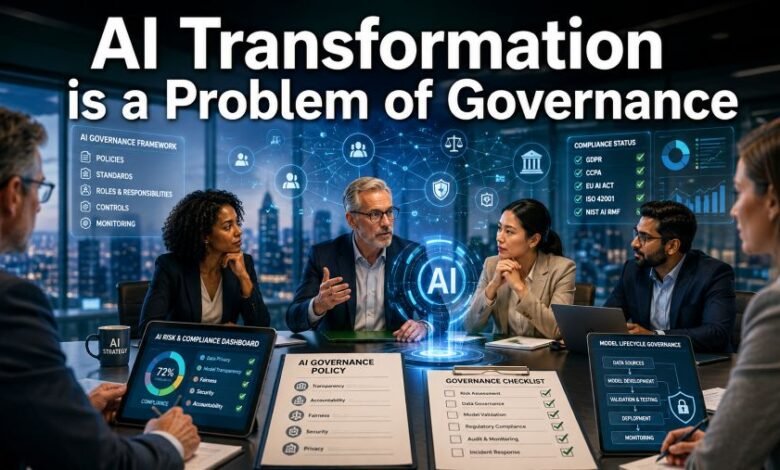
Introduction
Artificial intelligence is changing how businesses work. Companies are using AI to write content, analyse information, answer customers, automate tasks, support employees, and make faster decisions.
But buying an AI tool is easy. Changing an entire organisation with AI is much harder.
That is why the statement “AI transformation is a problem of governance” has become increasingly important.
The biggest question is often not:
Which AI model should we use?
The bigger questions are:
- Who is allowed to use AI?
- What information can AI access?
- Who is responsible when it makes a mistake?
- Which decisions can AI make automatically?
- When must a human check the answer?
- How is sensitive data protected?
- How are risks discovered and reported?
- Who can stop an AI system if something goes wrong?
These are governance questions.
NIST’s AI Risk Management Framework places governance at the centre of AI risk management and organises responsible AI work around four major functions: Govern, Map, Measure, and Manage.
What Does “AI Transformation Is a Problem of Governance” Mean?
The phrase means that successful AI transformation depends on much more than technology.
A company may have powerful models, skilled developers, large amounts of data, and expensive software. However, those resources cannot guarantee successful AI adoption.
The organisation still needs clear rules about ownership, responsibility, risk, access, human oversight, security, and acceptable use.
AI governance creates those rules.
ISO/IEC 42001 describes an AI management system as an organisation-wide structure for establishing AI policies, objectives, processes, and continual improvement. This shows why AI management is becoming an organisational issue rather than a task for the IT department alone.
AI Transformation: Technology Problem vs Governance Problem
| Technology Question | Governance Question |
|---|---|
| Which AI model should we use? | Who approves its use? |
| How accurate is the model? | What level of error is acceptable? |
| What data can it process? | Who owns and controls that data? |
| Can the task be automated? | Should the task be automated? |
| Can an AI agent take action? | What actions is it allowed to take? |
| Can we connect another system? | What permissions should it receive? |
| Can AI make decisions faster? | Who remains accountable for those decisions? |
| Can the system scale? | Can it scale safely and responsibly? |
Technology tells an organisation what is possible.
Governance helps decide what is appropriate, safe, accountable, and useful.
Why AI Pilots Often Do Not Become Real Transformation
A small AI experiment can look successful because it operates in a controlled environment.
A company might create an AI assistant for one department and quickly see useful results.
Scaling that system across an organisation creates new questions.
Should employees in every department have the same access? Can AI read confidential documents? Can it contact customers? Can it update financial records? Can it make recommendations affecting employees? What happens if it produces incorrect information?
This is where governance becomes essential.
A 2026 Zapier analysis describes a similar challenge as “AI pilot purgatory”: individual experiments may work, but connecting them to existing systems, workflows, data sources, approvals, and enterprise processes is much more difficult.
Governance Creates Clear Ownership
One of the biggest AI problems inside a business is unclear responsibility.
Imagine that an AI system gives a customer incorrect financial information.
Who owns the problem?
The developer?
The employee using the tool?
The technology department?
The vendor?
The department manager?
Senior leadership?
Without governance, responsibility can become unclear.
A useful AI governance structure defines who owns each system, who approves it, who reviews risks, who monitors performance, and who can suspend it.
Accountability is also one of the major principles promoted by the OECD for trustworthy AI, alongside transparency, human-centred values, safety, security, and robustness.
Data Governance and AI Governance Must Work Together
AI systems depend heavily on data.
If an organisation does not understand where its data comes from, who owns it, whether it is accurate, or whether AI is allowed to use it, introducing AI can make existing problems larger.
IBM argues that data governance and AI governance should be treated as complementary parts of enterprise governance. Data lineage, for example, can help organisations understand where information originated and how it was transformed before being used by an AI system.
Before allowing AI access to company information, organisations should understand:
- What data exists
- Where it is stored
- Who owns it
- Who can access it
- Whether it contains private information
- Whether it is reliable
- Whether AI is permitted to process it
- How long information should be retained
Good AI cannot automatically repair poor organisational control.
Agentic AI Makes Governance Even More Important
Traditional AI often gives an answer and waits for a person to decide what happens next.
AI agents can potentially go further.
Depending on how they are designed and connected, agents can carry out multi-step tasks, use tools, interact with software, retrieve information, and perform actions.
That changes the risk.
A chatbot that gives a bad suggestion creates one type of problem.
An autonomous system with permission to modify records, send communications, execute workflows, or access important business systems creates a much larger governance challenge.
The organisation therefore needs to define boundaries before giving AI greater autonomy.
Important questions include:
What can the agent access?
What can it change?
Which actions require human approval?
How can its activity be audited?
How can its access be removed quickly?
This is why modern AI governance increasingly needs operational controls rather than a simple written policy.
Human Oversight Still Matters
AI transformation does not mean removing humans from every decision.
Different AI applications carry different levels of risk.
Using AI to summarise an internal meeting is very different from using AI to influence employment, healthcare, credit, education, security, or other high-impact decisions.
The OECD states that trustworthy AI should respect human-centred values and fairness while remaining transparent, robust, secure, and accountable.
Organisations should therefore decide where humans must review, approve, correct, or override an AI system.
Human oversight is especially important when mistakes could significantly affect people.
Governance Is Becoming a Legal Issue Too
AI governance is no longer only an internal business choice.
Regulation is developing around the world.
A major example is the European Union’s AI Act, which uses a risk-based regulatory approach. As of 2 August 2026, the European AI Office and authorities in EU Member States have responsibilities for implementing, supervising, and enforcing major parts of the AI Act.
The EU has also introduced transparency requirements covering certain AI systems and AI-generated or manipulated material.
This means organisations cannot treat AI governance simply as optional paperwork.
Depending on the organisation, location, system, and use case, governance may also be closely connected with legal and regulatory obligations.
AI Literacy Is Part of Governance
A company cannot govern AI effectively if employees do not understand what they are using.
Workers should know both the benefits and limitations of AI.
They should understand issues such as:
- Hallucinated or incorrect information
- Confidential data
- Security
- Bias
- Human review
- Acceptable AI use
- Restricted information
- Reporting problems
- Responsible prompting
The European Commission’s guidance on AI literacy specifically encourages organisations to consider what AI systems they use, the risks involved, the knowledge of staff, and the context in which AI is deployed.
Training therefore becomes part of transformation.
Installing AI software without preparing employees is not a complete AI strategy.
What Good AI Governance Looks Like
Good governance does not mean creating hundreds of rules that prevent employees from using AI.
The goal should be to make responsible AI easier.
A practical structure can include:
1. Create an AI Inventory
Know which AI tools and systems the organisation is using.
Include official tools, internal systems, third-party applications, and important automated workflows.
2. Give Every Important AI System an Owner
Someone should be accountable for its purpose, performance, risks, and continued use.
3. Classify AI by Risk
A tool used to brainstorm marketing slogans should not need the same controls as a system influencing major decisions about people.
Higher risk should usually mean stronger review.
4. Set Clear Data Rules
Define which information employees and AI systems can access.
Pay particular attention to confidential, personal, financial, proprietary, or security-sensitive information.
5. Define Human Approval Points
Specify which actions AI can perform independently and which require a person.
6. Test Before Deployment
Evaluate accuracy, reliability, security, potential bias, failure cases, and other relevant risks.
NIST’s AI RMF encourages organisations to continuously map, measure, and manage AI risks rather than treating risk assessment as a one-time task.
7. Monitor AI After Launch
AI governance should continue after deployment.
Performance can change. Data can change. Business processes can change. New threats can appear.
Monitoring allows organisations to identify problems earlier.
8. Keep Records
Document important decisions, approvals, system versions, tests, incidents, and changes.
Good records make accountability and investigation much easier.
9. Prepare an Incident Process
Employees should know what to do when an AI system behaves unexpectedly.
The organisation should be able to investigate the incident, restrict access, correct the problem, and prevent repetition.
10. Review Governance Regularly
AI technology changes quickly.
Policies created for simple chatbots may not be enough for more autonomous AI systems.
Governance must evolve with capability.
Does Governance Slow AI Innovation?
Poor governance can slow innovation.
Good governance can do the opposite.
When nobody knows the rules, every AI project can create lengthy discussions about security, permissions, responsibility, privacy, or approval.
Clear governance answers many of those questions before the project begins.
Teams know what they are allowed to build.
Managers know who approves it.
Employees know how to use it.
Security teams know what controls are required.
Leadership knows who is accountable.
ISO/IEC 42001 reflects this management-system approach by connecting AI governance with policies, processes, risk management, accountability, and continual improvement.
Governance should therefore be viewed as an infrastructure for responsible innovation, not simply as a barrier.
Why Leadership Must Own AI Transformation
AI transformation cannot remain only inside the technology department.
AI can affect operations, employees, customers, risk, finance, security, compliance, products, strategy, and reputation.
Senior leaders therefore need to decide:
- Why the organisation is using AI
- Which outcomes matter
- Which risks are acceptable
- Which decisions remain human
- Who owns individual systems
- How success will be measured
- When an AI system should be stopped
Technology teams can build systems.
Leadership must define the boundaries within which those systems operate.
The Future of AI Transformation
The organisations that benefit most from AI may not simply be the organisations with access to the most powerful models.
AI models are becoming widely available.
The larger competitive difference may increasingly come from how organisations integrate AI into real work.
That requires strong data, good processes, trained employees, clear ownership, sensible controls, continuous measurement, security, and leadership.
In other words, AI transformation is organisational transformation.
And organisational transformation requires governance.
Final Thoughts
AI transformation is a problem of governance because AI changes who—or what—can make decisions and take actions inside an organisation.
Technology provides capability.
Governance provides direction.
A company needs both.
Without governance, AI can become a collection of disconnected experiments, unclear responsibilities, uncontrolled access, and hidden risks.
With effective governance, organisations can define ownership, protect important information, monitor systems, train people, manage risk, and give AI enough freedom to create value without giving it unlimited authority.
The real challenge of AI transformation is therefore not simply building smarter machines.
It is building organisations capable of using those machines responsibly.
Frequently Asked Questions
Is AI transformation really a governance problem?
Yes, governance is a major part of AI transformation because organisations must decide who owns AI systems, what they can do, what data they can access, how risks are managed, and who remains accountable.
What is AI governance?
AI governance is the collection of policies, responsibilities, processes, controls, and oversight mechanisms used to guide the development and use of AI.
Why is governance important for generative AI?
Generative AI can produce inaccurate material, process sensitive data, or be used in inappropriate ways. Governance establishes boundaries and responsibilities for its safe use.
What is the difference between AI governance and AI management?
Governance usually defines authority, accountability, policies, and oversight. Management turns those expectations into everyday processes, controls, testing, monitoring, and improvement.
Who should be responsible for AI governance?
Responsibility should normally be shared across leadership and relevant functions such as technology, security, legal, compliance, risk, data, HR, and business teams. Individual AI systems should also have clearly identified owners.
Does every AI system need the same governance?
No. A risk-based approach is more practical. Low-impact applications can use lighter controls, while high-impact applications may require stronger testing, documentation, oversight, and monitoring.
Can AI governance help businesses innovate faster?
It can. Clear rules reduce uncertainty about permissions, ownership, security, data use, and approvals, helping teams understand how they can develop and deploy AI responsibly.
What standards can organisations use for AI governance?
Common reference frameworks include the NIST AI Risk Management Framework, ISO/IEC 42001, and the OECD AI Principles. Organisations operating in regulated markets should also understand the laws that apply to their specific use of AI.