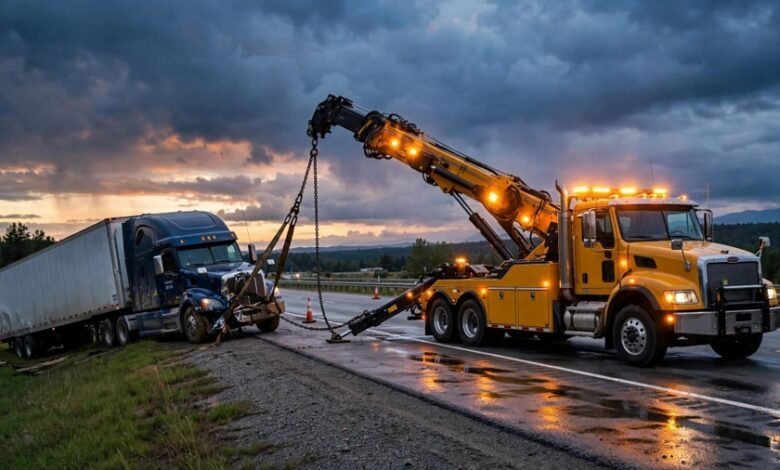
The Moment Your Rig Quits on You
Every veteran driver remembers a night like this: 3 a.m., somewhere on I-81 in Virginia, reefer humming behind the trailer, and then… nothing. Just wind noise and a pounding heartbeat. You know that feeling? One minute the cruise is set and you’re thinking about breakfast, the next the dash is lit up like a slot machine and the steering’s gone heavy in your hands. Okay, breathe. Seriously, don’t stomp the brakes. Ease off, hazards on, and nurse that rig onto the shoulder, as far from the white line as the gravel lets you. Parking brake set, triangles out: first one maybe ten feet behind the trailer, the others walking back down the shoulder. Then get back in the cab, belt on, especially if traffic’s still blowing past at seventy. Look, plenty of drivers have watched guys climb out and lean against their trailer on a live interstate like they’re waiting for a bus. Terrifying to watch, every time. Standing out there like that is genuinely the most dangerous part of your whole breakdown. Meanwhile, your load’s not going anywhere, and neither are you. So here’s the truth nobody likes hearing at 3 a.m.: you can’t buddy-tow a semi. Your buddy’s pickup isn’t doing anything for forty tons of dead steel. Searching for heavy duty towing near me isn’t waving a white flag. It’s the only grown-up move on the board. The outfits that do this run wreckers built for exactly this nightmare, and every minute you wait to call is a minute the clock runs against you, not for you. Oh, and stop cranking that dead engine. Seriously. Each crank cooks the starter a little more, and there’s no prize for turning a tow bill into a tow bill plus a starter replacement.
Why a Regular Tow Truck Can’t Touch Your Semi
Quick math, because the numbers settle every argument. Your loaded rig: up to 80,000 pounds. The rollback that just hauled your neighbor’s Camry: rated around 10,000. Your tractor alone (just the tractor, no trailer) outweighs that little truck’s entire capacity, nearly twice over. So yeah, when folks choke on heavy-duty recovery prices, that’s understandable. Most drivers only go searching for semi towing near me once they’re already in trouble, which is exactly why the price lands like a punch. But the price starts with the iron. A real heavy wrecker? We’re talking 25 to 75 tons of lift. A boom that spins a full 360. Outriggers that plant it like a crane. An underlift that can cradle a drive axle without folding it like a taco. A different animal entirely. Then there’s the part that blindsides newer drivers: air brakes. No engine, no air. No air, no release. Your brakes are locked, hard, and that’s by design. A heavy-duty operator shows up with a way to feed air into your system, or he’ll cage the chambers by hand. Takes ten minutes if you know how. A regular tow guy? He’ll stare at it like it’s written in another language. And the fifth wheel deserves its own warning. Securing or splitting a loaded trailer is rigging work. Knowledge work. Not “chain it and pray” work. The aftermath is always the same when somebody hires the wrong truck to save a buck: torn air lines, a bent bumper, and a repair bill that ate the “savings” for breakfast, plus a truck sitting in the shop for a week.
What the Dispatcher Actually Needs to Hear
Here’s what most drivers get wrong about the phone call: the dispatcher isn’t a receptionist. She’s the person deciding which quarter-million-dollar truck rolls out of the yard, and your details make that call. Vague in, vague out. So do yourself a favor. Before you dial, get these five things straight:
- Where exactly you are. Mile marker. Direction. Nearest exit or anything with a name on it. “Somewhere near Richmond” is a hundred miles of interstate, friend. “Mile 78 northbound” is a truck rolling your way.
- What you’re driving. Year, make, model of the tractor, plus trailer type and length. Because “a semi” tells her almost nothing. Day-cab? Sleeper? 53-foot dry van? Reefer? It matters.
- Loaded or empty, and how heavy. Ballpark it. 45,000 pounds of freight means a different truck than an empty trailer, full stop.
- What broke. Died running? Won’t crank? Steer tire let go? Buried to the axles in mud? Every answer points at different gear in the yard.
- Where it’s going. Shop name, town. “Somewhere close” doesn’t help her help you.
Guys who rattle off all five? They get the right truck first try. That alone can cut an hour off your day. And she’s not grilling you for fun; each question is her mentally walking the yard, matching your mess to a specific rig. One last thing: guess beats silence. “I don’t know” gives her nothing. “Probably around 70,000” gives her a weight class, and that decides which truck leaves the yard.
How Long You’ll Really Be Waiting
Alright, the question everybody asks, answered straight: figure 45 minutes to two hours, most of the time. Sometimes you’ll get lucky: yard ten minutes out, truck sitting ready, quiet Tuesday afternoon, and you’re moving in half an hour. Other times? It’s 2 a.m., raining sideways, their rotator’s already forty miles out on somebody else’s disaster. Then you wait. Any dispatcher who promises you twenty minutes in that situation is selling you something. Here’s what actually sets the clock: how far the yard is (biggest factor, not even close), then traffic, then time of day, then weather. In that order, near enough. But you want to know the real delay-king? Wrong truck dispatched first. Which, surprise, comes back to how good your details were on the call. When you’re typing heavy duty towing near me into your phone at midnight, here’s the filter: call the outfit that answers live. Second ring, a human voice, a dispatcher. Not voicemail, not a call center three states away. Live voice means iron is actually rolling. A generic tow truck near me search buries you under car-tow companies, so put “heavy” or “semi” in front before you dial. Then ask for a straight ETA. And ask them to ring you back if it slips; the good ones offer before you ask. If they quote twenty minutes? Smile, say thanks, and mentally add thirty. Any driver would take an honest “about an hour” and headlights at fifty minutes over three rounds of “twenty more minutes” any day of the week.
What the Wrecker Does When It Arrives
Want to know how to spot a pro? Watch the first five minutes, because the good ones don’t touch your truck right away. They walk it first. Whole rig, slow lap, eyes on the air lines, the way the load’s sitting, the ground under your drives. A soft shoulder shows up in that walk long before the outriggers find it, and honestly that two-minute look is what separates a clean job from an expensive one. After the walk comes the sequence, though no two recoveries run it exactly the same:
- First they deal with your brakes, feeding air into the system or caging the chambers by hand. Either way the point is simple: wheels that roll instead of tires getting chewed flat down the interstate.
- The hookup comes next, and this is where you see the difference between a pro and a cowboy. Underlift cradling the axle, or the boom on a rated tow point. Rated being the key word. Not the bumper, not the fuel tank, not whatever looks sturdy. The points the manufacturer actually built for the job.
- If the situation needs muscle, out comes the winch or the rotator. That boom swings a full circle, which means they can upright you or swing the whole combination around without dragging forty tons sideways across the asphalt. When it’s done right it’s genuinely something to watch.
- Last comes the road-ready check. Safety chains on, lights plugged in, brakes tested, and then (the good ones never skip this) one more slow walk around the whole thing before anybody climbs into a cab.
While all that’s happening, your job is easy: stay where the operator can see you, keep the phone in your pocket, answer when asked. Every instinct says hover over your own truck. Fight it. The crew will wave you over the moment they need you.
What It Costs and Why the Price Stings
Deep breath. Let’s talk money, because dancing around it helps no one. Simple job, hook up and short hop to a nearby shop, and you’re generally looking at $400 to $1,200. Full recovery? Winching, an upright, a rotator sitting on scene for two hours? That can sail past $2,000 like it’s nothing. Here’s where the money goes: a hookup or show-up fee just for rolling the truck, hourly labor once the actual work starts, mileage on the tow, and surcharges for the spicy stuff: off-road, after-hours, holiday, that kind of thing. Now the honest limitation, no sugar on it: nobody, NOBODY, can price a heavy tow blind. No writer, no dispatcher, and definitely not the guy with the cheapest ad can do it without those three. Weight, distance, situation. Without those three, any number is just a guess. And here’s a rule worth defending at any truck stop in America: the cheapest quote on the phone almost always becomes the most expensive tow of your life. Either it balloons on scene (“oh, we didn’t know it was LOADED”) or it’s the wrong truck and you’re paying twice. So get the breakdown before they roll. Ask what the hookup costs, what the hourly rate is, and what they charge per mile, then get the whole thing in a text. Takes ten seconds, and that ten-second text has saved plenty of drivers from ugly surprises more than once.
The One Mistake That Turns a Bad Day Worse
Bluntly put, the mistake that comes up over and over, the one that turns a bad day into a legendary one, is hiring the wrong truck because the number sounded sweet. True story out of a shipper outside Greensboro: a light-duty wrecker shows up for a loaded day-cab sunk to the frame in soft ground. The operator hooks up, takes strain, and… the tow truck starts sliding. Sideways. Rear end walking across the lot while the boom makes this awful groaning noise like metal filing a formal complaint. Twenty minutes of that and the semi hasn’t moved an inch. The fleet manager paid for two trucks that day, and the second one was the heavy wrecker he should’ve called first. Same energy as “limping it in.” Oh, she’ll make it ten more miles, you tell yourself. Famous last words. That’s how a $600 tow becomes a $6,000 engine. When something big lets go, it let go for a reason, and every mile you bully it multiplies the damage. So here’s the rule worth tattooing wherever drivers keep their good judgment: match the truck to the weight, not to the wallet. A proper heavy wrecker bills more per hour because it finishes in thirty minutes what the wrong truck can’t do at all, and the invoice carries one line instead of two.
Finding Heavy Duty Towing Near Me Before You’re Desperate
Here’s the thing nobody does, and everybody should: line up your heavy-duty towing company NOW. Tonight. While your rig’s purring in a parking lot and not dying on a shoulder. Save ONE number in your phone. Not three. One, that you’ve actually vetted. How? Look at their fleet photos. Real wreckers in the pictures, or stock photos of trucks they wish they owned? Big tell. Read reviews, but read them right: you’re looking for the words “semi” or “tractor-trailer” from actual drivers. A hundred five-star reviews from Honda owners tells you exactly nothing about heavy recovery. Then make one call and ask one question: “Do you run a rotator?” Just that. The answer tells you the size of the whole operation in about four seconds. If you run the Mid-Atlantic, All Out Fleet Service serves Northern Virginia, which is exactly the kind of local footprint that keeps wait times down. It pays to know what heavy towing near me should include before you need it, so when the bad night comes you’re asking sharp questions instead of panicking. When you’re comparing, search heavy wrecker near me and check the photos for rotators, not just plain wreckers. And if you run a fleet? Put the number on a laminated card in every cab. A driver white-knuckling it on the shoulder should not be Googling anything. Do this once, one evening, ten minutes, and the worst day of your driving year gets shorter by hours. Breakdowns don’t check your schedule, and they don’t care about the load or how close to home you were. But they get a whole lot shorter when you know the drill: what to do, what to say, who to call. Save the number tonight.
Frequently Asked Questions
Q: How much does heavy-duty towing cost?
A: Simple local tow: usually $400–$1,200. Full recovery with winching or a rotator: $2,000 and up, easy. Get the hookup fee, hourly rate, and per-mile charge spelled out before the truck rolls, in a text if you can.
Q: How long will I wait for a heavy wrecker?
A: Most of the time, 45 minutes to two hours. Yard distance matters most, then traffic, time of day, and weather. Ask for a straight ETA and a callback if it slips.
Q: Can a heavy wrecker tow my loaded trailer too?
A: That’s literally what they’re built for. Just give the dispatcher your approximate total weight so the right class of truck shows up, not one rated for the tractor alone.
Q: What’s the difference between a tow truck and a heavy wrecker?
A: Weight class and equipment. Heavy wreckers lift 25–75 tons, run rotating booms on outriggers, and carry recovery rigging a standard tow truck doesn’t have. Different tools, different jobs.
Q: Should I stay with my truck while waiting?
A: If traffic’s moving, stay in the cab, belt on, hazards flashing. If you have to get out, get behind the guardrail and well clear of the travel lanes. Your truck can be replaced. You can’t.